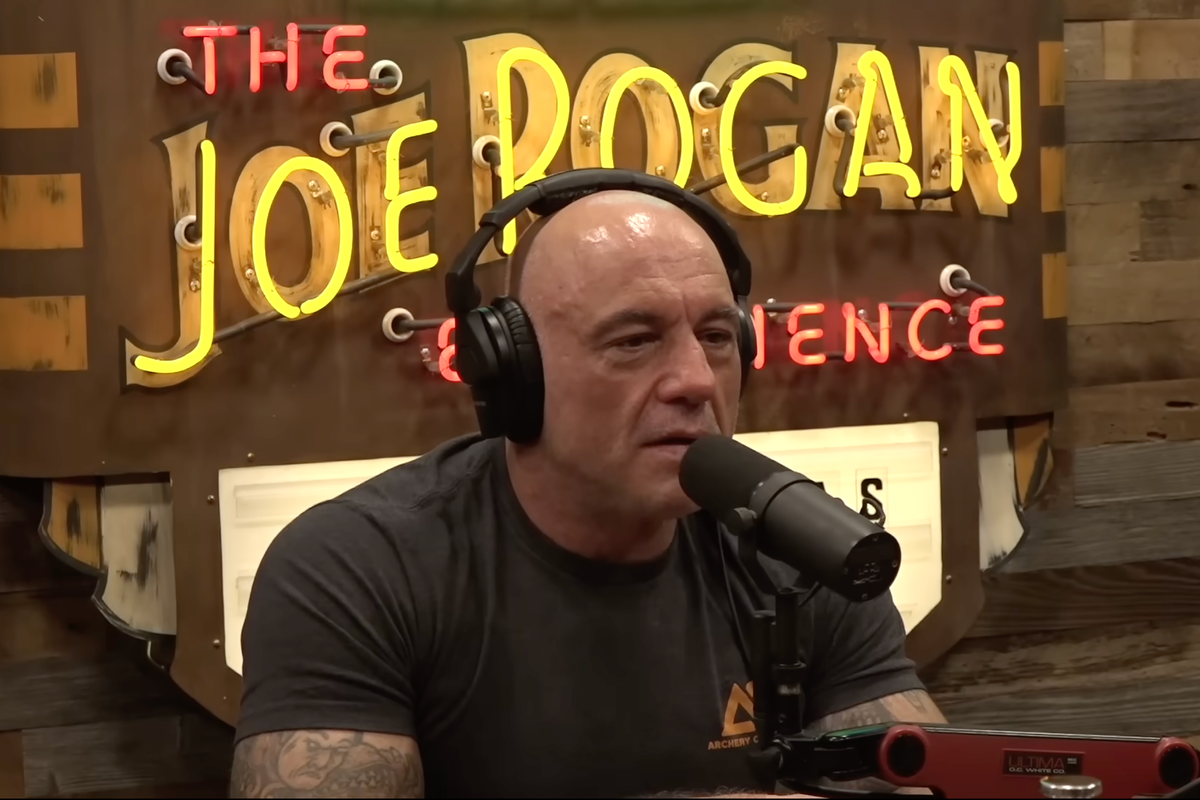
The microphone in the studio is always cold before it gets hot. That is the first thing you notice when you sit down in a room built for talking to millions. The steel boom arm, the heavy foam padding on the walls designed to swallow stray echoes, the small red glow of a recording light that feels less like a warning and more like a heartbeat.
On a Tuesday afternoon that felt like any other, the conversation drifted into territories most people prefer to leave mapped out by distant generals and cable news anchors. Donald Trump. Iran. The geometry of a modern war that has no clean edges.
Joe Rogan leaned back, adjusting the headset, and uttered a sentence that cut straight through the rhetorical fog of a thousand campaign speeches. There is no clear way out.
It was not a partisan declaration. It was an admission of gravity.
To understand why that moment matters, you have to step away from the polished walnut desks of Washington and walk through the dusty, olive-green corridors of memory where foreign policy is actually paid for. I remember sitting in a room years ago with a man who had spent three decades drawing lines on maps in the Middle East. He had retired with stars on his shoulders and a deep, restless exhaustion in his eyes. He pointed a scarred finger at a jagged border on a worn topographic sheet and said something simple. Anyone can start a fire with a match. No one ever asks which way the wind is blowing when the dry brush catches.
That is the exact trap waiting at the intersection of modern political bravado and ancient geopolitical friction.
Trump has always sold a very specific kind of narrative. It is the narrative of the master dealmaker. The central premise of his foreign policy brand is that conflicts persist simply because weak people are running them. The logic goes like this: walk into the room, project absolute strength, threaten economic ruin or military annihilation, and the other side blinks. It worked, his supporters argue, with trade deals and regional accords.
But a nation-state like Iran is not a recalcitrant real estate developer or a stubborn corporate board. It is a multi-layered civilization-state with a deeply entrenched ideological core, a complex proxy network spanning from Lebanon to the Persian Gulf, and a generational grievance ledger that goes back decades.
When you tell an audience that you can fix a centuries-old regional powder keg with a single phone call or a decisive stroke of a pen, you are selling an emotional sanctuary. You are offering safety in a complicated world.
And that is precisely where the illusion shatters.
Consider the mechanics of escalation. Suppose a commander-in-chief decides to squeeze the Iranian economy until the regime gasps for air. That is not a passive action; it triggers a reaction. Suppose that reaction involves asymmetric warfare, cyber attacks on critical infrastructure, or the closing of the Strait of Hormuz, a narrow bottleneck through which a massive percentage of the world's daily petroleum supply flows.
Suddenly, the price of gasoline spikes in Ohio. Supply chains fracture in Poughkeepsie. Inflation ticks upward, and the average voter, who was promised strength and stability, finds themselves paying an invisible tax for a distant confrontation they never voted for.
That is the part left out of the highlight reels.
Rogan’s observation struck a nerve because it exposed the fundamental tension between political performance and physical reality. On a podcast heard by tens of millions of people—an audience that spans disenchanted veterans, exhausted gig workers, and young voters who view traditional media with profound suspicion—people are hungry for unvarnished admissions of complexity. They are tired of being told that everything is either a total triumph or an unmitigated disaster.
They want to know what happens on the Tuesday after the bomb drops.
History is littered with leaders who thought they could manage a limited conflict the way an engineer manages a valve. They turn it half-open. They watch the pressure gauge. They assume they can turn it back whenever they get tired of the heat.
They are almost always wrong.
Think about the architecture of escalation. It moves like an avalanche down a steep mountain face. Once the first heavy stone breaks loose from the ridge, shouting instructions at it is completely useless. You cannot negotiate with gravity. Every retaliatory strike demands a counter-strike. Every intelligence report of a hidden centrifuge or a proxy militia movement requires a preemptive posture. Before long, the original objective—whatever it was supposed to be—disappears entirely beneath a mountain of operational necessity.
Trump’s political survival has always depended on projecting total agency. To admit that a situation might be genuinely intractable, or that every available option carries a catastrophic downside, goes against every instinct of modern populist theater. You must always have an enemy, and you must always have a winning hand.
Yet, beneath the posturing, the reality remains stubbornly intact.
The geography of Iran is not forgiving. It is a vast theater of rugged mountains, underground enrichment facilities, and deeply loyal security apparatuses that cannot be dismantled by airstrikes alone. To truly neutralize the threat through military force would require a ground invasion and an occupation that would make Iraq and Afghanistan look like minor skirmishes.
No one with a functioning map and a memory of the last thirty years wants that. Not the Pentagon. Not the allies in the region. And certainly not an American public that has grown profoundly weary of endless engagements in the sand.
Conversely, doing nothing while a hostile regional power inches closer to nuclear capability is its own kind of gamble. It invites a different kind of disaster, one where deterrence fails slowly until it fails all at once.
This is the agonizing dilemma that Rogan dragged into the light. There is no clean exit ramp. There is no clever rhetorical pivot that erases the structural dangers. Every choice is a bad one, weighed against a worse one.
We live in an era that despises nuance. We demand heroes and villains, clean victories and unambiguous defeats. We want our politics to function like a streaming service where we can skip past the boring, painful middle episodes and jump straight to the satisfying finale.
But international relations is not a fictional script. It is an ongoing, grinding negotiation with the dark side of human nature.
When a prominent voice tells millions of people that the emperor has no clear exit plan, it pierces the armor of certainty. It forces a pause. It reminds us that behind the bluster of campaign rallies and late-night social media posts, the machinery of state is steering blind through a very dark night.
The studio lights stay on long after the recording stops. The digital audio files are compressed, uploaded, and beamed out across the fiber-optic veins of the modern world, landing in cars, kitchens, and gym headphones across the globe. People listen, nod, and go about their days. But something subtle shifts in the room.
The map is still on the table. The lines are still drawn in blood and ink. And the wind outside is picking up speed, carrying the faint, unmistakable scent of smoke from a fire no one knows how to put out.