The border is not a line on a map. Not really.
If you stand in the dense, emerald canopy where northeast India blurs into western Myanmar, the border is a humidity that clings to your skin. It is the sound of the Chindwin River churning after a heavy rain. It is a shifting, living thing woven out of bamboo thickets, ancient migratory tracks, and the shared language of families who have lived here since long before empires drew grids across the hills.
For generations, this frontier was defined by a quiet rhythm of crossing. A farmer would walk a mile east to harvest a crop; a cousin would walk a mile west to attend a wedding.
But lately, the rhythm has broken. The silence of the forest is routinely shattered by the dry, metallic crack of automatic gunfire.
When Indian Prime Minister Narendra Modi sat down across from Myanmar’s leadership to address the growing instability along this 1,024-mile shared perimeter, the official press releases from New Delhi used the sterilized vocabulary of modern statecraft. They spoke of "security challenges," "armed group activities," and "managed repatriation."
Those words are masks. They hide a deeply human crisis, a geopolitical knot where national sovereignty, insurgent warfare, and thousands of displaced lives are colliding in the dark. To understand what is actually happening here, you have to look past the diplomatic communiqués and look at the dirt.
The Echo in the Valleys
Imagine a tea stall in a small border town in Mizoram or Manipur. Let’s call the man sitting there Lal. He is a hypothetical composite, but his anxieties are entirely real, shared by hundreds of thousands of residents along the frontier.
Lal remembers when the hills were safe. Today, he looks toward the ridgeline with a hard, calculated wariness. For months, the remote jungles just across the border have become a staging ground. Insurgent factions—some remnants of old Indian separatist groups hiding in the ungoverned spaces of Myanmar, others newer ethnic armed organizations fighting Myanmar's military junta—have turned the border into a sanctuary.
They move through the thick brush like ghosts. They smuggle weapons. They traffic narcotics. Sometimes, when pressure grows on one side, they simply slip to the other, exploiting the rugged terrain that no army on earth can perfectly police.
For Lal and his neighbors, this is not an abstract policy debate. It means their hunting tracks are suddenly laced with landmines. It means extortion demands delivered to village elders by men speaking unfamiliar dialects. It means the terrifying realization that the geopolitical tremor shaking Myanmar since the 2021 military coup has arrived on their doorsteps.
When Prime Minister Modi flagged these activities to the Myanmar President, it wasn't an act of standard diplomatic posture. It was an expression of deep, systemic alarm. India’s Northeast has spent decades painstakingly climbing out of the shadow of insurgency. The region was finally building roads, connecting markets, and dreaming of a prosperous future linked to Southeast Asia.
Now, the instability next door threatens to pull the entire region backward. The fear is contagious, and it spreads faster than the violence itself.
The Human Tide
But the armed groups are only one side of the coin. The other side is far more fragile.
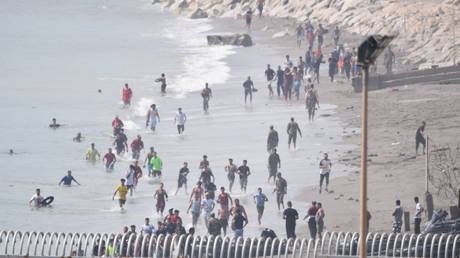
When the bombs fall on villages in Myanmar’s Sagaing region or Chin State, the people living there do what any of us would do. They run. They grab their children, pack what they can carry into faded plastic sacks, and head toward the only safety they know: the Indian border.
Consider the sheer exhaustion of that journey. Men, women, and the elderly scrambling up steep, muddy ravines under the cover of night, praying that the headlights of a military patrol don't catch them in the open.
Thousands have crossed into the Indian states of Mizoram and Manipur. They are not invaders; they are terrified refugees. Many share deep ethnic and cultural ties with the local Indian populations, who initially welcomed them with open arms, offering food, shelter, and church sanctuaries.
Yet, as the weeks have turned into months, and months into years, the strain has become unbearable.
Resources are drying up. Local economies are buckling. In Manipur, the influx has inadvertently tangled with pre-existing, highly sensitive ethnic balances, adding fuel to an already volatile internal situation. What started as a humanitarian impulse has transformed into a complex security nightmare.
This is the agonizing paradox that India faces. How does a nation maintain its humanity while protecting its sovereignty? How do you close a door to prevent insurgents from entering when doing so also shuts out a mother carrying a starving child?
India has historically chosen not to sign the 1951 UN Refugee Convention, preferring to handle displaced populations on a case-by-case, bilateral basis. But the sheer scale of the Myanmar crisis has broken the old template. The Indian government has moved to scrap the Free Movement Regime (FMR), a decades-old arrangement that allowed border residents to travel up to 16 kilometers into each other’s territory without a visa.
The construction of a massive border fence has begun. The line on the map is being turned into steel and concrete.
The Ghost of Geography
To look at this crisis and see only a contemporary political dispute is to misunderstand history entirely. This border was born out of colonial convenience, drawn by British cartographers who cared little for the communal realities of the tribes inhabiting these mountains. The Mizos, the Chins, the Nagas, the Kukis—their ancestral homelands were sliced in half by an invisible boundary.
Because of this, the border has always been porous. It was built to be porous.
The real problem lies elsewhere, buried deep within the internal dynamics of Myanmar itself. Since the military junta seized power, large swathes of the country have fallen out of central government control. Resistance forces and ethnic armies have pushed the military back, creating a fractured patchwork of fiefdoms.
When India raises these issues with the Myanmar leadership in Naypyidaw, they are speaking to a government that often cannot enforce its will on its own frontier. New Delhi is forced into a delicate diplomatic dance. It must maintain working relations with the junta to ensure cooperation on border security, yet it cannot ignore the fact that the junta’s actions are the primary driver of the refugee crisis in the first place.
It is an uncertain, frustrating game of chess played in a thick fog.
The Long Shadow
The sun sets early in the eastern hills. As the darkness swallows the ridges, the campfires in the refugee settlements begin to flicker, casting long, dancing shadows against the tarpaulin walls.
For the people living in these camps, the geopolitical discussions happening in air-conditioned rooms hundreds of miles away feel incredibly distant. They do not think in terms of bilateral trade or regional stability. They think about tomorrow's meal. They wonder if their homes across the river still exist, or if they have been reduced to ash.
Meanwhile, on the Indian side of the line, security forces double their night patrols, peer through thermal imaging scopes into the blackness of the jungle, waiting for a rustle in the leaves that could be a desperate family, or a column of heavily armed militants.
The border cannot be fixed by a single meeting or a sharply worded memorandum. Fences can be built and treaties can be signed, but the forest remembers a different history. Until stability returns to the valleys of Myanmar, the hills of Northeast India will remain on edge, caught in the painful, heavy friction of a neighbor’s house on fire.
A single, cold wind from the east is all it takes to carry the sparks across.