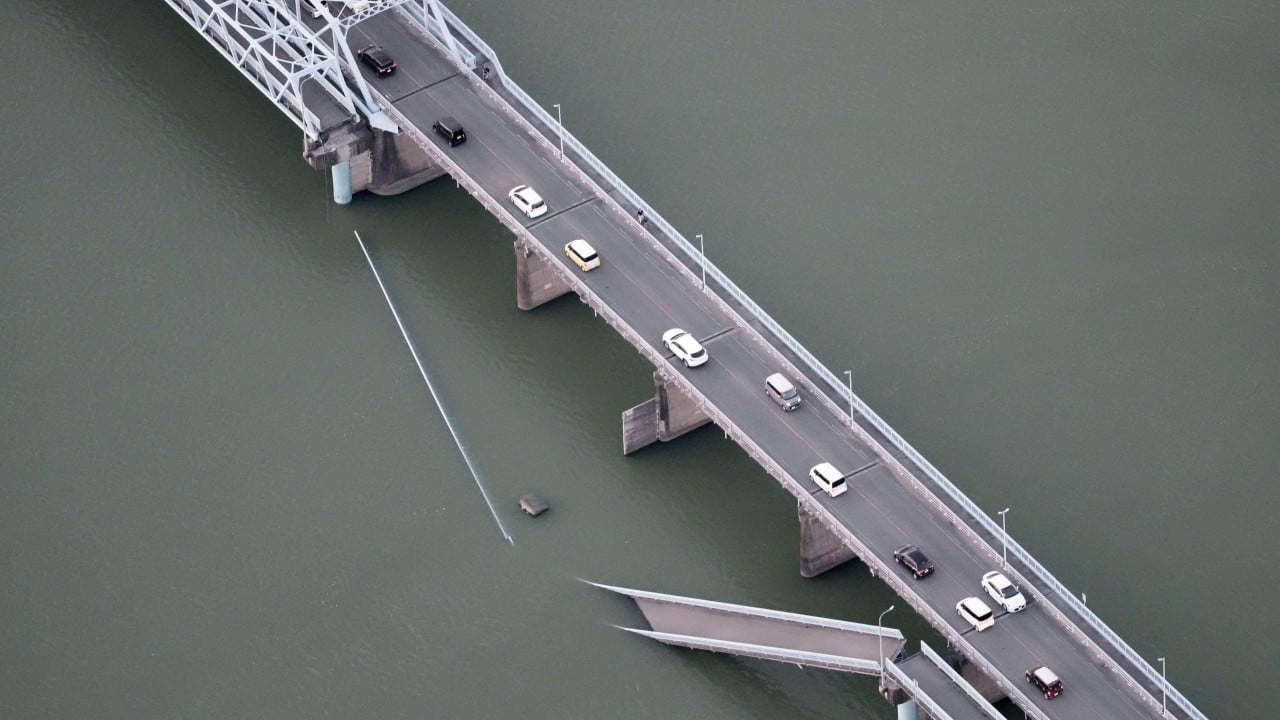
Navigational safety in coastal ports relies on a delicate equilibrium between vessel kinetic energy management and the physical constraints of harbor infrastructure. When a ferry impacts a concrete pier repeatedly during severe sea states, it exposes systemic vulnerabilities in docking protocols, local meteorological forecasting, and real-time harbor operational decision-making.
The Kinetic Energy Equation of Berth Collisions
To understand why a ferry sustains damage during high-energy wave events, one must evaluate the physics governing moving vessels in confined waters. The kinetic energy $E$ of a vessel approaching or being pushed against a fixed structure is proportional to its mass and the square of its velocity:
$$E = \frac{1}{2} m v^2$$
In open water, wave action induces six degrees of freedom: surge, sway, heave, roll, pitch, and yaw. When a vessel is moored or attempting to berth adjacent to a solid pier, lateral wave action translates into uncontrolled sway and roll. If the incoming wave frequency matches the natural roll period of the vessel, resonance occurs, amplifying the lateral velocity $v$. Even a marginal increase in velocity exponentially spikes the impact force transferred upon contact with the pier structure.
Operational Variables in Port Approach and Mooring
Port authorities and vessel captains operate under standardized protocols to mitigate environmental risks, yet catastrophic incidents occur when discrete operational variables fail to synchronize.
- Wave-Structure Interaction: Solid vertical piers reflect wave energy rather than absorbing it. This creates standing waves, or clapotis, which dramatically increase localized water particle velocity and exert compounding pressure on both the pier wall and the vessel hull.
- Fender System Limitations: Standard elastomeric or pneumatic fenders are engineered to absorb predictable kinetic loads within a specific deformation threshold. High-energy swells can bottom out these buffers instantly, resulting in metal-on-concrete contact.
- Tidal and Bathymetric Influences: Shallow water depths near piers alter wave shoaling profiles, steepening wave fronts and increasing particle velocity right at the surface where the hull makes contact.
The Mechanics of Environmental Miscalculation
Incidents where tourists observe vessels slamming into infrastructure usually stem from delayed operational cutoffs. The decision-making timeline of a harbor master or vessel captain depends on threshold metrics: significant wave height, wind shear, and current velocity.
When forecasting models underpredict local wave amplification caused by underwater topography or sudden wind shifts, vessels find themselves inside a restricted harbor basin without adequate maneuvering room. Tugboat assistance becomes ineffective if the sheer force of the incoming swell exceeds the bollard pull capacity of available tugs relative to the displacement tonnage of the ferry.
Strategic Recommendations for High-Energy Berth Management
Mitigating structural impact risks requires moving away from reactive seamanship toward predictive kinetic control.
- Dynamic Under-Keel Clearance and Wave Monitoring: Ports exposed to heavy swells must deploy real-time wave rider buoys outside the breakwater to feed live data into local hydrodynamic models, eliminating reliance on regional forecasts that miss micro-scale wave amplification.
- Adaptive Fender Implementation: Retrofitting critical berths with smart energy-absorption systems that adjust dampening resistance based on real-time impact velocity telemetry.
- Pre-Determined Evacuation Thresholds: Establishing automated operational triggers that mandate immediate departure to open deep water or relocation to lee anchorages before wave heights cross the structural threshold of local pier defenses.