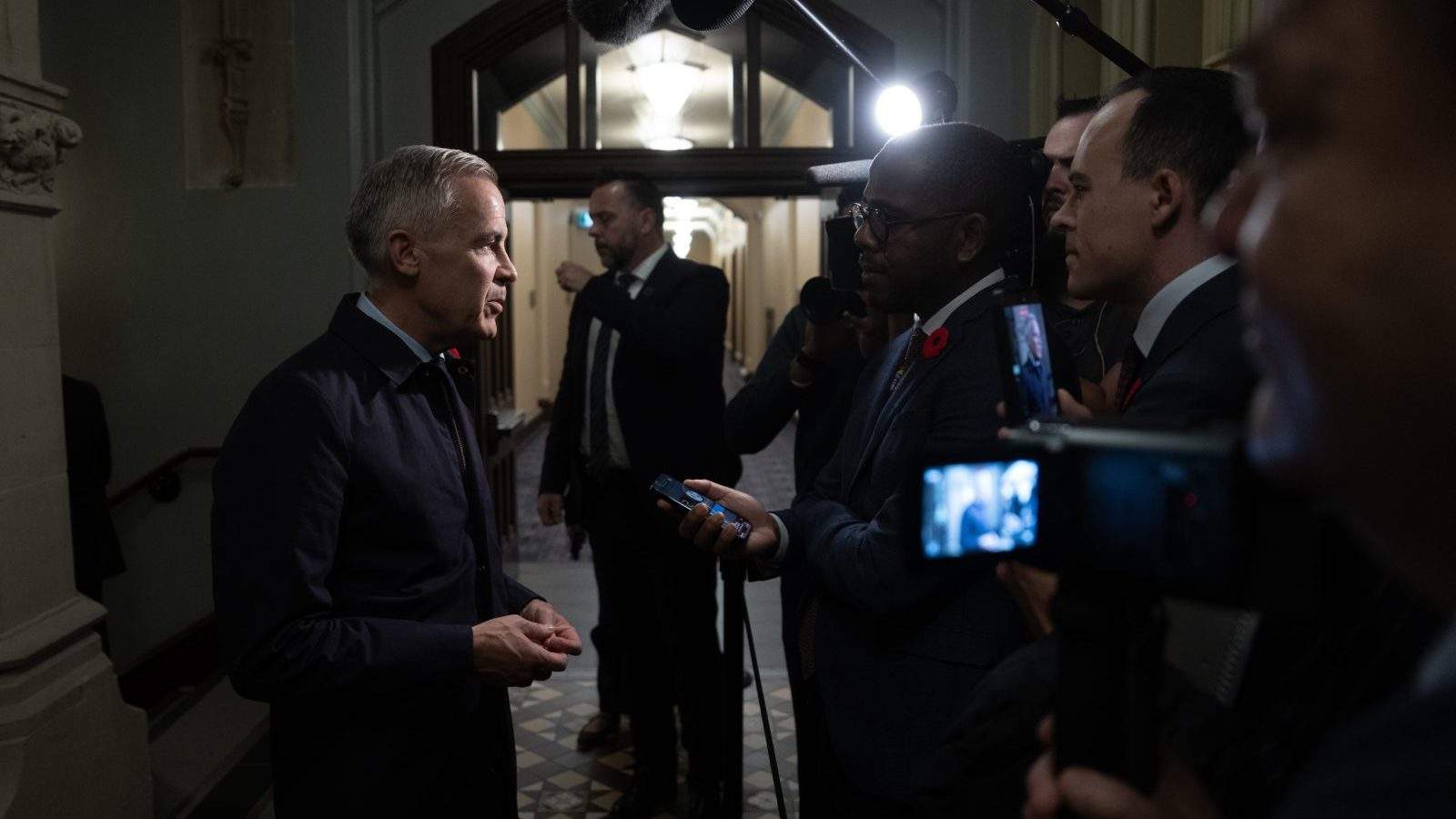
When Mark Carney declares that Canada remains confident and that Ottawa’s strategic focus will not budge in the wake of the U.S. midterm elections, he is not merely offering political reassurance. He is signaling a deliberate, high-stakes wager that structural economic fundamentals and institutional stability matter more than the shifting partisan winds in Washington. That confidence rests on a clear premise: Canada’s core trade relationships, energy integration, and domestic fiscal reforms are insulated enough to withstand legislative gridlock or renewed protectionist rhetoric south of the border. Yet beneath the calm exterior lies a far more complicated reality about just how exposed the Canadian economy remains to American political volatility.
Standard coverage of diplomatic statements after U.S. midterms tends to treat them as routine talking points. Politicians project strength, markets briefly nod, and the news cycle moves on. That superficial reading misses the mechanics of how bilateral pressure actually works between Ottawa and Washington. Midterm elections rarely rewrite trade treaties overnight, yet they routinely alter committee chairs, shift regulatory enforcement priorities, and reshape the domestic political incentives of the sitting White House. When a leader of Carney’s background—having steered both the Bank of Canada and the Bank of England through systemic shocks—insists that the strategy remains unchanged, he is speaking directly to institutional investors, bond markets, and corporate boards watching for signs of panic.
The Architecture of Projected Calm
Central bankers learn early that signaling is half the policy. If Ottawa were to pivot its economic agenda every two years to match the electoral pendulum in the United States, long-term capital allocation inside Canada would grind to a halt. Businesses do not build cross-border supply chains, refineries, or manufacturing plants based on the outcome of a single congressional cycle. They invest when they believe the host government possesses a predictable multi-year framework.
Carney’s refusal to alter course is rooted in this institutional logic. By framing Canada’s posture as steady and self-assured, the government aims to prevent a self-fulfilling prophecy of domestic hesitation. When political leaders openly fret about American protectionism, domestic firms delay capital expenditure, hoard cash, and wait for clarity that never fully arrives. Projecting unwavering focus is an attempt to anchor expectations in much the same way an inflation target anchors wage and price setting.
There is also a tactical diplomatic calculation at play. Entering any trade review or bilateral negotiation from a posture of visible anxiety invites concessions before talks even begin. Washington’s trade apparatus, regardless of which party controls the House or Senate, responds to economic strength and credible alternatives rather than public appeals to historical friendship. Demonstrating that Canada has its own domestic growth agenda—and is not waiting on Congress for permission to execute it—is basic negotiating discipline.
Where Structural Reality Meets Political Rhetoric
Confidence, however, is not a macroeconomic shield. The cold arithmetic of North American trade leaves Canada with narrow margins for error whenever Washington turns inward. Roughly three-quarters of Canadian merchandise exports still flow to the United States, a concentration that no amount of rhetorical poise can erase in the short term.
Consider what happens when a U.S. midterm produces a divided government or empowers populist wings within either major party. Major legislative breakthroughs often stall, pushing the executive branch toward unilateral tools. Tariffs imposed under national security or unfair trade statutes do not require congressional approval. Regulatory bottlenecks at the border, Buy American procurement rules, and targeted subsidies for domestic U.S. industries can quietly divert investment away from Ontario, Quebec, and Alberta without a single treaty formally breaking.
Critics of Ottawa’s steady-as-she-goes posture argue that pretending the external environment has not shifted risks leaving Canadian exporters unprepared for death by a thousand regulatory cuts. While the headlines focus on broad macro stability, individual sectors—from softwood lumber and steel to automotive parts and critical minerals—experience American political shifts as immediate margin compression. A strategy that refuses to adjust to new political realities in Washington can quickly look less like principled resolve and more like institutional inertia.
The Investment Gravity Problem
The deeper vulnerability is not just existing trade volume, but future capital flows. Over the past several years, massive American industrial subsidies and tax incentives have exerted an undeniable gravitational pull on North American investment. Even when Congress is gridlocked after a midterm cycle, existing industrial programs continue disbursing billions of dollars, forcing Canadian policymakers into an expensive game of fiscal catch-up.
If Ottawa maintains an unchanged policy mix while the U.S. regulatory and tax environment evolves, the relative attractiveness of investing north of the 49th parallel shifts automatically. Capital is unsentimental. Global firms evaluating where to place a new battery facility, data center, or clean energy plant compare after-tax returns, permitting timelines, and market access certainty. Standing still while your largest competitor alters the playing field is itself a decision, and often a costly one.
The Domestic Equation Carney Is Actually Trying to Solve
To understand why the message is so tightly controlled, you have to look inward rather than southward. Much of the commentary surrounding post-midterm Canada-U.S. relations assumes the primary audience is in Washington. In truth, the primary audience sits between Vancouver and St. John’s.
Canada has spent years wrestling with sluggish productivity growth, high household debt, and persistent housing affordability pressures. These are homegrown structural challenges that neither a friendly Congress nor a hostile one created, and neither will solve them. When leaders emphasize that their focus is not changing, they are attempting to keep political capital trained on domestic bottlenecks—interprovincial trade barriers, sluggish infrastructure permitting, and weak business research and development spending.
Allowing U.S. midterm outcomes to hijack the Canadian policy agenda would provide a convenient excuse for delaying hard domestic reforms. It is always easier for politicians to blame external headwinds in Washington than to confront entrenched provincial monopolies or overhaul complex tax codes at home. By downplaying the need for a reactive pivot, Carney removes that escape hatch and places the burden of economic performance squarely on Canadian execution.
Diversification Beyond the Talking Points
For decades, every Canadian government has promised to diversify trade away from the United States, and nearly every government has watched geographic proximity pull trade right back into the continental orbit. Deepening ties with European and Indo-Pacific partners requires physical infrastructure—ports, rail corridors, pipelines, and export terminals—that take a decade or more to permit and construct.
A confident posture only carries weight if it is backed by visible progress on these physical arteries. Without faster project approvals and genuine movement of goods to non-U.S. tidewater, trade diversification remains a slide deck rather than an economic reality. Markets know the difference between a country that genuinely possesses alternative buyers and one that merely talks about finding them.
What History Tells Us About North American Gridlock
Historical precedent offers a mixed verdict on how Canada fares when Washington enters a post-midterm phase. During past periods of divided U.S. government, bilateral friction has often shifted from sweeping ideological battles to granular, sector-by-sector skirmishes. Sometimes gridlock in Washington actually benefits Ottawa by preventing radical legislative overhauls that could disrupt cross-border commerce. At other times, paralysis on Capitol Hill pushes administrations toward aggressive executive actions on trade to score domestic political points without needing congressional votes.
During the renegotiation of the North American trade pact years ago, Canadian officials learned that relying solely on White House assurances was dangerous, yet overreacting to every congressional speech was equally counterproductive. The most effective moments came when Ottawa combined quiet, relentless engagement with state governors, local mayors, and American business coalitions whose own supply chains depended on Canadian inputs. Those sub-national alliances rarely make front-page news, yet they consistently act as the real circuit breakers against destructive protectionism.
If Carney’s unchanged focus includes quietly reinforcing those state-level and corporate alliances while avoiding public sparring matches with Washington, the approach aligns closely with what has historically worked. If, however, it translates into passive complacency while new trade review deadlines approach, the confidence will prove brittle.
The Real Test Ahead
Strip away the diplomatic polish, and the core tension comes down to timing. Macro stability and institutional credibility take years to build, whereas trade disputes and capital flight can accelerate in quarters. Betting that Canada’s current trajectory is strong enough to weather whatever emerges from a post-midterm Washington is a defensible, disciplined opening stance—provided it is paired with ruthless execution on domestic productivity and infrastructure at home.
Watch capital expenditure numbers, cross-border mergers, and project approval timelines over the next twelve months rather than press conference transcripts, because that is where the market will deliver its actual verdict on whether Ottawa’s confidence was warranted or misplaced.