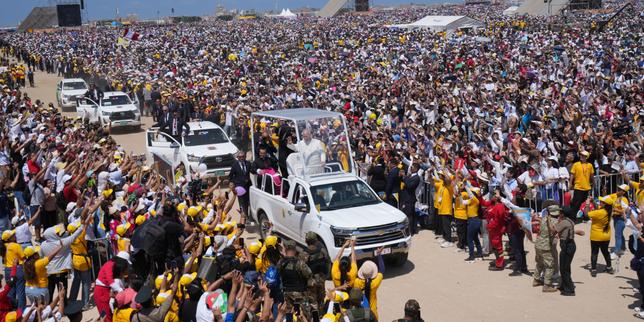
Mainstream religious coverage loves a crowd shot. Give a Vatican correspondent a wide-angle lens, a sun-drenched Peruvian plaza, and tens of thousands of waving flags, and they will write the exact same story every single time. They call it a triumphant homecoming. They frame it as proof of institutional vitality. They treat headcount as the ultimate metric of spiritual health.
That reading is lazy, superficial, and dangerously wrong.
When Pope Leo XIV returned to his former diocese in Peru—Chiclayo, where Robert Francis Prevost spent years as bishop before his elevation to Rome—the sheer scale of the turnout dominated the headlines. Pundits immediately spun the event into a narrative of an unstoppable, unified Global South church rallying behind its own. Look closer at the mechanics of Latin American Catholicism, the political reality on the ground in Peru, and the structural vulnerabilities of the papacy itself, and a completely different picture emerges.
Massive papal crowds do not prove institutional strength. More often, they mask deep structural decay.
The Illusion of the Headcount Metric
In media and institutional communications, volume is the easiest metric to sell and the hardest one to interrogate. I have watched major global organizations burn millions of dollars chasing vanity attendance metrics at flagship rallies while their core retention rates collapsed behind the scenes. The Catholic Church is not immune to this exact blind spot.
When a former local bishop returns to his old turf wearing the white cassock, turnout is guaranteed. Chiclayo is not just another stop on a diplomatic itinerary; it is personal territory. Prevost became a naturalized Peruvian citizen in 2015 after decades of missionary and administrative work in the country. For locals, seeing a man who walked their dusty streets and navigated their regional crises return as the Bishop of Rome triggers a powerful mix of civic pride, cultural identity, and genuine affection.
Civic pride, however, is not the same thing as religious adherence.
To understand what those crowds actually represent, you have to separate cultural Catholicism from practicing institutional allegiance. Across Latin America, public religious festivals and papal visits function as massive civic spectacles. People show up for the history, the spectacle, and the national validation. Yet, when you look at the baseline metrics that actually sustain a religious institution—weekly Mass attendance, priestly vocations, financial self-sufficiency, and resistance to evangelical defection—Peru tells a far more sobering story.
Over the past three decades, the Catholic share of Peru’s population has steadily eroded, dropping from over 90 percent in the late twentieth century to roughly 70 to 75 percent today, according to data from Pew Research Center and Latinobarómetro. Meanwhile, Pentecostal and evangelical churches have captured the fastest-growing segments of the urban working class. A one-day stadium-sized crowd for a returning favorite son does not reverse thirty years of Sunday-morning attrition. Treating a homecoming rally as a sign of institutional dominance is like mistaking a sold-out reunion concert for a thriving record label.
What the Mainstream Coverage Completely Missed About Chiclayo
Standard reporting frames Leo XIV’s return to Peru as a simple, heartwarming reunion. That framing erases the intense political and ecclesiastical friction that defined his actual tenure in the region.
Before becoming Pope Leo XIV, Robert Prevost was not merely a beloved pastoral figure handing out blessings. He was an Augustinian missionary, a canon lawyer, and an administrator dropped into the middle of Peru’s brutal political instability and the Vatican’s messy internal battles over abuse and governance.
Consider the context of his time in Chiclayo and his subsequent role leading the Dicastery for Bishops in Rome:
- Navigating Political Collapse: During his years in Peru, the country cycled through presidents at a dizzying pace—impeachments, corruption scandals, violent protests, and deep polarization between Lima’s political elite and the marginalized provinces. A bishop in northern Peru does not survive that environment by being universally adored; he survives by making calculated, often unpopular compromises to keep local parishes functioning while the state fractures.
- The Sodalitium Christianae Vitae Fallout: Peru was the epicenter of one of the most toxic ecclesiastical scandals in modern Latin American history—the abuse and financial corruption allegations surrounding the Sodalitium Christianae Vitae (SCV). Prevost was directly involved in the Vatican’s prolonged, agonizing efforts to investigate and dismantle the group’s power structure. For victims and reformers, Rome’s response felt agonizingly slow; for entrenched conservative elites in Peru, Vatican intervention felt like an existential threat.
- The Myth of the Monolithic Global South: Western journalists love to talk about the "Global South" as if it were a single, progressive voting bloc united behind Rome. It is not. Peruvian Catholicism is sharply divided between liberation-theology-adjacent social activism, deeply traditionalist factions, and charismatic movements that look remarkably similar to the Pentecostal competitors stealing their members.
When the cameras pan across a roaring crowd in Chiclayo, they flatten all of that tension into a single, sanitized image of unity. They miss the reality that the very people cheering him in the streets hold wildly incompatible expectations of what his papacy is supposed to deliver.
The Trap of the "Favorite Son" Papacy
History offers a brutal warning to popes who lean too heavily on emotional homecomings. Whenever a pontiff returns to his native or adopted homeland, the immediate boost in morale creates a dangerous psychological trap: the belief that personal charisma can substitute for structural reform.
Think about John Paul II’s triumphant returns to Poland in 1979 and throughout the 1980s. The crowds were astronomical. The emotional energy changed the geopolitical map of Europe. Yet within two decades of the fall of communism, Poland—once considered the immovable fortress of European Catholicism—began experiencing one of the fastest rates of youth secularization on the continent. Personal magnetism bought time, but it could not permanently insulate the institution from modernity or internal scandals.
Francis experienced a similar dynamic across Latin America. His 2013 trip to Rio de Janeiro drew over three million people to Copacabana Beach. Pundits declared a "Francis Effect" that would revitalize the region. Ten years later, the data showed that evangelical growth in Brazil had barely slowed down, and Francis’s 2018 trip to neighboring Chile was met with half-empty venues and open public hostility over the mishandling of clerical abuse.
Leo XIV faces an even sharper version of this dilemma. Because he bridges two worlds—born in Chicago, formed as a missionary and bishop in Peru—both North Americans and Latin Americans project their own institutional fantasies onto him.
- North American observers look at his administrative background and hope for pragmatic governance, financial discipline, and a cooling of culture-war rhetoric.
- Peruvian and Latin American crowds look at him as a champion of the periphery—a pope who understands poverty, migration, and political dysfunction firsthand because he lived it with them.
A crowd of hundreds of thousands in Peru raises expectations to an impossible altitude. When a pope is welcomed as a hometown savior, every subsequent bureaucratic delay in Rome, every unfulfilled economic hope in the provinces, and every unresolved local scandal feels like a personal betrayal. The bigger the welcome, the steeper the cliff when normal papal governance resumes.
Answering the Questions Nobody Wants to Ask
If you strip away the breathless commentary, the real questions surrounding Leo XIV’s return to Peru look very different from the ones dominating the press releases.
Does a massive turnout in Peru mean the Catholic Church is winning back Latin America?
No. Event attendance and weekly sacramental participation are entirely different behaviors. Latin America remains deeply spiritual, and the Catholic Church retains unmatched cultural infrastructure—schools, charities, historic parishes, and civic prestige. However, the religious marketplace in countries like Peru is permanently pluralistic now. Evangelical churches offer hyper-local leadership, immediate community support, and high-energy worship that a centralized, hierarchical institution struggles to match. A papal visit is a high-water mark, not a rising tide.
Why did Peruvians turn out in such huge numbers for Leo XIV specifically?
Three reasons, and only one of them is strictly theological:
- Authentic Local Credibility: Unlike a visiting dignitary flying in for a forty-eight-hour photo op, Prevost actually lived there. He spoke their dialect, ate their food, and stayed through crises. People respect proximity.
- National Validation: Peru has endured years of bruising international headlines defined by political chaos, economic stagnation, and social unrest. Hosting a pope who proudly claims Peruvian citizenship gives the country a rare moment of global prestige.
- The Power of Spectacle: In regions where state institutions consistently fail to deliver basic services or national pride, the Church remains one of the few organizations capable of staging a massive, peaceful, unifying public event.
What is the biggest risk for Leo XIV after a trip like this?
Mistaking applause for alignment. In Rome, a pope governs through committees, dicasteries, and slow-moving diplomatic channels. The cheering crowds in Chiclayo have zero leverage over the Roman Curia. If Leo XIV allows the emotional high of his Peruvian homecoming to convince him that his pastoral style alone can bridge the ideological and administrative fractures inside the Vatican, he will get chewed up by the bureaucracy just like his predecessors.
How to Actually Read Papal Travel
If you want to understand the true state of the Vatican—or any massive global institution—stop looking at the crowd sizes during homecoming tours. Crowd sizes measure nostalgia, celebrity, and civic pride. They do not measure institutional durability.
Instead, watch the unglamorous indicators over the next twenty-four months:
- Diocesan Appointments: Look at who Leo XIV appoints to lead key archdioceses in Lima, Bogotá, Mexico City, and Chicago. Personnel is policy. A pope’s real priorities show up in the bishops he promotes, not the speeches he gives from a stage.
- Seminary Enrollment in the Peripheries: Track whether the enthusiasm in northern Peru actually translates into young men entering the priesthood five years from now. If the applause does not produce vocations, it is just noise.
- Follow-Through on Accountability: Watch how the Vatican handles lingering abuse and financial corruption cases in Peru once the cameras leave. True authority is measured by what an institution cleans up when nobody is cheering.
To be clear, dismissing the emotional power of Leo XIV’s return to Peru entirely would be a mistake. Human beings run on symbols, and seeing a former missionary bishop return to his adopted home as pope is a potent symbol of a truly globalized Church. That connection is real, and it gives Leo XIV a reservoir of moral credibility that few world leaders can match.
Credibility, however, is a depreciating asset if you refuse to spend it on hard decisions.
The reporters covering the trip will file their stories about the sea of waving flags, the deafening chants, and the historic emotion of a hometown boy made good. They will call it a triumph. They will move on to the next stop on the itinerary.
Meanwhile, the real test of Leo XIV’s papacy begins the exact moment his plane leaves Peruvian airspace—when the banners come down, the loudspeakers are packed away, and the people in Chiclayo wake up on Monday morning to the exact same broken politics, empty seminaries, and aggressive religious competitors they had before he arrived.