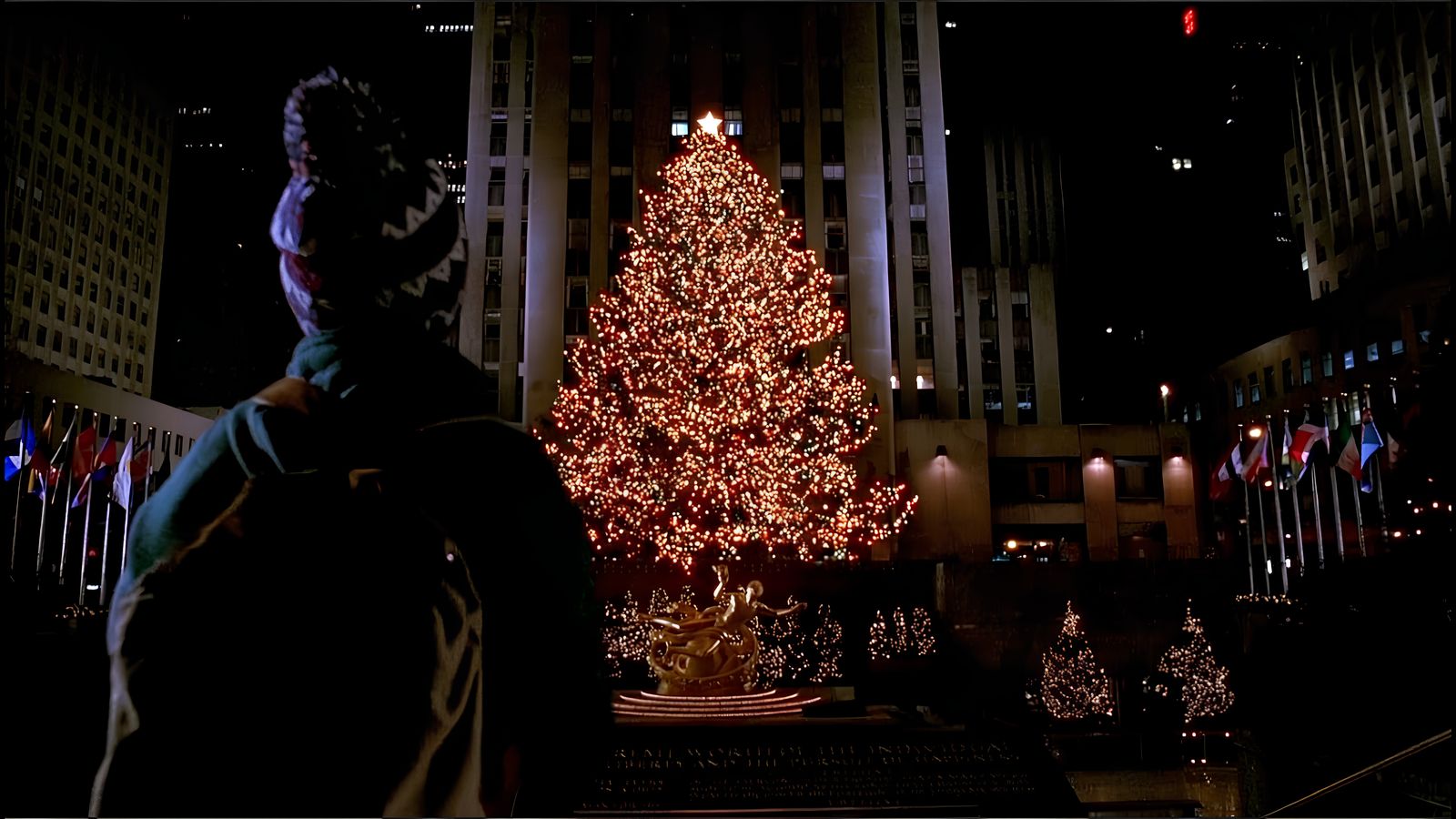
The towering Norway spruce that reunited Kevin McCallister with his mother in the 1992 film Home Alone 2: Lost in New York was not a Hollywood prop. It was the actual 1991 Rockefeller Center Christmas Tree, a 75-foot specimen hauled down from Suffern, New York, decorated with roughly 25,000 multicolored lights, and filmed live on location during the actual holiday season.
For decades, pop culture nostalgia has softened the story of that cinematic moment into pure, effortless holiday magic. Look past the celluloid glow, however, and you find something entirely different. Putting a 12-ton evergreen into the middle of Manhattan—and shutting down one of the busiest plazas on earth so Macaulay Culkin could film a tearful reunion—is a masterclass in high-stakes urban logistics, aggressive corporate branding, and calculated municipal compromise. Discover more on a related topic: this related article.
How Hollywood Hijacked a Manhattan Landmark
Securing a film permit for Rockefeller Center during the peak of December tourism is practically impossible. The sheer volume of pedestrian traffic turns Fifth Avenue and 49th Street into a gridlocked bottleneck from Thanksgiving until New Year's Day. Yet director Chris Columbus and 20th Century Fox pulled it off in late 1991.
They did not get access through charm. They got it through timing, money, and an existing corporate symbiotic relationship. Additional journalism by IGN highlights related views on the subject.
At the time, Rockefeller Center was desperate for positive publicity and financial stabilization. In 1989, the Mitsubishi Estate Company had purchased a controlling stake in the Rockefeller Group, a move that sparked intense xenophobic backlash in the American press. The complex was bleeding cash, saddled with massive debt, and facing a softening New York commercial real estate market. Having a major holiday tentpole movie—the sequel to the highest-grossing live-action comedy of all time—feature the plaza as its emotional climax was worth millions in unpaid global advertising.
Even with the property owners on board, the physical execution was grueling. The production crew had to work around the strict lighting schedule of the tree itself. The Rockefeller Center Christmas Tree is not a set piece that can be turned on and off at a director's whim; its electrical grid is tied into the plaza's centralized power infrastructure and governed by rigid union contracts and municipal curfews.
To capture the iconic final scene, the crew shot in the dead of night, utilizing freezing temperatures and exhausting overnight shifts to keep the plaza clear of the roughly 750,000 daily visitors who normally pack the sidewalks. The crowd seen in the background was carefully controlled, composed largely of paid extras bundled in heavy winter coats, directed to maintain natural movement while keeping clear of the camera tracks laid across the concrete.
The Brutal Logistics of a 12-Ton Propaganda Piece
Long before Chris Columbus ever yelled "action" beneath its branches, the Rockefeller tree was already an exercise in industrial-scale theater. Its origins are entirely devoid of holiday sentimentality.
In December 1931, at the absolute nadir of the Great Depression, construction workers building the Rockefeller Center complex pooled their meager wages to buy a modest 20-foot balsam fir. They decorated it with strings of cranberries, paper garlands, and a few tin cans. Two years later, the Center's management realized the public relations value of the gesture, took over the tradition, and turned it into a permanent fixture of New York corporate culture.
By 1991, the operation had evolved into a year-round scouting and engineering campaign. Head Gardener David Murbach, who oversaw the tree selection process for decades until his death in 2009, spent months flying over the Northeast in helicopters and driving down rural backroads in search of candidates.
A tree cannot simply be tall. It has to survive a violent extraction and transport process without shedding its needles or snapping its limbs. The selection criteria are ruthlessly specific:
- Species: Almost exclusively a Norway spruce, prized for its dense foliage, symmetrical conical shape, and sturdy branches capable of bearing hundreds of pounds of wiring.
- Dimensions: Ideally between 70 and 100 feet tall, with a trunk diameter thick enough to withstand high wind tunnels created by Manhattan skyscrapers.
- Access: The tree cannot be deep in a forest. It must stand in a clear yard or open field where a 100-ton crane and a specialized telescoping flatbed trailer can maneuver without destroying municipal roads or power lines.
Once the 1991 tree was cut in Suffern, New York—roughly 35 miles northwest of Midtown Manhattan—it had to be wrapped in heavy netting to compress its 40-foot width down to a legal highway transport size. Moving a 12-ton load through the Lincoln Tunnel or across the George Washington Bridge requires New York Police Department escorts, permits from the Port Authority, and precise timing to avoid paralyzing commuter traffic.
When the tree arrives at the plaza, a massive steel spike is driven into the base of the trunk, which is then lowered onto a custom-engineered base plate anchored directly into the concrete above the ice rink. Four thick guy-wires are attached to the upper third of the trunk and anchored to the surrounding buildings to keep the tree from toppling onto skaters during winter nor'easters.
Why No One Gets Paid for the Tree
A persistent urban legend suggests that families who donate their backyard trees to Rockefeller Center receive a massive payday. The reality is much bleaker for the homeowner's bank account, though lucrative for their ego.
Rockefeller Center pays exactly zero dollars for the tree itself. It is strictly a donation.
What the property owner gets in return is free tree removal—a service that would normally cost between $5,000 and $15,000 for a mature 80-foot spruce—along with basic landscaping restoration once the stump is ground down. The real currency is prestige. Donors get their names broadcast on national television during the annual tree lighting special, VIP seating at the event, and permanent bragging rights.
For Tishman Speyer, the real estate titan that currently owns and operates Rockefeller Center, the financial math is staggering. The company spends tens of thousands of dollars on the crane rentals, trucking, scaffolding, 50,000-plus LED lights, and round-the-clock security. In exchange, the tree drives an estimated 125 million visitors to the complex over a five-week period.
Those visitors buy tickets to the Top of the Rock observation deck, rent skates at the rink below the Prometheus statue, and spend millions of dollars at the high-end retail tenants leasing ground-floor space from Tishman Speyer. The tree is not a charity project. It is the ultimate loss leader in commercial real estate.
The Environmental Hangover Nobody Talks About
While Home Alone 2 cemented the tree's image as a timeless symbol of family warmth, the reality of harvesting an 80-year-old living organism for five weeks of entertainment has drawn increasing scrutiny from urban planners and environmentalists.
A Norway spruce of that size is a mature ecosystem. It sequesters significant amounts of carbon, provides shelter for local bird populations, and stabilizes soil with an extensive root system. Cutting it down to wrap it in five miles of electrical wire and blast it with spotlights generates a massive carbon footprint, from the heavy-duty diesel cranes used to lift it to the continuous power draw required to keep it illuminated from early morning until midnight.
Rockefeller Center has attempted to neutralize this criticism through aggressive greenwashing—or, more charitably, circular sustainability. Since 2007, after the tree is taken down in early January, the trunk is milled into lumber and donated to Habitat for Humanity.
The wood is used to build doorframes, flooring, and structural framing for low-income housing across the tri-state area. The remaining branches and needles are mulched and distributed to local parks and community gardens. While this prevents the tree from rotting in a landfill, critics rightly point out that milling a single tree does not offset the massive logistical emissions of the annual spectacle, nor does it replace a century-old tree that took decades to reach maturity.
The Cinematic Illusion vs. The Street-Level Reality
Watching Home Alone 2 today, the scene at the tree feels remarkably intimate. Catherine O'Hara runs up to the plaza, spots Macaulay Culkin staring up at the massive spruce, and they embrace in a quiet, snow-dusted moment accompanied by John Williams' soaring orchestral score.
If you visit Rockefeller Center in December hoping to recreate that atmosphere, you will be violently disappointed.
The film entirely erased the sensory overload of the real location. In reality, the plaza is flanked by metal barricades manned by private security guards and NYPD officers shouting through megaphones to keep foot traffic moving. You cannot stand still in front of the tree for more than thirty seconds without being aggressively ushered forward. The air smells of roasted nuts, diesel exhaust from idling tour buses on Fifth Avenue, and the collective body heat of thousands of tourists jammed shoulder-to-shoulder.
Furthermore, the lighting in the movie was heavily manipulated. The real 1991 tree was lit with traditional incandescent bulbs, which cast a warm, slightly amber glow that often struggled to cut through the harsh ambient light of Midtown Manhattan's streetlights and storefront displays. Cinematographer Julio Macat had to bring in massive, diffused HMI lights—daylight-balanced lamps typically used for stadium lighting—and bounce them off giant white silks just out of frame to properly expose the actors' faces without blowing out the delicate points of light on the branches behind them.
Even the snow was fake. While New York was cold during the shoot, Mother Nature did not cooperate with a picturesque snowfall on cue. Special effects crews used industrial snow machines pumping out biodegradable foam and shredded paper flakes, strategically aimed into the camera's backlight to create the illusion of a gentle winter flurry.
The Enduring Power of Manufactured Nostalgia
The 1991 Rockefeller Center Christmas Tree stood for roughly six weeks before it was unceremoniously stripped of its wires, chopped into manageable logs, and hauled away in the dead of night. Like every tree before and after it, its physical existence was fleeting.
Yet because 20th Century Fox spent millions of dollars to capture it on 35mm film, that specific spruce from Suffern, New York achieved a kind of immortality that no other tree in the landmark's history can match. It was preserved at the exact intersection of peak 1990s Hollywood excess and old-world New York iconography.
Every December, millions of families sit down to watch Home Alone 2, absorbing a carefully constructed fantasy of New York City that never truly existed. They see a magical, quiet wonderland where a lost kid can find his mother beneath a glowing giant evergreen, completely unaware of the diesel cranes, real estate debt, union overtime, and crowd-control barricades working furiously just outside the frame to keep the illusion alive.