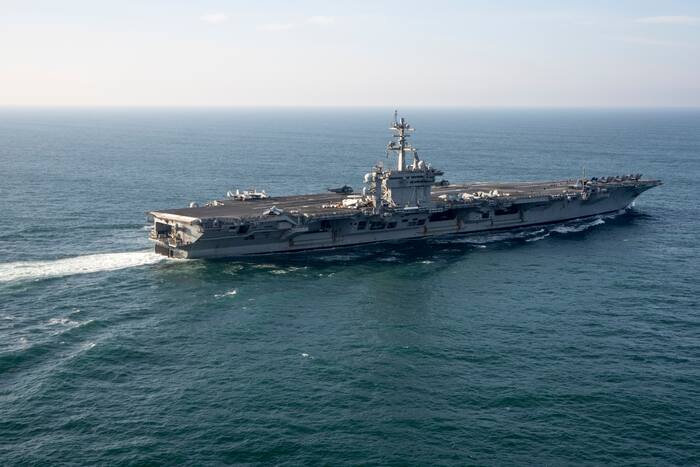
Deploying a second US Navy Carrier Strike Group to the Middle East shifts the regional security architecture from defensive containment to continuous offensive saturation. A single carrier operates on a finite sortie-generation cycle constrained by human fatigue and deck space; two carriers eliminate the operational pause, creating an overlapping 24-hour combat air patrol and strike window that complicates adversary targeting models.
The Operational Mechanics of Dual-Carrier Presence
Standard coverage of naval deployments treats warships as static chess pieces moved across a map for political signaling. In practice, a Carrier Strike Group (CSG) is a floating airfield governed by strict thermodynamic, logistical, and physiological limits.
A single Nimitz- or Ford-class aircraft carrier typically embarks a Carrier Air Wing (CVW) of approximately 65 to 75 aircraft, including four strike-fighter squadrons (F/A-18E/F Super Hornets and F-35C Lightning IIs), electronic attack aircraft (EA-18G Growlers), and airborne early warning platforms (E-2D Advanced Hawkeyes). Under sustained high-intensity operations, a single carrier can maintain cyclic flight operations for roughly 12 to 14 hours per day before flight deck crews, ordnance handlers, and pilots require mandatory rest cycles to prevent catastrophic safety failures.
This operational reality creates a predictable vulnerability window. Adversary intelligence, surveillance, and reconnaissance (ISR) networks track launch and recovery cycles to identify periods of reduced airborne coverage.
Introducing a second Carrier Strike Group resolves this constraint through Temporal Interleaving:
- Continuous 24-Hour Strike Availability: While Carrier Alpha enters its 10-hour maintenance, rearming, and crew-rest window, Carrier Beta assumes active cyclic flight operations. The theater never experiences a drop in airborne strike capacity.
- Electronic Warfare Saturation: Two air wings double the available EA-18G Growler inventory. Rather than allocating electronic attack assets solely to self-defense for a strike package, commanders can dedicate persistent jamming orbits over adversary radar networks and coastal missile batteries.
- Distributed Defensive Geometry: A single carrier in the Red Sea, Gulf of Oman, or Eastern Mediterranean forces escorts to defend a single geographic point. Two carriers operating in separate maritime basins—such as one in the Eastern Mediterranean and one in the Red Sea or Arabian Sea—force adversary planners to divide their anti-ship ballistic missile (ASBM) and one-way attack drone inventories across two distinct azimuths.
The Deterrence Cost Function and Asymmetry
Military deterrence relies on altering an adversary's expected-value calculation. In the Middle East, the primary operational friction stems from an acute cost-exchange asymmetry between state-backed irregular forces and high-end naval task forces.
When a regional proxy launches a $20,000 to $50,000 one-way attack drone or a $100,000 anti-ship cruise missile, a guided-missile destroyer (DDG) accompanying the carrier often intercepts the threat using an SM-2 or SM-6 surface-to-air missile costing between $2 million and $4.3 million per round. Over an extended deployment, this exchange rate degrades fleet magazine depth—the total number of Vertical Launching System (VLS) cells available in theater.
A dual-carrier posture modifies this cost function through three mechanisms:
- Air-to-Air Interception Economics: With double the airborne fighter patrols, combat air patrols (CAP) intercept low-slow drones using cannon fire or lower-cost air-to-air munitions rather than depleting shipboard VLS cells reserved for high-velocity ballistic threats.
- Offensive Suppression Over Passive Defense: A single carrier is frequently consumed by defensive counter-air missions to protect commercial shipping lanes and regional bases. A second air wing frees offensive strike capacity to target mobile launchers, storage facilities, and radar nodes ashore before munitions are launched.
- Escort Multipliers: Each Carrier Strike Group deploys with a Cruiser or Destroyer Squadron (typically 3 to 5 Aegis-equipped surface combatants). Two strike groups inject between 500 and 900 VLS cells into the theater simultaneously, expanding regional ballistic missile defense (BMD) coverage for land bases and allied infrastructure.
The Global Force Management Penalty
The decision to maintain two carriers in the US Central Command (CENTCOM) area of responsibility is never isolated; it imposes an immediate structural tax on global readiness. The US Navy operates a total fleet of 11 nuclear-powered aircraft carriers, governed by the Optimized Fleet Response Plan (OFRP).
The OFRP divides a carrier's lifecycle into four strict phases: Maintenance, Basic Training, Integrated Training, and Sustainment/Deployment. At any given moment, roughly one-third of the fleet is in deep shipyard maintenance (such as Refueling and Complex Overhaul, which removes a hull from service for up to four years), one-third is in post-deployment recovery or basic workups, and only one-third—three to four carriers—is certified ready for immediate global deployment.
Committing two of those available hulls to the Middle East produces measurable cascading effects across other combatant commands:
- The Indo-Pacific Presence Gap: Because hull availability is a zero-sum equation, holding two carriers in CENTCOM frequently requires extending a deployment already underway or pulling a carrier assigned to the Western Pacific (USINDOPACOM). This creates temporary "carrier gaps" in the South China Sea and Philippine Sea, reducing day-to-day deterrence against peer competitors.
- Maintenance Backlog Compression: Extending a standard 7-month deployment to 8 or 9 months delays a ship's entry into dry dock. Because shipyard capacity at public and private facilities (such as Newport News and Puget Sound) is tightly scheduled years in advance, a 60-day deployment extension can cause a carrier to miss its dry-dock window, triggering multi-month delays for subsequent hulls in the maintenance queue.
- Material Fatigue Rates: High-tempo flight operations in high-salinity, high-temperature environments like the Red Sea and Persian Gulf accelerate corrosion on airframes and catapult systems. Operating two carriers at peak tempo consumes flight hours on F/A-18E/F airframes faster than depot-level maintenance can restore them.
Distinguishing Known Facts from Operational Hypotheses
Evaluating the strategic impact of a dual-carrier return requires separating verifiable force-structure realities from unconfirmed operational assumptions.
Verified Operational Facts:
- Logistical Self-Sufficiency: Unlike land-based tactical fighter wings deployed to airbases in Qatar, Jordan, or Saudi Arabia, aircraft carriers operate in international waters. They do not require diplomatic overflight clearances or host-nation basing permissions to launch combat sorties, insulating US strike options from regional political pressure.
- Command and Control Bandwidth: Two CSGs bring two flag-level staffs (each led by a Rear Admiral) with high-capacity satellite communications and intelligence fusion centers, vastly increasing theater battle-management capacity.
- Ordnance Re-supply Bottlenecks: While carriers are nuclear-powered and do not require propulsion fuel, their aviation fuel (JP-5) and precision-guided munitions must be replenished via underway replenishment (UNREP) from Military Sealift Command oilers and dry-cargo ships. High-tempo dual-carrier operations strain the finite global fleet of combat logistics ships.
Educated Strategic Hypotheses:
- Deterrence Thresholds Against State Actors: Defense planners operate on the hypothesis that visible, overwhelming conventional mass deters state-level escalation by making the failure of a retaliatory strike near-certain. However, empirical history shows that non-state actors with high risk tolerance and low infrastructure footprints often absorb conventional strikes without altering their strategic calculus.
- Duration of the Dual-Carrier Window: Based on historical OFRP constraints since 2023, dual-carrier concentrations in the Middle East function as surge mechanisms rather than permanent posture shifts. Unless the Navy alters its deployment-to-dwell ratios—which risks severe retention drops among naval aviators and deck crews—the two-carrier overlap typically lasts between 30 and 90 days before one group rotates out of theater.
Tactical Limitations of Naval Mass
Concentrating two high-value capital ships within confined maritime geography introduces specific vulnerabilities that analysts frequently overlook.
First, geographic compression reduces maneuver advantage. In the open ocean, a Carrier Strike Group moving at 30+ knots can vanish within a search area of thousands of square miles within hours. In narrow waterways like the Red Sea (roughly 190 miles wide at its broadest point) or the Persian Gulf, maneuver room is restricted by shipping lanes, shallow shoals, and territorial waters. Adversary coastal surveillance radars and commercial satellite imagery can narrow the carrier's operating box, simplifying targeting solutions for anti-ship ballistic missiles.
Second, naval airpower cannot hold terrain. Carriers provide unmatched episodic firepower and rapid crisis response, but they cannot independently dismantle deeply buried hardened facilities or permanently occupy territory to stop mobile rocket teams. Without persistent, distributed ground-based ISR and regional partner intelligence sharing, an air wing risks expending high-end precision munitions against low-value decoy targets.
Third, the signaling paradox. Deploying a second carrier is intended to de-escalate a crisis by demonstrating resolve. Yet to an adversary viewing the buildup through a defensive lens, the arrival of 140+ strike aircraft and 1,000+ cruise missiles looks identical to preparation for an imminent preventive war. This perception can incentivize an adversary to strike first before the second carrier fully integrates into theater operations.
Strategic Execution for Force Planners
Sustaining a two-carrier posture without breaking the global fleet requires shifting from reactive hull surges to distributed lethality. Military planners and defense policymakers must execute three specific adjustments to extract maximum strategic return from the current deployment window:
- Prioritize High-Value Infrastructure Over Mobile Attrition: Use the temporary 24-hour sortie window to systematically degrade hardened adversary command nodes, subterranean weapons storage, and naval production facilities, rather than wasting carrier flight hours chasing low-cost mobile launchers.
- Integrate Unmanned Surface and Aerial Screening: Deploy unmanned surface vessels (USVs) and long-endurance reconnaissance drones forward of the strike groups to absorb ISR duties and act as picket sensors, preserving manned fighter hours for high-threat strike and air-superiority missions.
- Establish a Hard Sunset Date: Enforce a strict 60-day cap on the dual-carrier overlap, transitioning to a single carrier augmented by land-based Air Force strategic bombers and Guided Missile Submarines (SSGNs) to preserve shipyard schedules and maintain deterrence credibility in the Indo-Pacific.