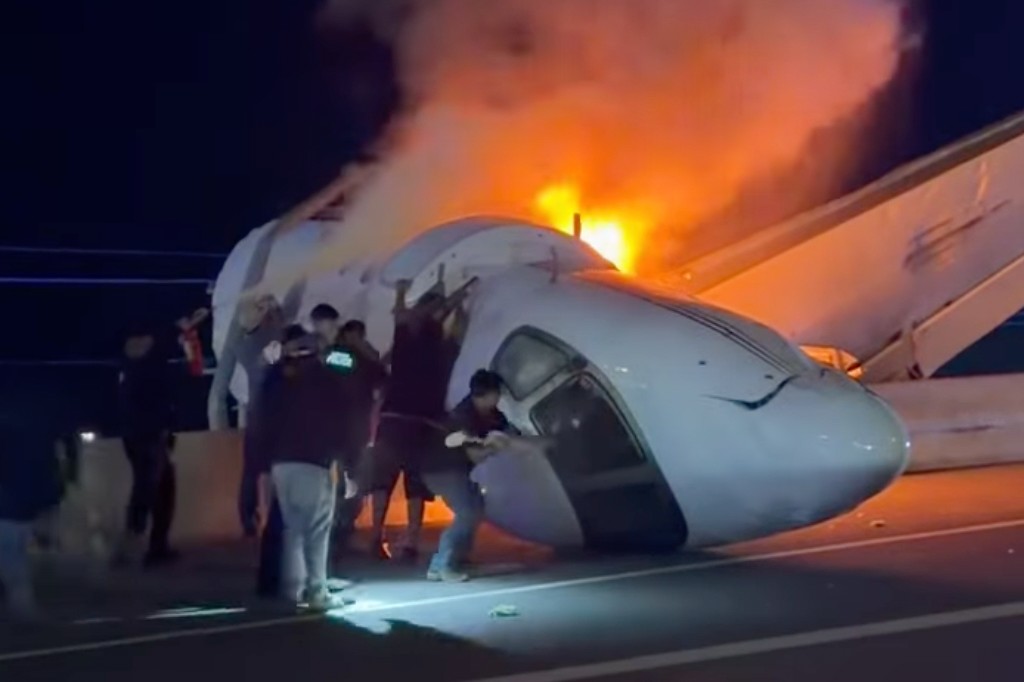
Aviation emergencies cascading into highway crash sites represent a specific failure mode where urban infrastructure becomes the final, non-permissive runoff zone for distressed aircraft. The June 16, 2026, crash of a NetJets Cessna 680A Citation Latitude (Registration: N523QS) on Loop 20 in Laredo, Texas, outlines the exact physics and operational limits governing emergency diversions. When an aircraft experiencing multi-system degradation fails to reach a designated runway, the selection of a highway as an emergency landing strip introduces a predictable set of physical forces, structural hazards, and survival bottlenecks.
Evaluating this event requires breaking down the sequence into three primary analytical phases: airborne system degradation, energy management during forced descent, and post-impact structural survivability.
The Airborne System Degradation Profile
The flight originated from San José del Cabo with a planned destination of Austin, Texas. Initial data points to a multi-system emergency declared approximately several miles short of Laredo International Airport (LRD) at 9:58 PM CDT. According to airport authority statements, the flight crew indicated mechanical difficulties alongside low fuel indications and a subsequent power outage, resulting in a rapid loss of communication with air traffic control.
The convergence of low fuel states and electrical failure introduces an operational bottleneck. In modern twin-jet aircraft, such as the Cessna Citation Latitude, fuel serves a dual purpose: propulsion and ballast/cooling. A simultaneous loss of power and fuel starvation indicates one of two mechanical realities:
- True Fuel Starvation: Total depletion of usable onboard fuel, causing dual-engine flameout. This immediately triggers the loss of engine-driven electrical generators, forcing the aircraft onto emergency battery power or an auxiliary power unit (APU) if deployed.
- Fuel Starvation via System Isolation: Mechanical or electrical faults preventing fuel transfer from the tanks to the engines, simulating starvation despite physical fuel presence.
When engines flame out, the aircraft transitions from powered flight to unpowered glide. The glide ratio of a business jet dictates the exact distance it can traverse per unit of altitude lost. For typical mid-size business jets, this ratio sits between 10:1 and 14:1. Without thrust, any deviation from the optimal glide speed drastically shortens the available footprint for emergency landing, forcing an immediate diversion to the nearest geographic clearing, which in urbanized border corridors is frequently a multi-lane highway.
Energy Management and Infrastructure Obstacles
Choosing a highway corridor like Loop 20 introduces structural variables absent from certified runways. A runway provides a flat, predictable surface engineered to dissipate kinetic energy via standard braking and friction. A highway presents an unyielding, high-risk environment defined by specific physical impediments.
[Kinetic Energy Dissipation] -> [Impact with Ground Vehicle / Barriers] -> [Fuselage Torque & Disruption]
The kinetic energy ($E_k$) that must be dissipated during an emergency landing is governed by the formula:
$$E_k = \frac{1}{2} m v^2$$
Where $m$ represents the mass of the aircraft and $v$ represents its velocity. Because velocity is squared, even minor increases in touchdown speed exponentially increase the destructive energy during impact. The Cessna Citation Latitude has a typical landing configuration stall speed near 90 to 100 knots. When an aircraft hits highway infrastructure at these velocities, the dissipation of $E_k$ occurs through destructive deceleration rather than controlled braking.
The presence of concrete highway dividers, light poles, and civilian vehicles prevents a smooth rollout. In this specific event, the aircraft struck a passenger vehicle and a light pole before overturning onto its side against a highway barrier.
- Vertical Obstacles: Light poles and sign gantry structures act as point-impact cutting mechanisms, slicing through wing structures or control surfaces and causing asymmetric drag.
- Mechanical Asymmetry: Striking a concrete barrier on one side forces the aircraft into an immediate ground loop, inducing severe lateral torque on the fuselage and tearing the tail section away from the pressure vessel.
- Civilian Incursion: Unlike a sterile runway, a highway contains moving masses. Hitting a ground vehicle adds a secondary vector of kinetic exchange, complicating the deceleration profile and transferring structural stress directly to the cabin floor.
Post-Impact Survival Dynamics and Fuselage Integrity
The structural survival of occupants hinges on the integrity of the pressure vessel during the initial impact and the subsequent prevention of thermal vectors inside the cabin. The Laredo crash resulted in one fatality among the six occupants, while five survived with injuries. This outcome highlights the specific protective engineering of modern aluminum-lithium and composite fuselages, alongside the extreme hazards of post-crash fires.
When a jet crashes with low fuel, the volume of flammable liquid is reduced, yet the residual fuel in the wings remains highly volatile. Impact forces breach the wing tanks, vaporizing the fuel instantly as it contacts hot engine components or frictional sparks generated by scraping aluminum. This initializes an immediate post-crash fire.
Survival under these conditions is bounded by a tight temporal envelope, typically compressed to less than 90 seconds before cabin flashover or toxic smoke inhalation renders occupants unconscious. In this incident, the aircraft coming to rest on its side compromised the primary emergency exits, trapping occupants within a burning hull.
Civilian bystanders utilizing tools like sledgehammers and shovels to breach the cockpit glass and pry open the main cabin door represents a critical failure of autonomous egress systems. Aircraft windshields are constructed from layered stretched acrylic and polycarbonate materials designed to withstand bird strikes at 250 knots. Breaching this glass from the exterior using manual tools is mechanically inefficient and highly difficult. Survival in this instance relied entirely on the successful mechanical deformation of the cabin door frame by external actors, allowing three passengers and the flight crew to escape before thermal conditions became unsurvivable.
The National Transportation Safety Board (NTSB) investigation will systematically isolate the exact breakdown sequence. Investigators will focus on fuel logs from San José del Cabo, the mechanical integrity of the engine fuel control units, and the maintenance history of the electrical generation systems. The final determination will map whether the highway diversion was forced by absolute resource depletion or a mechanical failure that isolated available resources from the engines.
The operational reality remains absolute: highways are non-viable alternatives to runways, acting purely as a last-resort terrain choice where survival is dictated by structural elasticity, immediate civilian intervention, and luck rather than engineered safety margins.