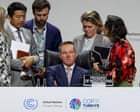
Multilateral climate diplomacy operates under a structural defect that guarantees diplomatic failure whenever negotiations approach the core drivers of global emissions. The failure to secure explicit fossil fuel phaseout language—the "f-word" of international climate negotiations—at COP31 is not an isolated diplomatic stumble by Australian Climate Change and Energy Minister Chris Bowen, nor is it simply a triumph of petrostate obstructionism. It is the mathematically predictable output of a consensus-based voting architecture colliding with irreconcilable sovereign balance sheets. When nearly 200 nations with diametrically opposed economic survival models must achieve unanimity, the resulting text defaults to the lowest common denominator.
To understand why COP31 stalled on fossil fuels, observers must stop evaluating the summit through the lens of individual political personalities and start analyzing the institutional mechanics, fiscal dependencies, and geopolitical trade-offs governing the United Nations Framework Convention on Climate Change (UNFCCC) process.
The Structural Trap of UNFCCC Consensus Rules
The primary bottleneck in global climate negotiations is Rule 42 of the UNFCCC draft rules of procedure. Because parties have never formally adopted a voting mechanism, every substantive decision requires consensus. Consensus does not mean a majority vote; it means the absence of formal, sustained objection from any single sovereign state.
This institutional design creates an asymmetric veto power:
- The Cost of Blocking is Zero: A petrostate or coal-dependent economy incurs no procedural penalty for stalling negotiations into overtime until phaseout language is diluted into non-binding phrasing like "transitioning away" or "abated."
- The Cost of Collapse is Infinite for Hosts: The COP presidency—and aligned progressive blocs—bears the reputational and political cost if a summit collapses without a final cover decision.
This asymmetry dictates the entire negotiation arc. Petrostates possess a credible threat of walking away, whereas middle-power hosts and vulnerable island states need a signed document to preserve the multilateral framework itself. Chris Bowen’s position at COP31 exemplifies this structural vise. Positioned as a senior negotiator representing a major fossil fuel exporter attempting to pivot toward renewable superpower status, Bowen had to balance domestic economic realities, Pacific Island security guarantees, and the rigid procedural constraints of the UNFCCC floor. Blaming a single minister for failing to extract a fossil fuel phaseout ignores the reality that no negotiator can overcome a unanimous-consent rule when a blocking coalition holds an existential financial stake in the status quo.
The Sovereign Balance Sheet Problem
Media coverage routinely frames COP deadlocks as a moral clash between climate realists and fossil fuel villains. In operational reality, the deadlock is a dispute over sovereign solvency and asset stranding.
For high-cost, low-diversification hydrocarbon producers, an immediate, binding fossil fuel phaseout is not an environmental policy; it is a sovereign debt crisis. Many OPEC+ members and emerging hydrocarbon exporters rely on oil and gas revenues to fund over 50 percent of their national budgets, subsidize domestic energy and food prices, and maintain internal political stability. A binding timeline to eliminate fossil fuel production immediately impairs the sovereign credit ratings of these nations and threatens to strand trillions of dollars in state-owned infrastructure.
The Three-Tiered Producer Hierarchy
Not all fossil fuel producers face the same risk profile, which explains why different blocs deploy distinct obstruction tactics during plenary sessions:
- Low-Cost, High-Reserve Petrostates: Nations like Saudi Arabia and the United Arab Emirates possess the lowest extraction costs globally. Their strategic objective is to ensure that if global demand contracts, they remain the last producers standing. They fight "phaseout" language to protect long-term market share, while selectively endorsing carbon capture, utilization, and storage (CCUS) to keep hydrocarbons viable in net-zero models.
- High-Population Developing Producers: Countries such as India, Indonesia, and Nigeria face surging domestic energy demand alongside massive poverty reduction targets. Their resistance stems from energy security and capital scarcity. Without guaranteed, concessional climate finance to build grid-scale renewables, abandoning domestic coal or gas reserves risks economic stagnation and civil unrest.
- Western Industrialized Exporters: Nations including Australia, the United States, Canada, and Norway operate within democratic systems facing intense domestic climate pressure, yet their export revenues and trade balances remain heavily tied to liquefied natural gas (LNG), thermal coal, or crude oil. These states frequently endorse ambitious global targets while maintaining domestic loopholes for new gas projects or export terminals, creating a credibility deficit that petrostates routinely exploit during closed-door drafting sessions.
When Chris Bowen or any Western counterpart pushes for strict phaseout language while their own domestic jurisdictions continue approving gas extensions or coal mine expansions, petrostate negotiators immediately weaponize that contradiction. The diplomatic leverage evaporates before the final gavel falls.
The Finance-Phaseout Nexus
A critical failure in standard political analysis is treating the fossil fuel text as independent from the climate finance negotiations. Within the UNFCCC architecture, mitigation ambition (cutting emissions) and means of implementation (finance, technology transfer, and capacity building) are strictly linked.
Developing nations, organized under the G77 and China bloc, view Western demands for rapid fossil fuel phaseouts without commensurate financial commitments as an attempt to pull up the economic ladder. Building a decarbonized energy grid requires massive upfront capital expenditure (CAPEX), whereas fossil fuel infrastructure relies more heavily on ongoing operational expenditure (OPEX). Because developing economies face borrowing costs that are often three to five times higher than those in OECD nations, the levelized cost of renewable energy becomes prohibitively expensive without international de-risking mechanisms.
The causal chain operates as follows:
- Input Failure: Developed nations consistently fall short of delivering low-cost, grant-based public finance at the scale required for emerging market grid transitions.
- Negotiating Leverage: Developing nations withhold support for binding fossil fuel phaseout timelines, using the mitigation text as a hostage to extract stronger financial commitments.
- Petrostate Exploitation: Traditional oil and gas exporters align themselves with the legitimate developmental grievances of the G77, effectively shielding their own export markets behind the banner of "energy justice" and "common but differentiated responsibilities."
This coalition dynamic explains why the "f-word" disappears in the final hours of a COP. By the second week of negotiations, progressive nations are forced to choose between a weak mitigation text that preserves the Paris Agreement framework or a total breakdown of talks that leaves developing nations without any financial pledges at all.
Why Australia’s Diplomatic Positioning Compounded the Friction
Evaluating Chris Bowen’s specific role requires examining Australia’s unique geopolitical footprint. Australia entered the COP31 cycle carrying a dual mandate: repairing its international climate reputation after a decade of domestic policy paralysis, and co-hosting or partnering closely with Pacific Island nations that face existential threats from sea-level rise.
This dual alignment created severe internal friction:
- The Pacific Imperative: For Pacific Island Forum members, a 1.5°C warming limit is a non-negotiable survival threshold, making an explicit fossil fuel phaseout the primary metric of summit success.
- The Trade Reality: Australia remains one of the world’s largest exporters of metallurgical coal, thermal coal, and LNG. Its primary trading partners—Japan, South Korea, and China—rely on Australian energy exports for industrial stability and have actively lobbied against abrupt supply disruptions.
When an Australian minister leads or shapes the push for aggressive phaseout text, every negotiating partner at the table understands the domestic political constraints binding Canberra. Petrostate diplomats recognize that Australia cannot economically afford an immediate collapse in global LNG or coal demand within the next decade. This structural vulnerability weakens the moral and strategic authority of the negotiator, turning bold plenary speeches into easily discounted bargaining chips.
The Diminishing Returns of COP Cover Decisions
The obsession with whether a COP cover decision includes the words "phaseout" or "phase-down" misunderstands how energy transitions actually occur. UNFCCC cover decisions are political declarations, not legally binding domestic statutes. They carry no enforcement mechanism, no tariffs, and no financial penalties for non-compliance.
Real-world decarbonization is driven by three concrete mechanisms outside the UNFCCC plenary hall:
- Capital Allocation and Cost Curves: Utility-scale solar, wind, and battery storage displace fossil fuels when their marginal cost drops below the operating cost of existing coal and gas plants. Financial markets respond to levelized cost of electricity (LCOE) metrics, not UN adjectives.
- Industrial Policy and Trade Tariffs: Unilateral and plurilateral economic measures—such as the European Union’s Carbon Border Adjustment Mechanism (CBAM), the US Inflation Reduction Act, and China’s state-backed clean tech manufacturing dominance—alter global supply chains far faster than consensus diplomacy.
- Bilateral and Sectoral Coalitions: Smaller clubs of willing nations, such as the Powering Past Coal Alliance or the Beyond Oil and Gas Alliance, establish concrete, verifiable exit dates without waiting for unanimous global approval.
Relying on a 198-nation consensus forum to force petrostates to sign their own economic obsolescence guarantees annual frustration. The "f-word" failure at COP31 is simply proof that the UNFCCC has reached the limit of what unanimity can achieve on supply-side fossil fuel restrictions.
Strategic Realignment for Future Climate Diplomacy
Continuing to treat the COP cover decision as the primary battleground for fossil fuel elimination misallocates diplomatic capital. To break the cycle of annual gridlock, climate-aligned governments and negotiators must execute a fundamental shift in operational strategy:
- Decouple Supply-Side Restrictions from Consensus Plenaries: Stop burning political capital trying to force OPEC+ members to sign off on "phaseout" phrasing in UNFCCC cover texts. Instead, shift supply-side negotiations into plurilateral trade and finance agreements among major energy importers and exporters willing to adopt binding schedules.
- Target Demand-Side Infrastructure Financing: Redirect diplomatic leverage toward international financial institution (IFI) reform, sovereign debt relief, and blended finance facilities that lower the cost of capital for renewable grids in high-growth developing economies. When emerging markets stop building new coal and gas power plants due to cheaper clean capital, fossil fuel demand erodes regardless of COP text.
- Enforce Domestic Policy Coherence: Exporting nations like Australia, Canada, and the United States must align their domestic project approval pipelines with their international diplomatic rhetoric. Establishing clear, legally binding timelines for winding down new fossil fuel export infrastructure is a prerequisite for restoring negotiating credibility on the global stage.
- Weaponize Trade Policy Over Diplomatic Text: Utilize border carbon adjustments, green procurement standards, and methane intensity regulations on imported fuels to penalize high-emission production directly in global commodity markets, bypassing the UNFCCC consensus veto entirely.


