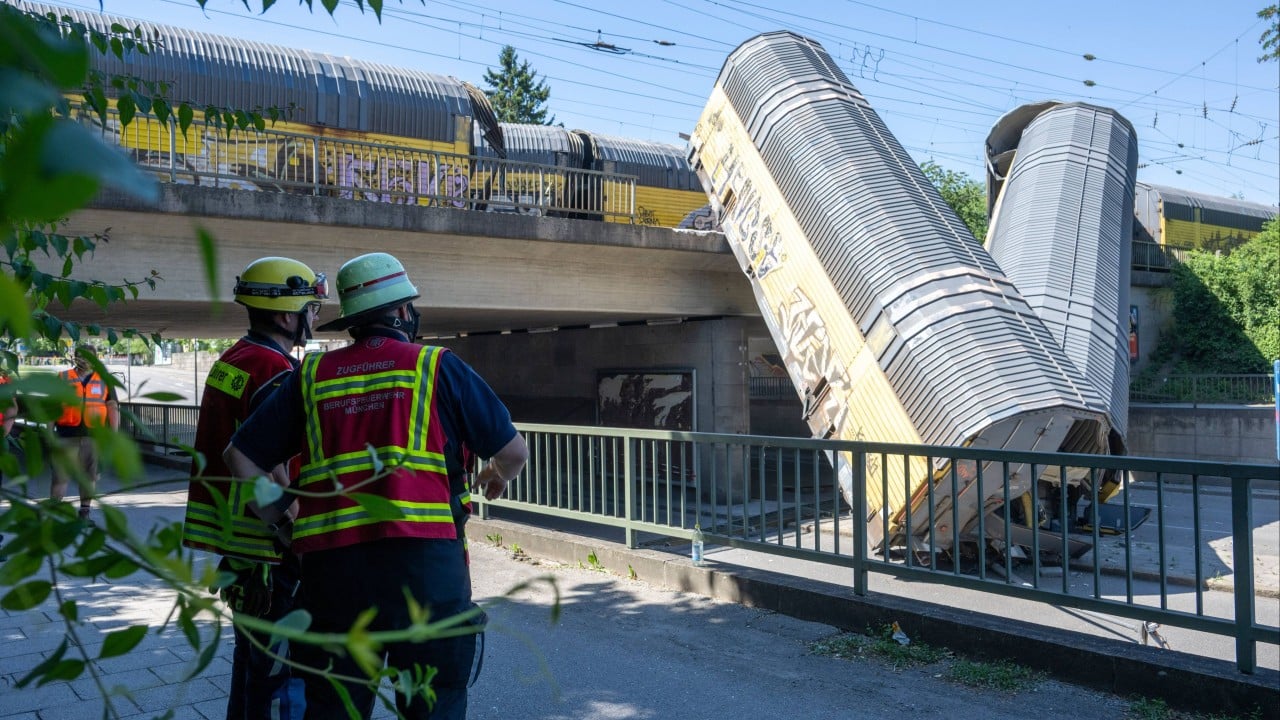
A single point of failure within complex transit networks creates systemic cascading effects that far exceed the localized physics of the initial impact. The recent fatal freight train derailment and subsequent bridge collapse in Germany serves as a stark case study in how kinetic energy transfer, structural vulnerabilities, and logistical dependencies intersect. When a freight train derails on or immediately preceding a bridge structure, the incident ceases to be a simple vehicular accident; it becomes a complex civil engineering failure with immediate macroeconomic repercussions. Evaluating this event requires breaking down the incident into three distinct phases: the kinetic trigger, the structural collapse mechanism, and the systemic network disruption.
The Kinetic Trigger and Initial Energy Transfer
The transition from a standard operational state to a catastrophic failure sequence begins with the derailment mechanism itself. In freight rail operations, derailments generally stem from one of three variables: mechanical failure of the rolling stock (such as axle fractures or wheel flange wear), track defects (including rail spread or thermal buckling), or external obstructions.
When a multi-thousand-ton freight train leaves the guide rails at operational velocity, the lateral and vertical forces shift drastically. The primary objective of rail infrastructure is the continuous, predictable dissipation of kinetic energy along a pre-engineered path. A derailment causes an instantaneous decoupling of this energy management system.
[Kinetic Energy Out of Alignment]
       │
       ▼
[Lateral Impact on Bridge Guard Rails]
       │
       ▼
[Failure of Redundant Structural Elements]
       │
       ▼
[Direct Loading on Primary Load-Bearing Piers]
The momentum of the train, calculated as the product of its mass and velocity ($p = mv$), must be absorbed by the immediate environment. If the derailment occurs on an approach to a bridge, the uncontrolled mass deviates from the track centerline, directing massive lateral forces toward structures never designed to withstand sustained horizontal impacts. Bridge abutments and guard rails are engineered to redirect minor deviations, not to halt the momentum of fully loaded freight cars.
The Structural Collapse Mechanism
The collapse of the bridge structure following the impact highlights the limits of redundant engineering when subjected to extreme, concentrated loads. Civil infrastructure, particularly rail bridges, relies on structural load paths to distribute dead loads (the weight of the bridge itself) and live loads (the weight of the passing train) safely down to the foundations.
Bridges are inherently vulnerable to localized structural modifications caused by impact. The collapse sequence in this scenario can be categorized by specific mechanical vulnerabilities:
- Load Path Disruption: The impact of the derailed rolling stock likely compromised a critical load-bearing element, such as a primary pier or a structural truss member. Once this element failed, the internal forces within the bridge were instantaneously redistributed to adjacent members.
- Progressive Collapse: If the remaining structural elements lack the capacity to handle the sudden influx of redistributed weight, they fail sequentially. This domino effect propagates through the structure, leading to a total loss of structural integrity.
- Dead Load Overwhelm: Once the structural integrity is compromised, the weight of the bridge deck itself becomes the primary driver of the collapse, pulling the remaining spans down into the gap below.
The fatality recorded in this incident underscores the extreme hazard presented by falling structural debris to underlying transit corridors or workspaces. When a bridge span fails over a road, waterway, or another rail line, the zone of impact expands exponentially, transforming a rail-contained incident into a multi-modal disaster.
Network Vulnerabilities and Systemic Disruption
The immediate consequence of a bridge collapse within a major European rail network is the creation of a logistical bottleneck. Rail networks operate on high-density scheduling frameworks where capacity is finely balanced against demand. The removal of a critical link ripples across the entire logistics chain.
The economic and operational impact can be modeled through three core variables:
- Capacity Elimination: The physical destruction of the bridge completely reduces the capacity of that specific line segment to zero. Unlike road transport, where detours can often utilize parallel local infrastructure, rail networks are highly rigid. Rerouting requires compatible track gauges, electrification overheads, and signaling systems.
- Rerouting Overheads: Displaced freight must be diverted to alternative corridors. This increases the total transit distance, alters crew scheduling requirements, and introduces significant delays. The influx of diverted traffic quickly consumes the residual capacity of secondary lines, inducing network-wide congestion.
- Supply Chain Decoupling: Modern manufacturing and industrial sectors rely heavily on just-in-time logistics. Freight trains in Germany frequently carry raw materials, automotive components, and chemicals. A prolonged interruption in the rail network forces industrial facilities to either draw down safety stocks or curtail production schedules.
Strategic Mitigation and Infrastructure Resilience
Resolving the systemic vulnerabilities exposed by this incident requires a shift from reactive maintenance to predictive, structural resilience frameworks. Relying solely on standard post-incident investigations fails to address the underlying risks inherent in aging infrastructure networks.
- Implementation of Kinetic Deflection Systems: Future bridge designs and high-risk approaches must incorporate heavy-duty deflection barriers. These structures are explicitly engineered to absorb and redirect the kinetic energy of a derailed train away from critical structural supports, maintaining the integrity of the bridge piers even during a major derailment.
- Sensor-Driven Structural Health Monitoring: Integrating continuous acoustic emission sensors and fiber-optic strain gauges along critical bridge components allows infrastructure managers to detect micro-fractures and structural shifts in real-time. If an impact occurs, these systems immediately gauge whether the structural integrity has been compromised, enabling automated network halts before a progressive collapse can occur.
- Dynamic Network Redundancy Mapping: Rail operators must deploy algorithmic routing models that constantly simulate the total loss of critical nodes. By proactively identifying which secondary lines will experience immediate capacity failure during a detour event, operators can pre-stage personnel and locomotives to manage the shift efficiently, limiting the macroeconomic fallout of a localized structural failure.