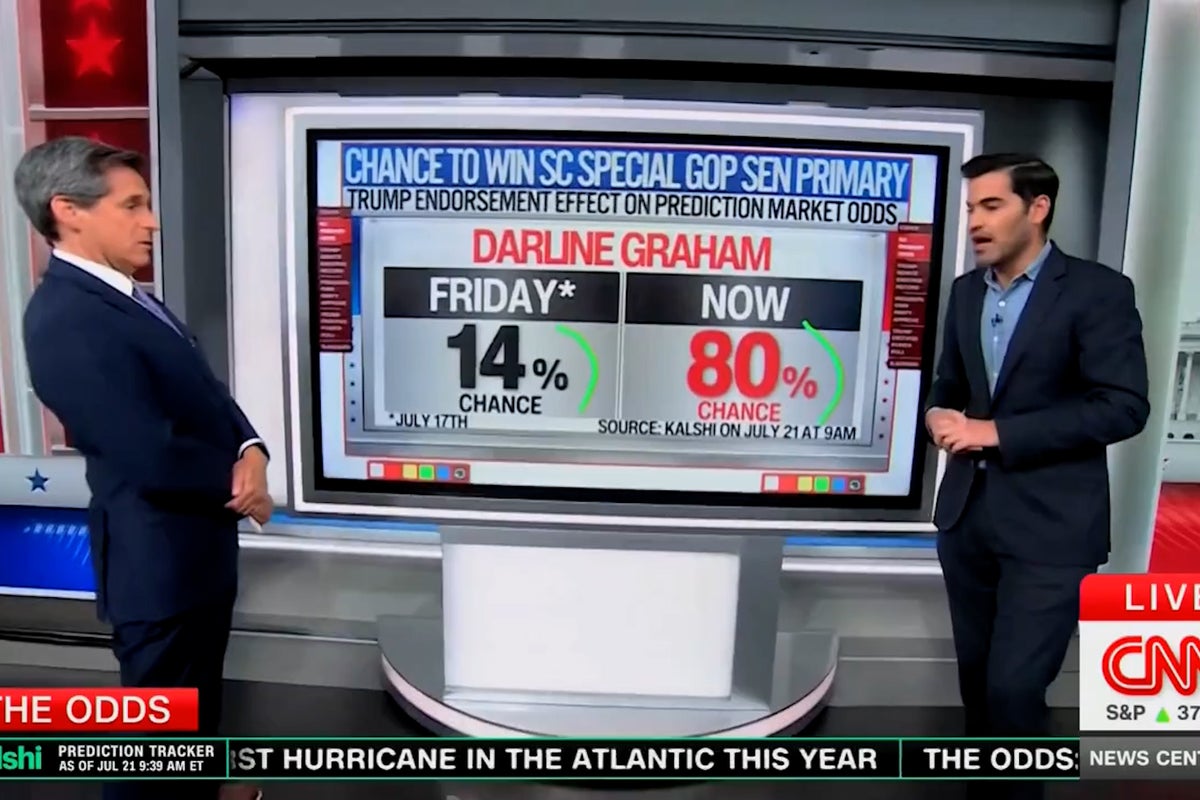
Political figures routinely deploy rhetorical framing to undermine critical journalism, yet selectively amplify quantitative validation from those same institutional media outlets when data aligns with strategic goals. This mechanism operates as a high-yield information arbitrage: delegitimizing the container while weaponizing the content. When Donald Trump selective-shares polling metrics or analytical breakdowns from CNN—an entity frequently labeled by his apparatus as unreliable—the underlying strategy is not contradictory. It is a precise exploitation of cognitive bias and institutional authority.
Understanding this dynamic requires dissecting the mechanics of media validation, the mathematical utility of legacy trust signals, and the strategic calculus of selectively adopting mainstream metrics.
The Tri-Factor Mechanism of Media Validation Arbitrage
Political actors do not consume or broadcast information at random. Communication channels serve specific functional roles in a campaign’s strategic portfolio. The selective adoption of adversarial data relies on three distinct structural variables.
- Asymmetric Institutional Authority: Mainstream legacy networks maintain baseline credibility among swing voters and undecided demographics that hyper-partisan outlets cannot replicate. A metric originating from an adversarial network carries a higher perceived objectivity premium than the exact same metric published by a aligned outlet.
- The In-Group Validation Incentive: Core supporters experience cognitive reinforcement when an opposing entity is forced to admit a favorable outcome. The narrative shifts from "our preferred candidate is winning" to "even our opponents admit our preferred candidate is winning."
- Decoupled Trust Vectors: Audiences routinely separate the legitimacy of the speaker from the validity of the data point. An audience can hold a generalized distrust toward an institution while simultaneously treating its localized quantitative outputs as empirical reality when convenient.
+-----------------------------------------------------------------------+
|                 Mainstream Institutional Media Source                 |
+-----------------------------------------------------------------------+
                                    |
            +-----------------------+-----------------------+
            |                                               |
            v                                               v
+-----------------------+                       +-----------------------+
|  Editorial Narrative  |                       |  Quantitative Data    |
|   (Lacks Alignment)   |                       |   (Favorable Outcome) |
+-----------------------+                       +-----------------------+
            |                                               |
            v                                               v
+-----------------------+                       +-----------------------+
| Rejected as "Fake"    |                       | Amplified as "Proof"  |
+-----------------------+                       +-----------------------+
When an analyst at a legacy network demonstrates a candidate’s polling strength or electoral resilience, the candidate’s team isolates the quantitative signal from the broader editorial context. The source’s perceived hostility becomes the precise mechanism that increases the signal's value.
Quantitative Dissection of Adversarial Validation
To evaluate why political entities utilize adversarial data, consider the mathematical relationship between source bias, voter persuasion, and narrative conversion.
Let the perceived authority of a media outlet be $A$, where $A \in [0, 1]$. Let $B$ represent the perceived bias of the network relative to the candidate, where $B = -1$ indicates extreme opposition and $B = 1$ indicates total alignment.
The persuasive weight $W$ of a data point presented to a neutral audience can be modeled as:
$$W = A \cdot (1 - B)$$
When a favorable data point originates from a highly aligned source ($B \approx 1$), $W$ approaches zero for neutral voters because the claim is discounted as partisan echo-chamber reinforcement. Conversely, when the data originates from an opposing outlet ($B \approx -1$), $1 - B$ approaches $2$, multiplying the perceived impact of $A$.
The candidate leverages this mathematical differential. By labeling the institution as hostile ($B < 0$), any concession by that institution carries maximum rhetorical weight $W$.
Operational Playbook for Rhetorical Decoupling
The strategic isolation of favorable metrics from unfavorable sources follows an operational sequence that relies on structural narrative framing rather than traditional debate.
Step 1: Baseline Discreditation
Establish a permanent narrative that the media entity is fundamentally biased, unreliable, or adversarial. This lowers the default expectation of fairness and sets the value of $B$ deep in negative territory.
Step 2: Metric Extraction
Isolate specific quantitative data—such as voter enthusiasm metrics, demographic shifts, or favorable polling trends—from the network's broader contextual commentary. The metric must be self-contained and visually clean (e.g., on-screen graphic packages, specialized polling segments).
Step 3: Contextual Inversion
Reframe the extracted metric not as routine reporting, but as an inadvertent confession. The rhetorical message changes: The data is so overwhelmingly favorable that even our fiercest critics are forced to concede it.
Step 4: Selective Broadcast
Distribute the clip or graphic across direct-to-consumer channels (social media feeds, rally visual loops, fundraising blasts). Ensure the original branding of the host network remains visible to preserve the authority vector.
Structural Vulnerabilities and Strategic Risk Metrics
This information strategy contains systemic vulnerabilities that introduce operational risk over extended campaign cycles.
- Validation Spillover: Consistently directing supporters toward an adversarial outlet to view favorable data risks accidentally re-legitimizing the source for non-favorable reporting.
- Data Reversal Vulnerability: Relying on an opponent's quantitative analyst creates an implicit dependency. When that same analyst later presents unfavorable trends using identical methodologies, the political entity loses the structural high ground to reject those specific findings.
- Message Dilution among Moderates: Discerning swing demographics may view the rapid transition between calling an outlet "fake news" and "accurate reporting" as opportunistic, reducing long-term message consistency.
Execution Framework
Political strategists seeking to maximize narrative impact without compromising structural consistency must execute data amplification through a disciplined protocol.
First, strictly separate the critique of editorial commentary from empirical data methodologies. Instead of labeling entire media enterprises as fraudulent, direct systemic critiques specifically at editorial frameworks while acknowledging standard statistical methodologies.
Second, establish an independent baseline for all amplified third-party data. Never rely on an adversarial network's metric as a primary source; utilize it exclusively as secondary validation for trends already established by internal or independent polling.
Finally, treat adversarial validation as a short-term persuasion tactical tool rather than a long-term strategy. The primary objective must remain building direct-to-voter communication infrastructure that bypasses legacy media filtering entirely, removing the dependency on external validation vectors altogether.


/IndonesianWoman-5ab91881ba61770037463fbd.jpg)