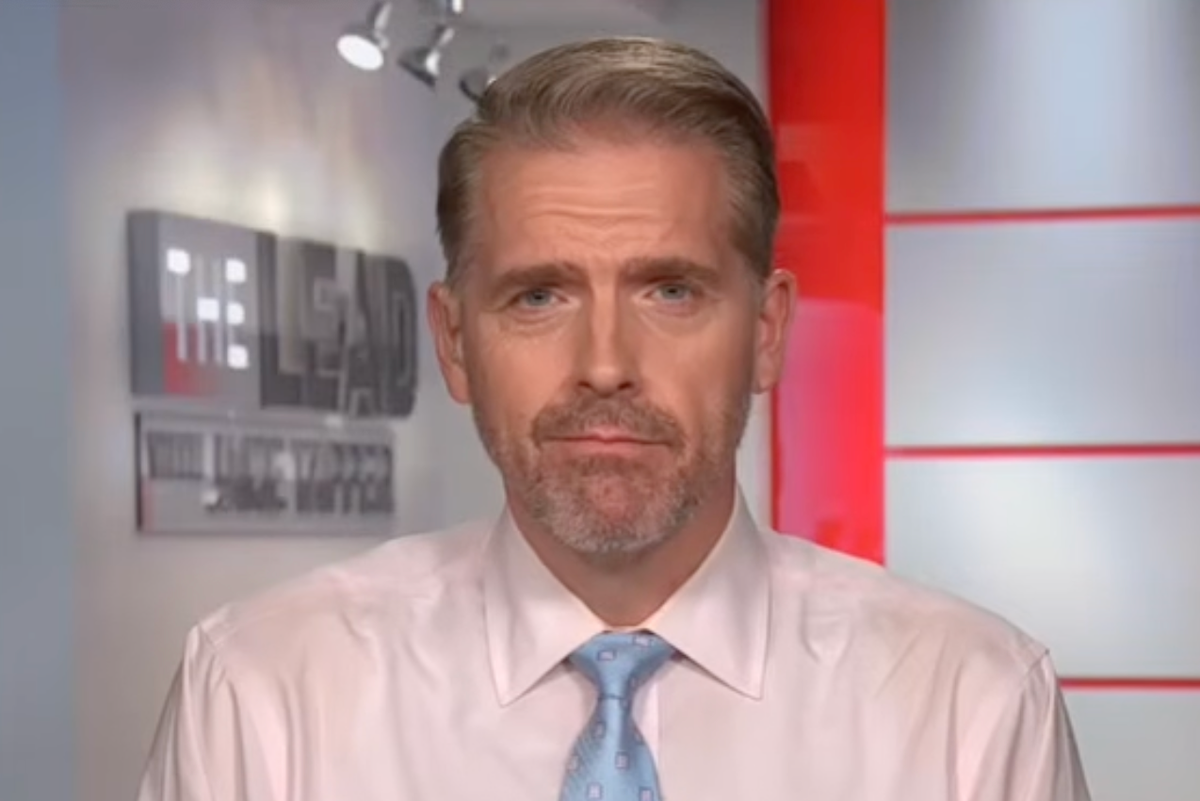
The television studio is an unforgiving machine. Under the relentless glare of the LED panels, every wrinkle tells a story, every micro-expression is dissected by millions, and a single second of silence can feel like an eternity. For a political commentator sitting in that chair, the job is usually to attack, defend, or pivot. But sometimes, the screen reflects something much older and deeper than partisan talking points. It reflects the terrifying fragility of human power.
Scott Jennings sat under those hot lights, carrying the invisible weight of a long, fiercely guarded history. For years, he had been known to the political world as a sharp, fiercely loyal strategist tightly bound to the orbit of Mitch McConnell. To understand Jennings is to understand the tribal loyalty of Kentucky politics, a world where alliances are forged in the mud of brutal campaigns and sealed with absolute discretion.
Then came the public freezing spells.
The images flashed across global news feeds, raw and unvarnished. The Senate Majority Leader, a man who had mastered the levers of American government with a chess player’s cold precision, suddenly standing immobile at a press podium. The microphone caught the heavy silence. His eyes, usually sharp and calculating behind his glasses, seemed fixed on some distant, invisible horizon. In those agonizing seconds, politics stopped mattering. The world was watching the visceral, undeniable reality of human aging play out on the grandest stage possible.
The commentary that followed was swift and brutal. Digital arenas erupted with demands for resignation, armchair medical diagnoses, and cold calculations about senate successions. It was a meat grinder of public opinion. For those who viewed the senator merely as an institutional obstacle or an ideological champion, it was a moment to score points. But for the small inner circle who had spent decades in his shadow, it was a deeply personal crisis.
Imagine the quiet panic of a green room during those weeks. Every text message carried a jolt of adrenaline. Every phone call from an unknown number felt like a potential ending. The political machinery of Washington relies on the illusion of permanence. We want our leaders to be statues, carved from marble, immune to the decay that claims the rest of us. When the marble cracks, the panic is infectious.
Then, a flicker of light emerged from the digital fog.
A post appeared online. It was a simple image, a brief update, a casual slice of political normalcy showing the senator active, alert, and engaged. In the modern lexicon of social media, the internet instantly labeled it a proof of life post. The phrase itself carries a grim irony, borrowed from the dark world of international hostage negotiations, now repurposed to describe an aging statesman going about his day.
For Jennings, watching from his analyst's perch, the moment demanded more than a standard analytical breakdown. It was a profound release of tension. Taking to his platform, he celebrated the update with an openness that cut through the usual manufactured veneer of cable news. It was the public sigh of relief from a man who had spent months defending a mentor against the wolves of the political press.
This reaction was not merely about maintaining a legislative majority or projecting party strength. It was about the deep, often invisible bonds that form between political staff and the leaders they serve. In the capital, these relationships frequently mimic those of a family. Operatives start as young idealists or ambitious fighters, adopted into the political house of a powerful figure. They learn how their boss thinks, how they take their coffee, and how they handle defeat. Over decades, that professional tie hardens into genuine devotion. Watching that leader age is not just a professional hazard; it is a preview of mortality that hits terrifyingly close to home.
The celebration of that single post reveals the strange, hyper-mediated reality of modern governance. Power is no longer just wielded in closed-door committee rooms or through the quiet whispers of cloakrooms. It must be performed. It must be broadcast. A leader must prove they can command the screen, or the system will begin to bypass them. The proof of life post has become a vital instrument of statecraft, a digital pulse check designed to steady jittery markets, quiet rebellious backbenchers, and reassure an anxious public.
The wider world often views Washington as a place of pure cynicism, inhabited by careerists who discard alliances the moment they lose utility. That view misses the genuine human drama occurring behind the scenes. The fierce defense mounted by loyalists during a leader’s twilight hours is driven by a complex mix of gratitude, protective instinct, and a stubborn refusal to let a lifetime of achievement be eclipsed by a few moments of physical vulnerability. They become the guardians of the legacy, standing between the fading giant and an impatient world.
Consider the sheer exhaustion of that vigil. It means constantly answering for another person’s health while managing one's own anxieties. It means walking into a television studio knowing that the first question won't be about policy or legislation, but about whether a friend is capable of finishing a sentence.
The digital update provided a brief sanctuary from that storm. It offered a moment to breathe, a chance to point to the screen and tell the critics to wait. For a brief window, the narrative belonged back to the living, not the foreboding future.
The cameras in the studio eventually turned to other stories, other crises, other breaking news alerts. The news cycle demands fresh material, always hungry for the next conflict. But the underlying reality remains unchanged. The halls of Congress continue to echo with the footsteps of those who have spent their entire lives chasing and holding power, even as time quietly works against them.
Jennings's public celebration was a reminder that behind the press releases and the polling data, politics is still driven by human hearts. It is a world of loyalty, fear, affection, and the quiet, desperate hope that the people who built our world can stay in it just a little bit longer.
In the quiet hours after the broadcast, when the studio lights finally dim and the monitors go black, the digital pulse keeps beating on the screen. A single image of an elderly man smiling at a camera, proving to a skeptical world that he is still here, holding the line. For the loyalists watching in the dark, that is more than enough.