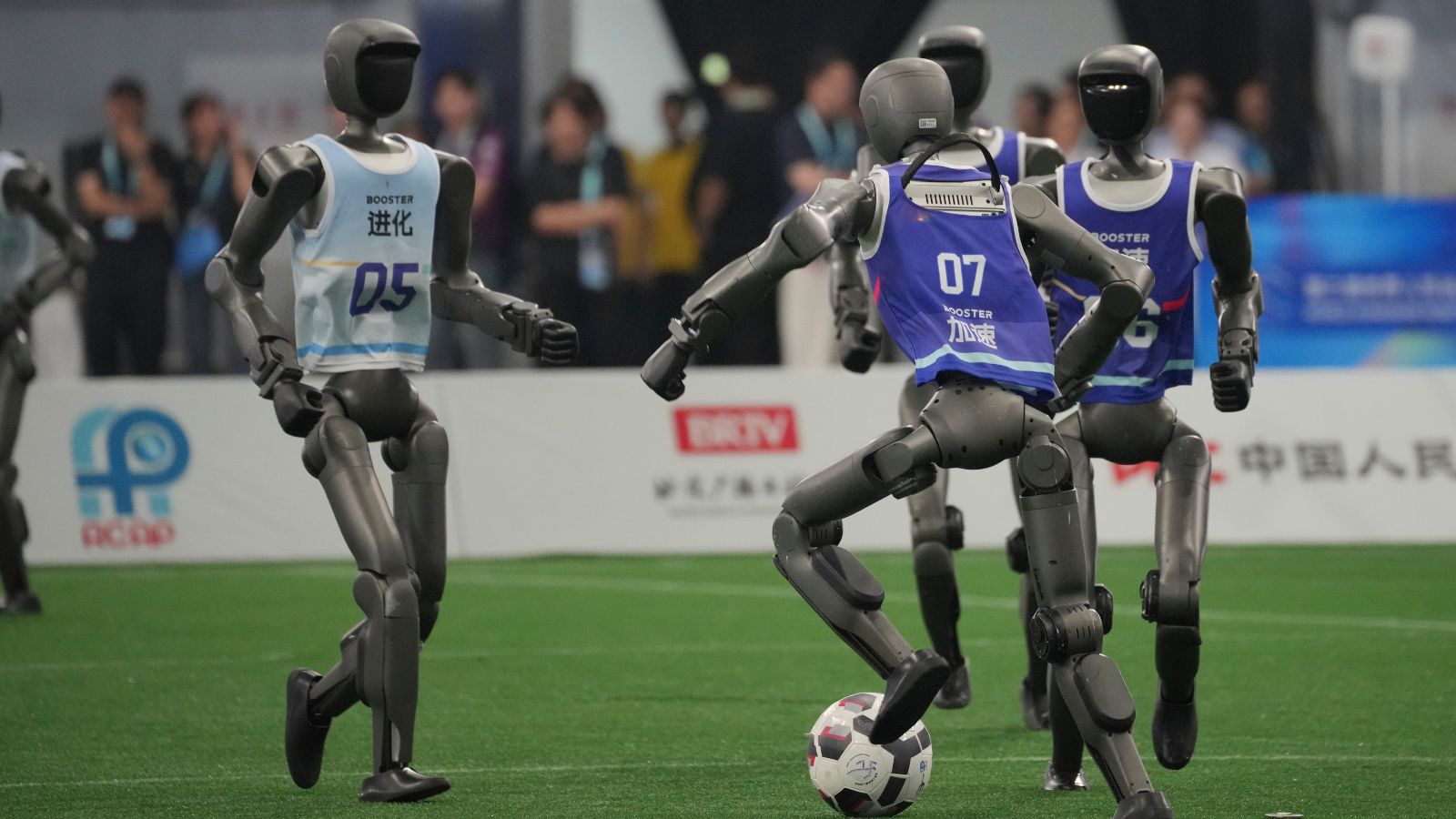
The air inside the Beijing arena smelled of ozone and hot lithium.
I stood near the polyurethane track, listening to the sound that will eventually define our century. It wasn't the roar of a crowd or the crack of a starter's pistol. It was the sharp, frantic clicking of high-torque actuators fighting gravity. Metal muscles twitching at frequencies no human fiber could ever hope to match.
A few feet away from me, a bipedal machine crouched at the starting blocks.
We have spent millennia believing that grace belonged exclusively to flesh. We wrote poetry about the runner's high, the burning lungs, the agonizing beauty of a hamstring stretched to its absolute limit on a hundred-meter dash. We treated biology as an impenetrable fortress of design. Evolution took millions of years to craft a runner who could cross that distance in under ten seconds.
Engineering just took an afternoon to catch up.
When the sensor beeped, the machine did not hesitate. It did not take a microsecond to process adrenaline or regret. It simply translated raw electrical current into kinetic violence.
The crowd gasped.
At the World Humanoid Robot Games in Beijing, history fractured. Chinese humanoid robots did not merely compete against their mechanical peers; they smashed established human records in the 100-meter sprint and the high jump. Let that sink in. A creation of aluminum, carbon fiber, and proprietary neural networks tore down a barrier that generations of biological athletes bled to conquer.
Consider what happens next.
We look at a machine running a ten-second split and we laugh it off as a party trick. A clever display of engineering vanity. An expensive toy funded by venture capital and state-backed laboratories. We tell ourselves that because it lacks sweat, it lacks soul. We comfort our fragile human egos with the thought that speed without suffering means nothing.
We are wrong.
I remember the first time I saw an industrial robot arm move on an assembly line. It was terrifyingly precise, but it was bolted to the floor. It was a prisoner of its own utility. It had no place in our world of uneven sidewalks, scattered curbs, and steep staircases. It stayed in its cage.
Those cages are gone now.
The machines competing on that Beijing track are not bolted down. They have eyes made of cameras and LiDAR. They have inner ears built from inertial measurement units. They fall down, and—crucially—they get back up. That is the detail that keeps me awake at night. The falling is easy. The recovery is where the paradigm shifts.
Let us talk about the high jump.
Picture a metal skeleton launching itself upward, folding its limbs in mid-air with geometric perfection, clearing a bar that would earn a medal at any regional collegiate track meet. There is no desperate arch of the back, no prayer whispered to a lucky shoe. There is only math executed at high velocity.
Why does this matter?
Because the body is just hardware.
For decades, computer scientists wrestled with the locomotion problem. Giving a computer a brain was easy compared to giving it legs. Balance is an ongoing crisis. Every step you take is a controlled fall, a chaotic ballet of micro-corrections executed by your cerebellum without your conscious permission. To replicate that in silicon required a revolution in reinforcement learning. Engineers stopped trying to program every step. Instead, they let the machines fall millions of times in simulation until they learned how not to.
They taught metal how to feel balance through trial and error.
If a robot can sprint a hundred meters and clear a high jump bar, it can also carry a fifty-pound pack across rubble after an earthquake. It can crawl through a burning chemical plant where human skin would char in seconds. It can tend to an aging population in a world where birth rates are plummeting and there are simply not enough human hands to hold the ones that are shaking.
We romanticize our limitations. We look at our vulnerability and call it humanity.
Yet, standing there in the Beijing arena, watching a battery-powered runner cross the finish line without a drop of sweat on its chassis, I did not feel threatened. I felt obsolete in the way a horse must have felt the first time it heard the chugging exhaust of a steam engine. A profound, sinking realization that the world was about to pivot on its axis.
The applause that followed the race was muted. It was not the thunderous ovation of an Olympic final. It was a nervous, scattered clapping of journalists, engineers, and officials who understood the subtext.
We are building our successors. And they are fast.
The track was empty now. The smell of hot lithium was fading into the stale air of the convention center. I walked over to the starting line and looked down at the polyurethane surface. There were no spikes driven into the rubber. No blood, no tears, no history etched into the lane. Just a faint dusting of gray graphite powder, swept away by the wind.