Most traditional economics treats humans like spreadsheets with legs. You want more stuff for less money, you weigh incentives on a clean scale, and you act purely out of cold self-interest. Honestly, that model misses half the room.
George Akerlof spent decades proving that real economic choices run on skewed information, unwritten social rules, and who we think we are. When you put those pieces together, a lot of "irrational" behavior starts making complete sense. Why do people turn down higher pay? Why do good products vanish from a market? Why do workers risk their necks for flat salaries? Akerlof's work gives us a sharper lens on human motivation than simple cash incentives ever could. For a deeper dive into this area, we recommend: this related article.
How skewed information breaks good markets
Start with a classic used car sale. The current owner knows every rattle, oil leak, and transmission hiccup under the hood. You, the buyer, only see a shiny paint job and hear a sales pitch. For further context on this topic, extensive analysis can also be found at Financial Times.
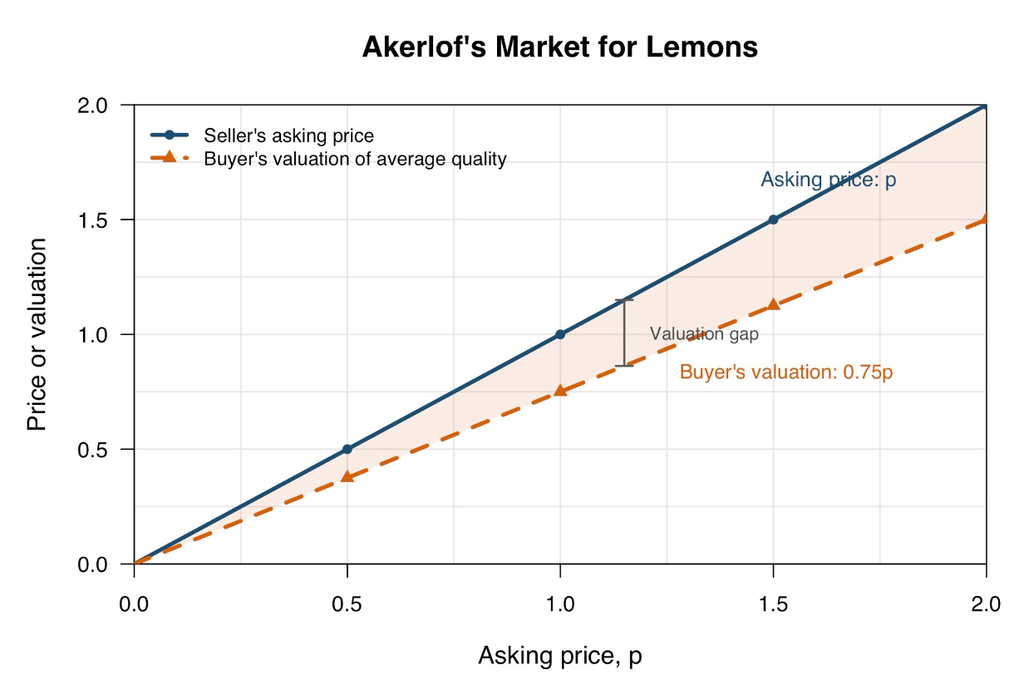
In his landmark 1970 paper on "lemons," George Akerlof showed how uneven knowledge can wreck a market from the inside out. If buyers can't tell a reliable car from a clunker, they won't pay top dollar for an unknown vehicle. Instead, they offer a price based on average quality. Once prices sit near that average, owners of genuinely great cars pull out because the offer feels insulting. That leaves an even higher share of bad cars behind, driving average quality—and trust—down further.
Watch how fast that logic spreads beyond used cars:
- Health insurance: If insurers can't price risk accurately, healthy people feel overcharged and drop coverage, leaving a riskier pool and higher premiums.
- Hiring: When employers struggle to verify real skill before day one, average offers fall, pushing top talent to look elsewhere or demand stronger signals like credentials and referrals.
- Used gear and digital marketplaces: Without warranties, return windows, or verified reviews, buyers hesitate and sellers hold back quality goods.
Notice the catch here. Asymmetric information isn't just about dishonest sellers. Sometimes both sides want a fair deal, yet missing facts create distrust that stops good trades from happening. Warranties, inspection reports, and clear disclosures exist precisely to close that gap.
Social norms set the invisible guardrails
Information tells you what you know. Norms tell you what you're supposed to do.
Standard models often treat preferences as fixed personal tastes, like preferring apples over oranges. Akerlof pushed back on that view by showing that context and social rules shape what feels normal, fair, or acceptable in a given moment. A norm can reward cooperation, enforce loyalty, or punish someone who breaks ranks.
Think about workplace pay. Research by economist Truman Bewley on manager interviews during downturns—cited in Akerlof and Rachel Kranton's work—highlights how reluctant bosses are to cut nominal wages even when times get rough. Cutting pay feels like breaking an implicit fairness norm, which hurts morale and weakens attachment to the firm. A spreadsheet says trim the cost. Real-world managers know slashing base pay can trigger resentment that costs more than the savings.
Of course, norms aren't magic cure-alls. A norm that helps one group can lock another group out. And when everyone follows an outdated rule just to avoid social friction, organizations can get stuck doing things that no longer work.
Identity economics changes the motivation equation
Here's where things get personal. In their influential 2005 paper on organizations and identity, George Akerlof and Rachel Kranton brought a person's sense of self straight into economic decision-making.
Instead of assuming workers only respond to paychecks and strict monitoring, they modeled how people sort into social categories—like "insider" versus "outsider"—and carry ideas about how someone in that role should act. When your actions match who you believe you are, you gain satisfaction. When your job forces you to act against your self-image or team identity, it feels uncomfortable and costly.
Look at the military example Akerlof and Kranton highlight. Armed forces often run on relatively flat pay scales compared with private-sector roles, yet members still take huge risks and put in grueling effort. Money isn't the whole story. Shared identity, training, camaraderie, and duty carry massive motivational weight.
People don't just ask, "What does this pay?" They also ask, "Is this who I am?"
Why heavy monitoring can backfire
Akerlof and Kranton point out a sharp tradeoff for leaders. Tight surveillance and rigid reporting give managers more data to calculate rewards, yet heavy control can signal distrust and weaken a worker's sense of belonging as an insider. Loose supervision with strong cultural alignment can sometimes get solid effort at lower friction, though it requires real trust and shared purpose.
That doesn't mean pay doesn't matter. Identity and money aren't simple substitutes in every situation; sometimes strong identification lowers the mental cost of effort and raises expectations across a team. Still, trying to bribe away a broken culture or a clash of identity rarely works for long.
Where standard economics still holds up
To be fair to traditional economics, price signals and incentives still do heavy lifting. If a gas station charges double the neighborhood price with no extra service, most drivers still drive past. If a bonus structure rewards short-term sales volume, salespeople will chase volume.
Akerlof's contribution isn't throwing out incentives. It's showing when incentives collide with hidden information, group norms, or self-image. Ignore those forces, and your neat incentive plan can produce ugly surprises.
Putting Akerlof's insights to work
Whether you run a team, build a product, or negotiate a deal, you can apply these ideas right away without turning into an academic theorist.
- Reduce information gaps early: Spell out expectations, scope, pricing, and quality standards up front so people don't price in worst-case guesses.
- Audit your unwritten norms: Watch what behavior actually gets praised or shamed on your team, not just what's written in the handbook.
- Design for identity, not just bribes: Connect roles to meaningful standards and shared purpose, and avoid micromanagement that treats trusted people like suspects.
- Watch for culture clashes in big shifts: Mergers, reorgs, and sudden policy overhauls often stall because people's sense of role and belonging gets rattled.
Start with one recurring bottleneck in your work or business this week and ask a simple question: are people holding back because they lack information, fear breaking a norm, or feel the role doesn't fit who they are?