The hum is the first thing that breaks you.
It is not loud, not exactly. It does not crash like thunder or screech like brakes. Instead, it vibrates somewhere deep inside your jawbone. A relentless, low-frequency drone that sounds like a jet engine idling three blocks away, permanently. Discover more on a connected issue: this related article.
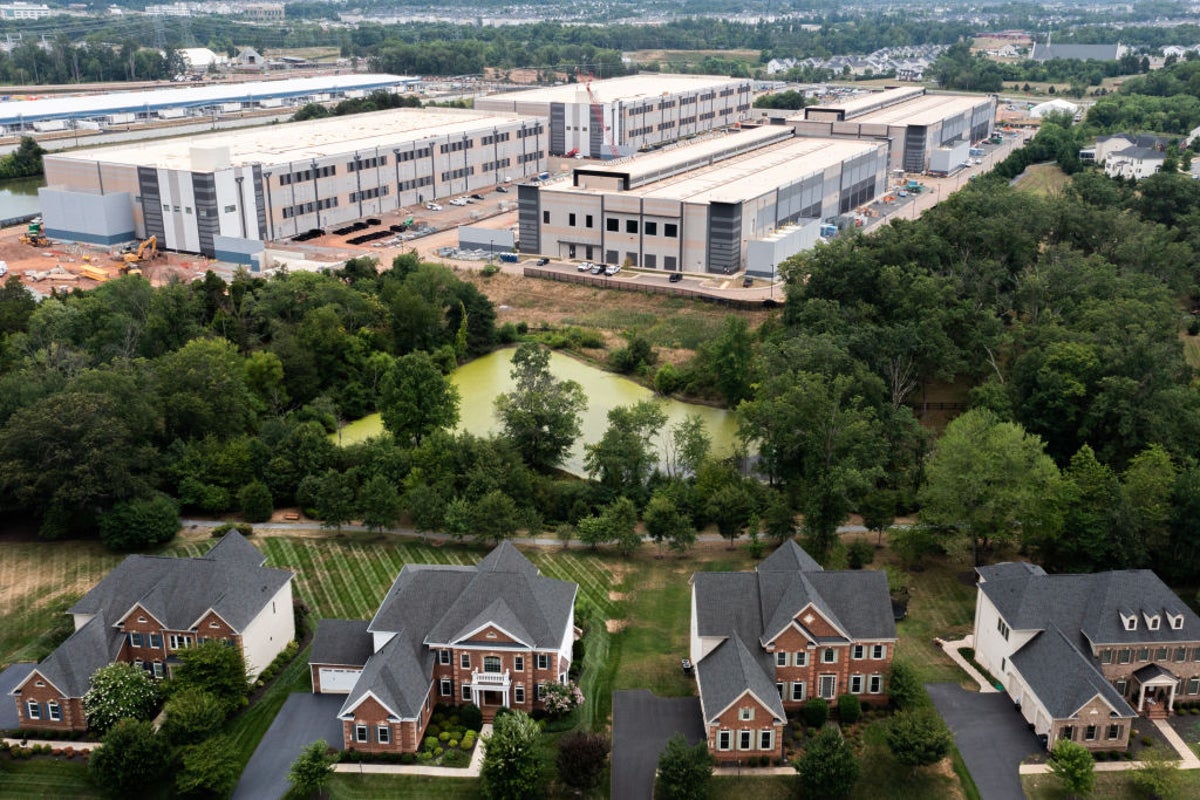
Imagine living in a quiet suburban cul-de-sac in Northern Virginia, where the loudest sound used to be the weekend lawnmowers. Now, walk out onto the porch at three o'clock in the morning. The air feels heavy. The drone fills the night. This is the reality for thousands of homeowners across America who have suddenly found themselves living on the frontline of the global artificial intelligence boom.
We talk about the cloud as if it is something ethereal. We treat our digital lives—the endless photo streams, the instant AI queries, the streaming video—as if they exist in a weightless, frictionless dimension. They do not. Every single byte of data requires physical space, massive amounts of electricity, and millions of gallons of water. The cloud is not a cloud at all. It is a three-story, windowless concrete fortress stretching the length of three football fields, packed with humming server racks that are quietly destabilizing American communities. Additional reporting by Engadget explores similar views on the subject.
The Digital Land Grab
The scale of this expansion is unprecedented. To understand how we got here, we have to look at the sheer velocity of the technology market. The sudden explosion of generative AI has created an insatiable corporate appetite for computing power. Because AI models require exponentially more energy to train and run than traditional internet searches, tech giants are locked in a desperate race to build infrastructure.
They are building them everywhere. Northern Virginia, already the data center capital of the world, handles an estimated 70 percent of global internet traffic. But the boom is spilling over. Massive complexes are tearing through rural farmlands and quiet suburbs in Ohio, Iowa, Arizona, Oregon, and Georgia.
For the people who live in these areas, the arrival of a tech giant is rarely heralded by a polite knock on the door. It usually starts with an mysterious LLC buying up hundreds of acres of agricultural land. Then come the zoning variance meetings, often held quietly during holiday weeks. By the time the community realizes what is happening, the bulldozers are already turning the soil.
Consider a hypothetical family—let us call them the Millers—living in a semi-rural pocket of Georgia. They bought their home for the peace, the sprawling tree line, and the dark night skies. Two years later, the forest across the road is leveled. In its place rises a grey concrete monolithic structure. It is surrounded by high chain-link fences, security cameras, and an electrical substation that looks like an industrial spiderweb.
The Millers were promised jobs and tax revenue. That is always the sales pitch. Local politicians proudly announce billions of dollars in corporate investment. What they omit is that these facilities are highly automated. Once the construction crews pack up, a data center employing a square mile of land might only require thirty or forty full-time security guards and technicians. The economic windfall looks less like a thriving community hub and more like a tax shelter for a trillion-dollar company.
Wringing the Grid Dry
The real crisis, however, is not visual pollution. It is structural. These facilities are putting an unimaginable strain on the basic infrastructure that keeps American towns alive.
First, look at the power grid. A single large data center campus can consume as much electricity as hundreds of thousands of homes. In some parts of the country, the sheer volume of energy requested by tech companies is outstripping the capacity of utility providers to generate it.
To keep up with this frantic demand, utility companies are forced to make decisions that affect every single resident. In several states, power companies are delaying the retirement of old, polluting coal-fired power plants just to keep the data centers online. The green energy transition that many tech companies publicly champion on their corporate websites is being actively undermined by their own hunger for power.
But the burden does not just fall on the environment. It lands squarely on the consumer's mailbox. When a utility company has to build billions of dollars in new transmission lines, substations, and generation facilities to accommodate a tech giant, those infrastructure costs are frequently shared across the entire ratepayer base.
Your electricity bill goes up so a server farm down the road can process millions of automated emails and deepfake videos.
Thirst in an Age of Drought
Then there is the water.
Servers generate an incredible amount of heat. If they get too hot, the digital infrastructure melts down. To prevent this, many data centers rely on evaporative cooling systems. It is an incredibly efficient way to keep computers cold, but it requires a staggering amount of liquid.
A typical data center can use between one million and five million gallons of water every single day. That is equivalent to the daily water consumption of a small city.
Now place that consumption pattern in the American West. In places like Arizona and Utah, where communities are already facing historic droughts and strict water rationing, tech corporations are pumping millions of gallons of pristine groundwater out of aquifers to cool their machinery.
Let us look at the mechanics of this process to understand why it is so devastating. Water is drawn into the facility, used to absorb the heat from the server racks, and then evaporated into the atmosphere through massive cooling towers. The water that is left behind becomes highly concentrated with minerals and treatment chemicals, meaning it cannot simply be dumped back into the local ecosystem without extensive, expensive treatment.
It is a one-way extraction of a public resource for private profit. When a nearby farmer watches their well run dry, or when a municipality bans residents from watering their lawns during a heatwave, it is not just because of climate change. It is because the concrete monster down the highway is thirsty.
The Acoustic Nightmare
Beyond the water and the power lies a more intimate, psychological toll: the noise.
Traditional industrial factories are usually relegated to designated zones, far away from bedrooms and schools. But because data centers require specific proximity to fiber-optic trunk lines, they are frequently zoned right up against residential property lines.
The sound they produce is unlike anything else. It is a combination of thousands of industrial exhaust fans and the constant hum of electrical transformers. It never stops. It does not sleep. It is louder in the winter when the air is crisp, and it becomes unbearable in the summer when the cooling systems are running at maximum capacity.
Acoustic engineers note that low-frequency noise is uniquely disruptive to human health. It penetrates standard residential walls, double-pane windows, and insulation. It vibrates through the human body, disrupting REM sleep, increasing cortisol levels, and triggering chronic stress.
Parents in impacted neighborhoods report children who can no longer sleep through the night. Residents talk about a permanent feeling of agitation, a subtle, vibrating anxiety that disappears only when they drive miles away from their own homes. The value of their properties plummets because no one wants to buy a house where the backyard sounds like a perpetual factory floor.
Redefining the Virtual
We are living through a profound disconnect. We demand an instantaneous digital world where everything is stored forever and answers are generated in seconds, but we refuse to see the physical wreckage left in the wake of that demand.
The tech industry has spent decades convincing us that the virtual world has no footprint. They used terms like "stream" and "cloud" to make their infrastructure invisible. But you cannot hide a building that consumes enough steel to build a warship and enough power to run a city.
The solution is not to abandon the internet or to pretend we can turn back the clock on technological progress. We rely on these systems. But the current trajectory is entirely unsustainable.
Changes must happen at the regulatory level. Municipalities must stop handing out massive tax breaks to companies that drain local resources while offering virtually no long-term employment. Zoning laws must be rewritten to treat these facilities like the heavy industrial factories they actually are, requiring miles of buffer zones between the cooling fans and human ears. More importantly, tech companies must be forced to invest in closed-loop cooling systems that do not consume fresh water, and they must build their own dedicated renewable energy sources instead of cannibalizing the public grid.
Until those guardrails are put in place, the expansion will continue unabated. More forests will be cleared. More rural roads will be paved over. More communities will wake up to find that their peace, their water security, and their financial stability have been sacrificed to feed the insatiable hunger of a machine they cannot see, processing data they do not need.
The next time you type a prompt into an AI interface or upload a batch of videos to storage, listen closely to the silence of your room. Somewhere across the country, a massive fan just kicked into high gear, a gallon of water vanished into the sky, and a family sat awake in the dark, listening to the hum.