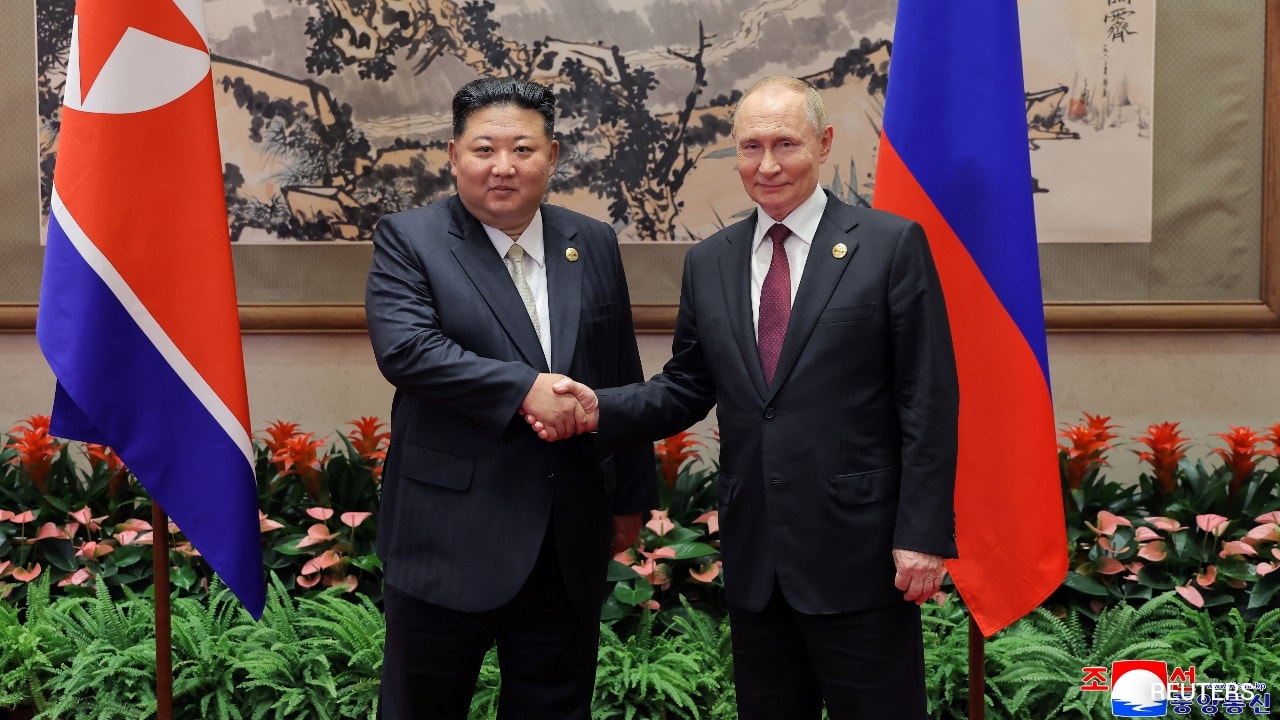
The recent exchange of correspondence between Kim Jong Un and Vladimir Putin serves as a public signal of a hardening military and economic architecture between two isolated actors. While media narratives focus on the emotional tone of the letters, the underlying mechanics represent a deliberate shift toward a transactional security arrangement. This alignment functions as a mutually beneficial exchange designed to mitigate specific resource constraints for both the Democratic People’s Republic of Korea (DPRK) and the Russian Federation.
The Mechanism of Resource Reciprocity
The partnership is built on the convergence of two distinct deficit models. Russia maintains an urgent requirement for high-volume munitions and manpower to sustain intensive ground operations in the Ukraine theater. Conversely, the DPRK faces structural challenges regarding access to foreign capital, advanced aerospace technology, and food security. Learn more on a related issue: this related article.
The transaction operates through three primary channels:
- Ordnance Supply: North Korean industrial facilities, long oriented toward a "long war" posture, provide a ready supply of artillery shells and ballistic missiles. This stabilizes Russia’s logistics chain, which would otherwise face critical shortages during prolonged attrition.
- Human Capital Deployment: The reported influx of North Korean personnel—engineers and combat units—to Russian-controlled territories functions as a labor and force multiplier. By integrating these resources, Moscow extends its operational capacity without immediate mobilization of its own domestic reserve force.
- Technology and Economic Transfers: In exchange, the DPRK secures direct transfers of military technology, likely focusing on satellite launch systems, missile guidance, and potentially submarine technology. These inputs allow Pyongyang to bypass internal research-and-development bottlenecks, rapidly advancing its strategic deterrence capabilities.
Defensive Posturing and Territorial Integrity
The ideological language regarding "territorial integrity" and "common struggle" acts as a rhetorical shield. Within realist political theory, this creates a framework of "defensive alignment." Both parties utilize the threat of Western intervention to justify internal austerity and external aggression. By characterizing their cooperation as a historic continuation of anti-imperialist resistance, they solidify domestic legitimacy while signaling to global adversaries that their bilateral ties possess a "deep integration" status. This moves beyond simple arms sales into a territory of functional alliance, where the survival of one regime is now tethered to the stability of the other. Further reporting by NBC News delves into related views on this issue.
The Strategic Constraints of the Alignment
Despite the public display of unity, the long-term sustainability of this partnership faces inherent volatility.
- Supply Chain Dependencies: The DPRK’s ability to maintain high-tempo production of complex weaponry is untested at this scale. Any degradation in their domestic production capacity would diminish their value as a security partner, creating a precarious leverage imbalance.
- Technological Escalation: The transfer of sensitive Russian military technology to Pyongyang introduces regional instability in East Asia. This forces South Korea, Japan, and the United States into a forced-response loop, increasing the probability of a regional arms race that neither Moscow nor Pyongyang may be able to manage effectively.
- The Cost of Sanction Evasion: Both nations incur significant diplomatic and economic costs by formalizing these ties. The "comprehensive strategic partnership" limits their potential for future diplomatic re-entry into the global financial system, effectively burning bridges to the West for the foreseeable term.
Analytical Assessment of Future Trajectories
The current exchange of letters provides more than mere diplomatic signaling; it marks the transition from transactional trade to a structural defense pact. As the war in Ukraine persists, the integration of North Korean logistics into the Russian front will likely accelerate. Observers should monitor the frequency of high-level ministerial meetings and the establishment of dedicated procurement offices in Russia as leading indicators of further deepening.
The strategic play for stakeholders in this environment involves anticipating a sustained period of low-intensity regional conflict in Europe and high-intensity rhetorical posturing in East Asia. Analysts must move away from viewing these interactions as isolated diplomatic events. Instead, they should track the specific volume of outbound shipping from Wonsan to Russian ports and the reported deployment figures of North Korean personnel. These data points—rather than the content of official communiques—will dictate the actual operational reality of this alignment. The goal is not to interpret the rhetoric, but to calculate the logistics.


