Salt rots everything eventually. It eats iron cannonballs until they flake like pastry, dissolves oak hulls into sponge, and turns silk from the hold of a Mughal treasure ship into black silt.
If you stand on the edge of the Bay of Ambodifotatra on Île Sainte-Marie—a slender sliver of volcanic rock and red clay off the northeastern coast of Madagascar—you will not see wooden masts piercing the horizon. You will not see chests spilling doubloons onto white sand. You will see zebu cattle wading in the shallows, pirogues carved from single tree trunks gliding across water the color of steeped tea, and children kicking a deflated football near the ruins of an old stone quay.
For three centuries, the world agreed that the Golden Age of Piracy was a fairy tale written in rum and gunpowder, largely confined to the Caribbean and the pages of nineteenth-century adventure novels. Historians treated the Indian Ocean pirates as footnotes—violent ghosts who flared up between 1690 and 1720, burned bright, and vanished without leaving an address.
They were wrong.
Down in the anoxic mud of Sainte-Marie, sealed beneath five meters of warm brine and centuries of mangrove runoff, the ghosts left their receipts.
The Lie of the Treasure Chest
I first stood knee-deep in the warm tide of Sainte-Marie years ago, watching an underwater excavation team haul up a lump of concretion that looked like a gray, barnacle-crusted potato. Inside that ugly stone, X-rays had already revealed the unmistakable geometry of seventeenth-century silver coins—pieces of eight minted in Potosí, high in the Bolivian Andes, carried across the Pacific to Manila, traded in Surat, and stolen at cannon-point in the Arabian Sea.
It was thrilling. It was also beside the point.
Hollywood taught us to look for gold. Because we looked for gold, we missed the people. When maritime archaeologists—including the late, relentless underwater explorer Barry Clifford, alongside Malagasy heritage teams and French researchers—began systematically mapping the harbor of Ambodifotatra, they were not hunting for buried loot. They were hunting for a society.
Think about what a shipwreck actually is. A building on land gets remodeled, looted by neighbors, swept clean, and built over for generations. A ship that sinks in a sheltered bay is a time capsule slammed shut in a single afternoon. Everything on board—the officer's porcelain teacup, the carpenter's calipers, the dice carved from bone, the ballast stones from Bristol—freezes at the exact second the water rushes over the gunwales.
In the harbor of Île Sainte-Marie, archaeologists haven't found just one capsule. They have identified the remains of at least a dozen vessels resting in the silt, including ships linked to the most infamous names of the Indian Ocean: William Kidd's Adventure Galley, Robert Culliford's Mocha Frigate, and the Fiery Dragon, captained by Christopher Condent.
Stop and let that register. Not one lucky find. An entire sunken fleet, parked in a bay smaller than Central Park.
Why were they all here? And why did so many of them stay until their ships literally rotted beneath their feet?
A Sanctuary Built on Broken Rules
To understand what happened in Madagascar at the turn of the eighteenth century, you have to forget the cartoonish image of the lone buccaneer with a parrot on his shoulder. Picture instead a twenty-four-year-old sailor from Devon or New York in the year 1695.
Let us call him Thomas. Thomas is not a real name from the Sainte-Marie manifests, though dozens of men just like him signed their marks on them. In the Royal Navy or on a merchantman out of London, Thomas is property. His captain can have him flogged until his ribs show for spilling tar on the deck. His wages are withheld for years to keep him from deserting, his rations are weevil-ridden hardtack and salted beef the texture of mahogany, and his life expectancy on a run to the East Indies is roughly that of a candle in a gale.
Now, picture Thomas rounding the Cape of Good Hope into the Indian Ocean.
At the end of the seventeenth century, the Indian Ocean was the richest maritime highway on Earth. Every autumn, massive ships belonging to the Mughal Empire—vessels like the Ganj-i-Sawai, carrying pilgrims to Mecca alongside millions of pounds in gold, silver, diamonds, and fine textiles—lumbered across the Arabian Sea with heavy cargo and light defenses. Meanwhile, the European superpowers were exhausted by wars at home. Neither Britain, France, nor the Dutch Republic had the naval bandwidth to police the waters east of Africa.
Pirates flooded into the vacuum. They called it the "Pirate Round."
They sailed down the coast of West Africa, rounded the Cape, and made straight for Madagascar. Île Sainte-Marie—known to the pirates simply as St. Mary's—sat forty miles off the mainland, protected by coral reefs, blessed with fresh water, wild citrus, timber for repairing hulls, and a deep, sheltered bay where a ship could be careened—hauled onto its side on the beach to scrape off the shipworms and barnacles that slowed a vessel down.
In 1691, a former New York merchant named Adam Baldridge set up a trading post on the island. He built a fortified warehouse overlooking the harbor, stocked it with gunpowder, rum, sailcloth, and iron tools shipped in by corrupt New York merchants, and waited.
He didn't wait long. Soon, up to fifteen hundred pirates were using Sainte-Marie as their base of operations.
What the Silt Actually Reveals
When divers descend into the murky visibility of Ambodifotatra Bay today—often working with visibility reduced to less than an arm's length, feeling their way through silt with their bare fingertips—they are not pulling up chests of rubies. They are pulling up evidence of how outlaws lived when nobody was watching.
Consider the artifacts recovered from the wreck sites and the shoreline excavations led by teams from the University of Antananarivo and international archaeological missions:
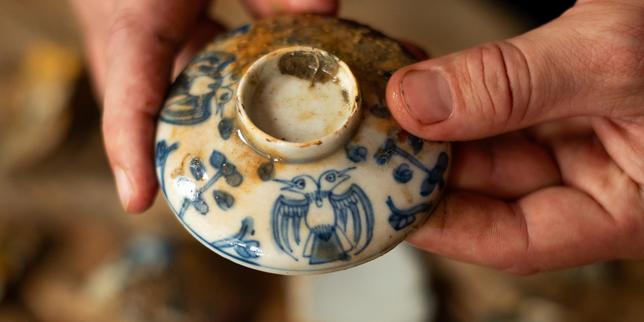
- Chinese Ming and Qing dynasty porcelain, shattered into blue-and-white crescents, sitting right next to coarse English earthenware jugs.
- Cowrie shells from the Maldives, used as currency across West Africa and the Indian Ocean trade networks.
- Lead musket balls flattened on one side—not from hitting a target, but from sailors chewing on them to relieve thirst or boredom during endless weeks becalmed at sea.
- Timber framing of European oak and teak, deliberately stripped of its brass fittings and iron bolts before being scuttled.
That last detail is the clue that changes the whole story.
Many of these ships didn't sink in battle. They weren't blown apart by royal frigates. They were abandoned. Stripped for parts, dragged into the shallows, and left to sink because their crews had decided they were never going home.
Why? Because in Sainte-Marie, Thomas—our hypothetical sailor from Devon—had found something Europe could not offer him at any price.
On board a pirate ship, men voted for their captains. They could depose a leader between battles if he proved cowardly or cruel. They divided plunder according to a written contract—the ship's articles—signed before the voyage began, where a captain received only two shares to an ordinary sailor's one. If a man lost an eye or a leg in combat, the common fund paid him a flat disability pension in silver pieces of eight before anyone else took a coin.
In 1698, a democratic welfare state existed nowhere on Earth. Except on the decks of pirate ships anchored off Madagascar.
The Invisible Stakes of Mud
I will admit something that archaeologists rarely say out loud at press conferences: underwater excavation is mostly unglamorous, agonizingly slow, and haunted by doubt.
You spend months securing permits. You fight funding gaps. You dive into warm, dark water where a single careless kick of a fin turns the seafloor into an impenetrable brown cloud for forty minutes. Every piece of waterlogged wood you bring to the surface immediately begins to warp, crack, and disintegrate the moment it touches oxygen unless it spends years soaking in polyethylene glycol baths.
And there is always the danger of getting the story wrong.
In 2015, a massive fifty-kilogram ingot recovered from the waters off Sainte-Marie made international headlines as the legendary silver treasure of Captain William Kidd. Television crews flew in. The Malagasy president held the block for cameras. Months later, UNESCO experts examined the find and delivered a brutal correction: the "silver" ingot was 95 percent lead, likely used as ballast, and the shipwreck it came from wasn't Kidd's Adventure Galley at all, but part of the island's old port infrastructure.
It was an embarrassing moment for the headline-chasers. Yet for anyone who cares about real history, that lead block was a gift. It stripped away the romantic fog and forced researchers to look at what was actually beneath the waves—not a single celebrity pirate's stash, but an entire working maritime ecosystem.
Because here is the truth most travelers miss when they fly to Sainte-Marie today to watch humpback whales breach in the channel: the pirates didn't just visit this island. They married into it.
Bloodlines in the Red Soil
Walk up the hill behind the harbor of Ambodifotatra, past the Catholic church built in 1857, and you will come to a quiet patch of grass overlooking the water. It is called the Pirate Cemetery—le Cimetière des Pirates.
Weathered black stones, many carved with faint skulls and crossbones, tilt into the tropical grass like crooked teeth. Most of the inscriptions have been erased by centuries of monsoon rain. Local guides will point to one stone and tell you it belongs to a French buccaneer, another to an English navigator. Some of the graves likely date to the nineteenth-century French colonial garrison rather than the 1690s, a reminder of how folklore and fact braid together on an island where written records were scarce.
The real monument isn't made of stone. It is walking down the road.
When European pirates settled on Sainte-Marie and the neighboring mainland coast of Betsimisaraka, they did not arrive as conquering armies. They didn't have the numbers, the immunity to malaria, or the supply lines to dominate the local Malagasy clans. To survive, they had to assimilate.
They learned Malagasy. They traded European flintlocks and gunpowder to local chiefs in exchange for rice, cattle, and protection. Most importantly, they married the daughters of Malagasy royal families.
Out of those unions emerged a distinct mixed-race caste known as the Zana-Malata—literally, "the children of the mulattoes."
In the early eighteenth century, one of those men—Ratsimilaho, the son of an English pirate named Thomas White and a Malagasy princess named Rahena—used his dual heritage to unite the fragmented coastal clans into the Betsimisaraka Confederation, one of the most powerful kingdoms in Madagascar's history.
Think about that arc. A runaway English seaman escapes the brutal hierarchy of the Atlantic world, lands on a tropical island in the Indian Ocean, marries into local nobility, and fathers the king who reshapes the political map of eastern Madagascar.
When archaeologists pull a shard of Chinese porcelain or a rusted flintlock barrel out of the bay today, they are not touching dead trivia. They are touching the physical evidence of the moment two completely separate worlds collided, negotiated, and fused into a new culture.
Why the Excavation Matters Now
You might wonder why we should care about three-hundred-year-old shipwrecks off an island in the Indian Ocean when the modern world has enough crises of its own.
Because history is never neutral, and whoever controls the physical objects controls the memory.
For decades, the story of Madagascar's pirate era was told almost exclusively through the trial transcripts of London's Old Bailey—documents written by the judges who hanged Captain Kidd at Execution Dock in 1701 and tarred his body in an iron cage over the Thames as a warning to rebellious sailors. In those records, the pirates are pure monsters, and the Malagasy people barely exist at all, reduced to silent backdrops in European depositions.
Furthermore, unchecked treasure hunting nearly erased the evidence before science could reach it. Throughout the late twentieth century, commercial salvagers scoured the coast with metal detectors and airlifts, hunting for intact coins to sell to private collectors in Europe and North America. Every time a coin is ripped out of the seabed without recording its exact coordinates, its depth, and the artifacts lying beside it, a page is torn out of a book that only has one copy.
A gold coin in a glass case in Zurich tells you one thing: someone was rich.
That exact same coin mapped in situ next to a Malagasy clay cooking pot, a shattered Dutch gin bottle, and the charred ribs of a scuttled English frigate tells you how human beings actually built a life on the edge of the known world.
Today, Malagasy archaeologists and international partners are racing against two clocks: illegal looting and climate change. Warming ocean temperatures and intensifying cyclones in the southwestern Indian Ocean are shifting the protective blankets of silt that have preserved these wrecks since the eighteenth century. Once exposed to warm, oxygenated water and shipworms, three-hundred-year-old timbers can vanish in a single decade.
What Remains When the Tide Goes Out
Late in the afternoon on Île Sainte-Marie, the heat breaks. The breeze swings off the Indian Ocean, rattling the fronds of the traveler's palms, and the water in the bay turns the color of hammered copper.
Down near the shoreline, fishermen wade out to check their nets, their calves disappearing into the same dark mud that holds the oak ribs of the Fiery Dragon and the ballast stones of ships whose names were forgotten before the American Revolution. A few hundred yards away, children with faces shaped by both the highlands of Madagascar and the ports of Bristol and New York laugh as they chase a stray dog through the surf.
We like to imagine that history is something that happens in marble halls, signed with quill pens by men in powdered wigs.
Stand on the shore of Sainte-Marie at dusk, and you realize how wrong that is. History is stubborn. It sinks into the mud, takes root in the bloodlines, and waits quietly in the dark until someone is brave enough to reach down into the silt and listen.