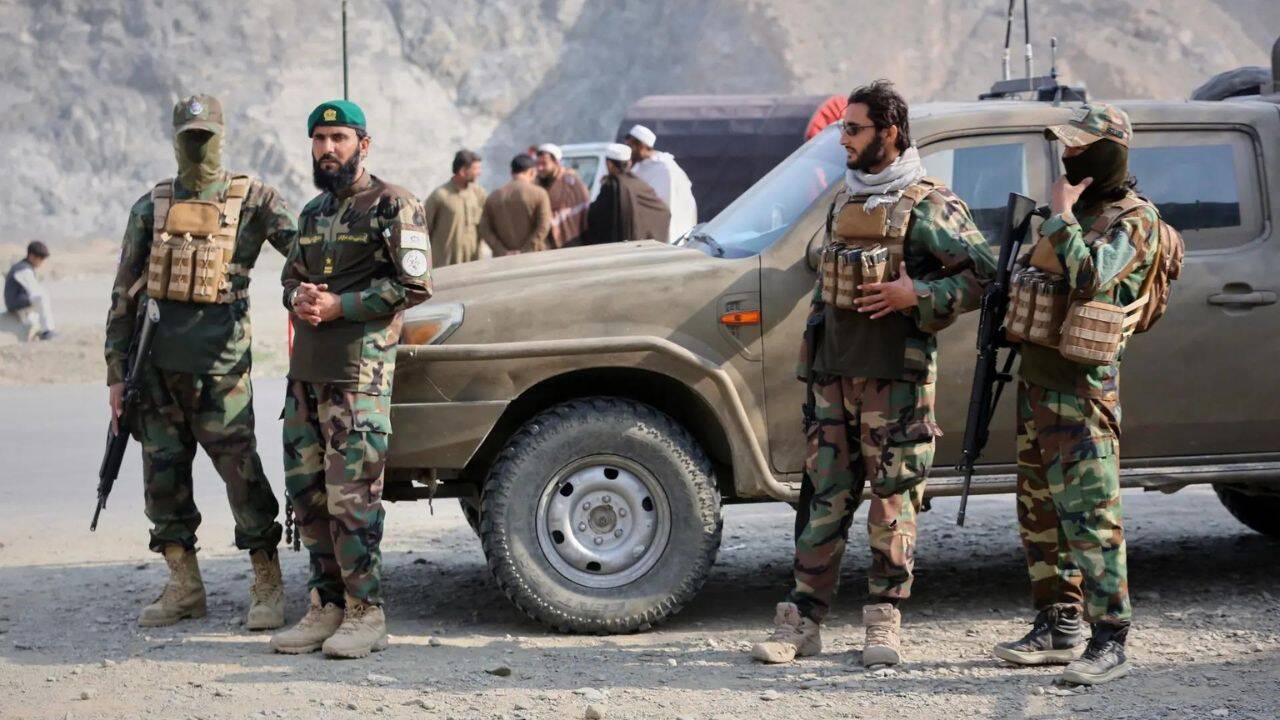
Mainstream newsrooms love the word "calibrated." It sounds precise. It evokes images of room-sized control centers, laser-guided munitions, and surgical accuracy. When news broke that Pakistan carried out military strikes near the Afghanistan border, killing 29 alleged militants, the media ran the standard playbook. They repeated official press releases, tallies of the dead, and the comforting narrative that a state is effectively managing its security threat.
It is a comforting lie.
The lazy consensus treats these periodic border operations as effective counter-terrorism. The reality known to anyone who has tracked the Durand Line for decades is that these tactical successes are strategic failures. Measuring counter-insurgency success by a body count is a relic of the Vietnam War era—a metric that ignores how insurgencies actually function. Killing 29 militants does not degrade a network; it opens up promotion tracks for younger, more radical commanders.
The premise that Pakistan can bomb its way to border security ignores the structural realities of the region.
The Body Count Deception
For forty years, intelligence analysts have watched states mistake tactical kinetic output for strategic outcome. When a military operation claims dozens of insurgent casualties, the immediate assumption is that the threat has decreased.
This calculus is fundamentally flawed. In highly fragmented, decentralized networks like the Tehrik-i-Taliban Pakistan (TTP) or various splinter factions operating in Waziristan and Khyber, leadership is non-linear. The loss of mid-level operatives rarely disrupts the operational capability for more than a few weeks.
Instead, these strikes trigger a predictable cycle:
- Forced Adaptation: The surviving elements scatter into smaller, more autonomous cells that are harder to track.
- Local Resentment: Inevitable collateral damage and displacement among the local Pashtun population provide a fresh pool of grievances for tribal recruitment.
- The Martyrdom Premium: High-profile deaths serve as propaganda fodder, fueling digital recruitment networks across the border.
If kinetic operations worked the way state narratives claim, the border region would have been pacified during Operation Zarb-e-Azb in 2014, or Operation Radd-ul-Fasaad in 2017. Millions of dollars were spent, hundreds of thousands of civilians were displaced, and the official victory tallies were massive. Yet, here we are, nearly a decade later, reporting on the exact same cross-border friction points.
The Sovereignty Paradox
The core argument of the conventional narrative is that Pakistan is securing its sovereign borders against cross-border terrorism emanating from an uncooperative Taliban government in Kabul.
This view misunderstands the nature of the Durand Line. The 2,640-kilometer border is not a hard barrier; it is a porous geographic abstraction that splits families, tribes, and economies down the middle. Expecting the interim Afghan government to act as a Western-style state apparatus that completely seals its side of the mountain passes is a fantasy.
Kabul lacks the institutional capacity, the financial resources, and crucially, the political will to wage war against fellow ideological factions on behalf of Islamabad. When Islamabad utilizes air strikes or heavy artillery near the border, it does not coerce Kabul into compliance. It solidifies the internal unity of the various militant factions who view the Pakistani state as an external adversary.
The hard truth is that every airstrike deepens the disconnect between Islamabad's security establishment and the local population living along the frontier. Security cannot be imported via a fighter jet when the local socioeconomic infrastructure remains entirely neglected.
Dismantling the Safe Haven Argument
When regional security is discussed, the standard question asked by international observers is: How can Pakistan stop militants from utilizing safe havens inside Afghanistan?
The question itself is broken. It assumes that "safe havens" are purely physical spaces—training camps with flags flying that can be wiped out by a drone strike. Modern militancy does not require permanent brick-and-mortar bases. A safe haven today is a smartphone, an encrypted messaging app, a sympathetic local network, and a mountain pass that a local shepherd can cross blindfolded.
By focusing on physical destruction, the state misses the actual infrastructure of the insurgency. You cannot calibrate a bomb to destroy a financial network based on informal hawala cash transfers. You cannot launch a missile at an ideological narrative that thrives on the absence of local governance, judicial delays, and economic deprivation in the newly merged tribal districts of Khyber Pakhtunkhwa.
The True Cost of Tactical Success
To understand the downside of this approach, look at the economic reality. Pakistan is navigating a severe financial crisis, reliant on international bailouts to keep its economy afloat. Military operations are extraordinarily expensive. The cost of maintaining high troop deployments along the western border, flying sorties, and reconstructing damaged infrastructure drains billions from a treasury that cannot afford it.
Meanwhile, the economic isolation of the border regions worsens. Hard border closures, trade blockades designed to pressure Kabul, and the disruption of local markets destroy the legitimate trade that keeps the border population from turning to smuggling or militancy as a survival mechanism.
The state is paying a premium to maintain a status quo of permanent low-level warfare.
Stop looking at the body counts reported by military spokesmen. Stop believing that the elimination of a few dozen militants changes the security dynamic along the Durand Line. Until the structural issues—local political disenfranchisement, the lack of economic alternatives to the war economy, and the flawed assumption that geopolitical alignment can be forced through kinetic pressure—are addressed, these operations are nothing more than expensive theater.
The next time a press release claims a "calibrated strike" has neutralized a threat, remember that the exact same claim will be made next month, next season, and next year. The strategy isn't broken; it is working exactly as designed to sustain a permanent crisis. Turn off the news feeds and look at the map.