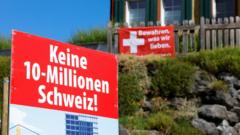
Switzerland will not freeze its borders or its economy. Early projections from the June 14, 2026 referendum indicate that Swiss voters have rejected a radical constitutional amendment to cap the national population at 10 million people. Public broadcaster SRF projects a 55% to 45% defeat for the proposal, a margin that exposes a deep fracture running through one of the world's wealthiest democracies. While headline writers frame the result as a simple triumph of European integration over right-wing populism, the reality is far more transactional.
The vote was a referendum on economic survival. Faced with a choice between the abstract comfort of an insulated Alpine enclave and the practical requirements of a labor-starved corporate sector, the Swiss electorate ultimately chose the money.
The Economic Engine That Demands Flesh
To understand why the "Sustainability Initiative" failed, one must look at the structural dependency of the Swiss economic model. This is an economy powered by multinational giants, sprawling pharmaceutical clusters, and a high-end financial sector that cannot function on native labor alone. The Swiss People's Party (SVP), the right-wing populist force behind the measure, attempted to leverage local anxieties over packed commuter trains, soaring apartment rents, and suburban sprawl. They offered a blunt instrument: halt population growth by 2050. If the population hit 9.5 million before then, the government would have been forced to suspend asylum approvals and family reunifications.
The fatal flaw in this strategy was ignoring the corporate dependency on foreign talent. Switzerland features a foreign-born population of roughly 32%. That places it near the very top of the developed world, trailing only extreme outliers like Luxembourg. Multinational firms operating out of Basel and Zurich do not view these workers as guests; they view them as life support.
Had the initiative passed, hitting the 10-million limit would have legally compelled Switzerland to tear up its bilateral treaties with the European Union, specifically the 2002 agreement on the free movement of people. For corporate Switzerland, this was an existential threat. The main business lobby, Economiesuisse, spent months warning that cutting off access to the European labor pool would trigger immediate domestic stagnation. When Swiss voters stood in their polling booths, the fear of an immediate corporate exodus and a severe contraction in pension funding outweighed the daily annoyance of a crowded Zurich tram.
The Mirage of Environmental Protection
The SVP masked its traditional anti-foreigner rhetoric in the trendy vocabulary of ecological preservation, branding the measure as a "sustainability" effort. The argument was simple. A small, mountainous country cannot absorb endless concrete without destroying the very landscape that defines its national identity.
This argument resonated with a surprising segment of the political center. For a significant portion of the campaign, polling suggested the initiative might actually pass. Urban centers are visibly densifying, and the pastoral ideal of Switzerland is increasingly confined to tourism brochures.
Yet, the environmental argument crumbled under intellectual scrutiny. Opponents successfully argued that capping the population does not automatically solve resource management issues. A frozen population can still increase its carbon footprint through rising consumption, larger average living spaces, and increased energy usage per capita. More importantly, blocking foreign workers does not stop the economic activity that drives resource consumption; it merely exports the productivity while leaving the domestic infrastructure stuck in an artificial bottleneck.
A System Engineered for Gridlock
The referendum outcome highlights the unique pressure-valve nature of Swiss direct democracy. Citizens are called to the ballot box up to four times a year, a mechanism that frequently allows populist movements to force uncomfortable conversations onto the national stage. Over the past few decades, the SVP has repeatedly used this system to target migration, though with highly volatile results.
A look at recent history reveals the pattern.
| Referendum Year | Initiative Focus | Outcome |
|---|---|---|
| 2014 | "Against Mass Immigration" | Passed (50.3%) |
| 2020 | "Limitation Initiative" (Ending EU Free Movement) | Rejected (61.7%) |
| 2026 | "10 Million Population Cap" | Rejected (55% Projected) |
The narrow success of the 2014 initiative sent shockwaves through Brussels and forced Bern into years of agonizing diplomatic acrobatics to avoid invalidating its EU trade access. Swiss voters watched that farce unfold and learned a lesson. When presented with the absolute ultimatum of the 2026 population cap, they recognized the hidden trapdoors.
The Demographic Debt Collectors
The defeat of the cap avoids an immediate diplomatic rupture with Brussels, but it solves absolutely none of the underlying systemic strains that generated 45% support for the measure. Switzerland is aging rapidly. The domestic birth rate is completely inadequate to maintain the current workforce, let alone fund the country's famously generous social security and pension systems.
Without a steady influx of working-age taxpaying immigrants, the Swiss welfare state faces insolvency. This is the central hypocrisy that European populist movements rarely address. You cannot demand a sealed border while simultaneously demanding an unchanged retirement age and fully funded healthcare.
By rejecting the cap, the electorate has tacitly accepted that Switzerland must continue to grow, build, and urbanize. The Swiss population has risen by 23% since 2002, reaching 9.1 million people. Over that exact same period, economic output grew by 24%. The correlation is total. Growth is not an optional feature of the Swiss state; it is the foundation of its stability.
The 45% of citizens who voted "yes" will not quietly go away. The frustrations regarding unaffordable housing markets in Geneva and infrastructure deficits in the midlands are real. The government in Bern now faces the complex task of managing the physical consequences of the growth it just fought to defend. They won the argument on economic necessity, but they have yet to show how they will prevent the country from turning into a continuous, concrete metropolis stretching from Lake Constance to Lake Geneva.
The border remains open to the market, but the domestic space is running out of room.