Fear has a very specific weight. It does not feel like electricity or sudden panic. It feels like lead poured directly into your chest, settling behind your ribs, making every breath a conscious negotiation.
If you have never smelled the air inside an isolation ward during an outbreak, consider yourself extraordinarily fortunate. It smells of relentless bleach, of hot recycled air, of latex gloves tearing against dry skin, and above all, of an absolute, suffocating silence. Patients do not scream toward the end. They are too weak. They simply wait.
For decades, humanity has played a terrifying game of catch-up with one of the most ruthless destroyers on the planet. We have watched from afar as outbreaks flare up in distant forest clearings, tearing through villages, wiping out entire family lineages, and claiming over three thousand lives in devastating surges before retreating back into whatever dark biological reservoir it calls home. We knew it was coming back. The virus always comes back.
Until now, our primary weapon has been a desperate retreat. We built walls of plastic sheeting. We wrapped ourselves in yellow hazmat suits that turned into portable saunas under a tropical sun. We tracked contacts through jungle paths with notebooks and pens, praying we could outrun an incubation period that moves like a ghost in the dark.
Defense is exhausting. Defense eventually fails.
At a quiet laboratory in a British university, a group of researchers decided to stop running. They did something nobody has ever successfully pulled off quite this way before. They rolled up their sleeves and administered the world's first human trial of a brand-new defensive shield against the invisible executioner.
Let us be entirely clear about what is happening here. (As a note of transparency, the following scenario is a dramatized composite based on the actual trial protocols, designed to illustrate the human reality behind the sterile medical data.)
Imagine walking into a sterile clinical trial room with palms slick with nervous sweat. You know the history. You know the statistics. You know about the fever that starts innocently enough, mimicking a bad flu, before escalating into a systemic collapse that liquefies the body's internal architecture. You sit down in a stiff metal chair. A nurse smiles behind a protective shield, her eyes crinkling at the corners to show warmth where skin cannot touch skin.
She holds a syringe. Inside that tiny glass barrel is not the live virus—that would be suicide. Instead, it carries a harmless genetic instruction manual wrapped in a modified, defanged carrier virus. It is a Trojan horse of mercy.
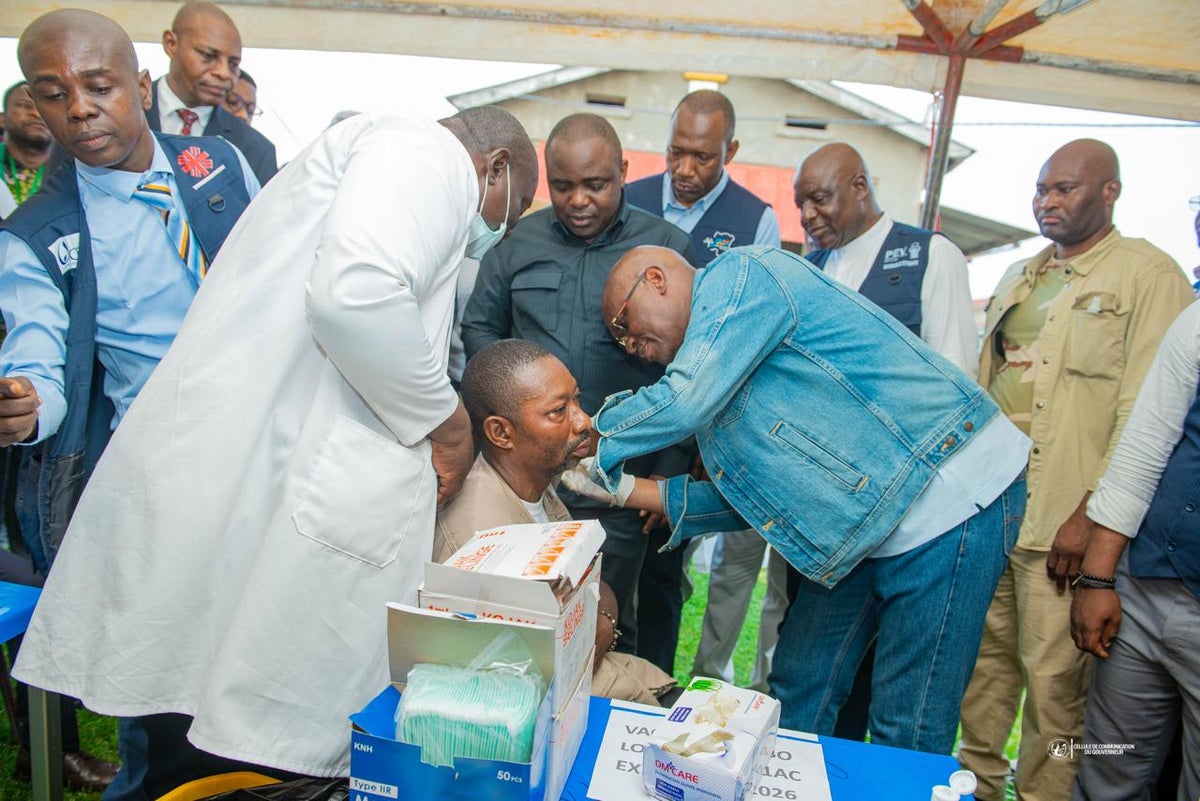
The needle goes in. A sharp pinch. Cold fluid sliding into the muscle.
In that single, quiet moment, an ancient script begins to rewrite itself.
The science behind this new Ebola vaccine trial is elegant, though translating it requires stripping away the medical jargon that often alienates us from our own survival. Think of your immune system as a medieval fortress. For generations, the Ebola virus has been an invading army that breaches the gates before the guards even realize the drawbridge is down. It uses proteins on its surface like skeleton keys, slipping past your defenses while throwing your cellular machinery into absolute chaos.
This new vaccine does not fight the battle for you. It teaches the guards what the enemy looks like before the war even begins. By introducing a non-replicating viral vector carrying the surface blueprint of the pathogen, the vaccine tricks the body into manufacturing harmless copies of the enemy's flag.
Your white blood cells spot the flag. They sound the alarm. They forge weapons—antibodies and T-cells—specifically calibrated to shred that exact protein on contact.
When the trial participant walks out of that room and back into the ordinary rush of city traffic, something profound has shifted in the invisible architecture of their biology. They are no longer just a potential statistic. They are a landmine. If the real virus ever dares to cross their path, the immune system will not hesitate. It will obliterate the threat before the first symptom can even whisper hello.
Why does this matter so desperately?
Because outbreaks do not stay contained to remote maps. In our hyper-connected age, a pathogen sitting in a rural clinic can board a commercial jetliner and land in London, New York, or Tokyo within twenty-four hours. The illusion of distance is dead. Every time a localized epidemic claims thousands of lives on the African continent, it is a global warning shot.
For years, vaccine development moved at the speed of bureaucracy. Funding would trickle in after a crisis peaked, only to dry up the moment the headlines faded from the evening news. Scientists were left shouting into an empty canyon, begging for resources to fight a ghost that the world had temporarily chosen to forget.
This latest trial at a British university represents a cultural shift as much as a medical breakthrough. It is proactive instead of reactive. It proves that academic institutions, clinical networks, and global health bodies can pivot with terrifying speed when the collective will matches the urgency of the threat.
Yet, we must confront the uncomfortable truth that science alone cannot save us.
Building a revolutionary vaccine in a high-tech laboratory is only the first act of a very long play. The real test—the part that keeps epidemiologists awake at three in the morning—is distribution. How do you transport a fragile, temperature-sensitive biological shield down dirt roads where the electricity fails and the humidity hangs like a wet blanket? How do you convince communities who have every historical reason to distrust medical interventions sent from afar that this needle is different?
Trust is harder to manufacture than antibodies.
It requires walking into villages, sitting on wooden benches under corrugated iron roofs, and answering hard questions without condescension. It requires acknowledging that past medical trials have sometimes left deep, generational scars. You cannot lecture people into safety; you have to earn it, one conversation, one handshake, one open dialogue at a time.
When you look at the volunteers rolling up their sleeves in these early trials, you are looking at the bridge between fear and resolution. They are not famous. Their names will likely never grace a history textbook. But they are carrying the weight of a safer tomorrow in their deltoids.
We stand at a rare juncture in human history. We possess the tools to cage the microscopic beasts that have terrorized our species since before we understood what a cell was. We have the genetic sequencing capabilities, the computational power, and the sheer human bravery required to test these innovations in the crucible of clinical reality.
The silence of the isolation ward does not have to be our permanent future.
The needle goes in. The microscopic war begins and ends in the dark, unnoticed by the conscious mind. And somewhere out there, in the quiet spaces between heartbeats, a ghost loses its power.