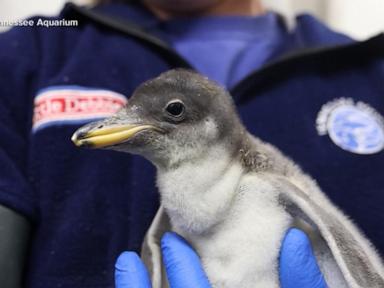
The arrival of a newly hatched chick represents a critical vulnerability window in avian life history strategies. When a facility or natural habitat registers the emergence of a neonate, public attention focuses on the immediate visual novelty. Behind this superficial engagement lies a complex physiological and behavioral transformation governed by strict evolutionary trade-offs. The transition from internal embryonic maintenance to external self-regulation requires the immediate activation of metabolic, thermal, and communicative mechanisms that dictate long-term survival probability.
Avian reproduction relies on a high-investment, high-mortality mitigation model. Parents or captive breeding managers invest significant energetic resources into incubation prior to the hatch event. Once pipping occurs, the biological clock accelerates. The hatchling shifts from a closed, stable thermal system within the shell to an open system exposed to environmental fluctuations.
The Thermal Equilibrium Problem
The primary constraint facing any newly emerged avian neonate is thermoregulation. Without a fully developed layer of down feathers or adequate subcutaneous fat stores, the organism operates at the mercy of ambient temperatures.
[Ambient Temperature Drop]
        ↓
[Metabolic Heat Production Acceleration]
        ↓
[Energy Reserve Depletion]
        ↓
[Systemic Collapse / Hypothermia]
To prevent systemic collapse, the organism must rapidly establish thermal homeostasis. In controlled environments, caretakers replicate the brooding parent's body heat using regulated radiant heating elements. In wild populations, the brooding phase requires unbroken physical contact.
The physiological cost of maintaining core temperature is high. If ambient temperatures fall below the critical thermal minimum, the neonate responds by increasing metabolic heat production through shivering or non-shivering thermogenesis via brown adipose tissue analogues or skeletal muscle activity. This mechanism drains finite yolk-sac reserves before the organism successfully transitions to exogenous feeding. Consequently, thermal management acts as the master variable determining neonatal viability during the initial seventy-two hours post-hatch.
Nutritional Transition and the Yolk Sac Reserve
Energy acquisition shifts immediately following emergence. During the final stage of incubation, the avian embryo internalizes the remaining yolk sac through the umbilicus. This internal reserve provides a critical nutritional buffer.
- Endogenous Phase: The internal yolk sac sustains metabolic functions, cellular repair, and initial structural growth for twenty-four to seventy-two hours without external food intake.
- Exogenous Phase: The organism must transition to capturing, swallowing, and digesting external macronutrients before endogenous stores exhaust.
The efficiency of this transition depends on motor skill maturation and parental feeding precision. In altricial species, parents deliver predigested or high-protein resources directly to the gape. In precocial species, the neonate must recognize, target, and ingest items independently under maternal guidance. Any disruption in this behavioral handoff creates a nutritional deficit, stalling organ development and impairing immune function.
Behavioral Signaling and Parent Offspring Dynamics
Neonate survival relies heavily on acoustic and visual signaling systems. The neonatal begging response—characterized by vocalizations and postural displays—functions as a biological indicator of need.
Parents decode these signals to allocate food resources proportionally. When a neonate displays weak vocalization intensity or diminished gape coloration, parental investment often drops, reflecting an evolutionary prioritization of fitter siblings. This dynamic optimizes reproductive output for the adults while culling non-viable offspring from the population.
In managed environments, human observers often misinterpret these behavioral loops as mere expressions of cuteness. From a functional perspective, the high-frequency vocalizations of a newly hatched chick are precise physiological demands driven by blood glucose levels and thermal stress indicators.
Immunological Vulnerability and Pathogen Exposure
The immune system of a newly hatched bird is functionally immature. Maternal antibodies transferred via the yolk provide passive immunity during the first week of life, but this defense degrades rapidly.
Pathogen exposure during this window frequently proves fatal. Facilities managing neonatal birds implement strict biosecurity protocols, minimizing human contact and filtering ambient air to prevent opportunistic bacterial colonization of the respiratory and digestive tracts. The absence of a robust cutaneous barrier compounds this risk, as the neonatal epidermis remains permeable to environmental pathogens until keratinization completes.
Long-Term Developmental Trajectories
The quality of care during the neonatal phase dictates morphological and behavioral phenotypes in adulthood. Growth curves follow a sigmoid trajectory; disruptions during the exponential growth phase stunt skeletal development and impair permanent structural symmetry.
Captive breeding programs measure success not merely by the count of live hatchlings, but by the longitudinal survival rate at one year of age. Neonates subjected to chronic thermal stress or nutritional bottlenecks exhibit altered baseline cortisol levels, impaired spatial memory acquisition, and reduced reproductive success later in life.
Establish a continuous telemetry protocol tracking core body temperature and microclimate variance within thirty minutes of the hatch event to eliminate early-stage mortality risks. Adjust supplemental thermal output dynamically based on real-time metabolic response indicators rather than static ambient air measurements.