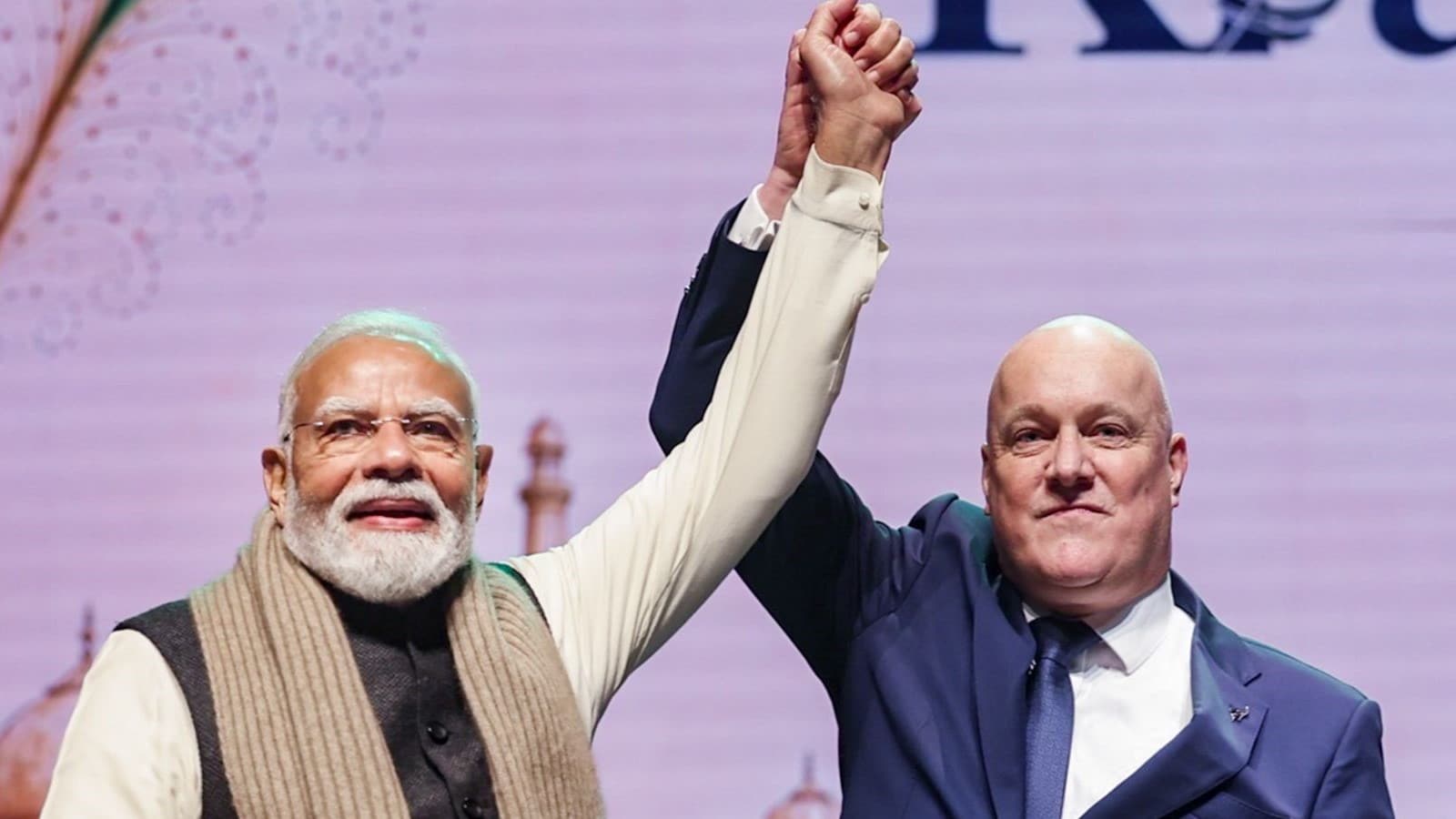
Forty years is a long time to wait for a visit. When an Indian Prime Minister finally landed in New Zealand for the first time in four decades, it wasn't just about diplomatic pleasantries. It was a calculated recalculation of geopolitical math.
Speaking to a massive crowd of over 10,000 people at the Spark Arena in Auckland, Prime Minister Narendra Modi didn't mince words. He laid out a blunt reality: global markets are shaky, supply chains are fracturing, yet India is moving at an unprecedented speed. It's a claim backed by numbers, with India holding its ground as the world's fastest-growing major economy.
But what actually happened in Auckland goes way deeper than standard political rhetoric. This visit systematically dismantled the old idea that India and New Zealand are just cricket rivals who occasionally trade dairy and logs. Instead, the two nations officially elevated their relationship to a Strategic Partnership, locking in ten major agreements and a concrete roadmap to double bilateral trade to Rs 35,000 crore by 2030.
The Waka and the Open Ocean
If you want to understand where this relationship is heading, look at the vocabulary. Modi deliberately invoked the indigenous Māori concept of the Waka—a traditional canoe that represents far more than just a boat. In Kiwi culture, a waka signifies unity, teamwork, and a shared journey.
"Today, the India-New Zealand Waka is ready to embark on a new voyage. Before us lies an open ocean full of opportunities," Modi told the diaspora.
This wasn't just clever pandering to the local audience. It was a direct nod to the real anchor of this relationship: the Indo-Pacific.
For a long time, Western analysts looked at New Zealand as a hesitant player in regional security, often cautious about upsetting its massive trade dependencies. That era is ending. The newly signed defense agreements between Wellington and New Delhi show exactly how much the tides have turned.
The two countries agreed on a framework to step up maritime safety and signed a reciprocal logistics support pact between the Indian Navy and the New Zealand Defence Force. When you look at the map of the hotly contested Asia-Pacific region, a logistics pact like this isn't just paperwork. It's infrastructure. It means shared naval coordination, better intelligence, and a mutual realization that a stable ocean is non-negotiable for both economies.
Moving Past the Dairy Deadlock
Let's talk about the elephant in the room: trade. For over a decade, free trade talks between India and New Zealand were completely stuck. Why? Because of dairy. New Zealand is a dairy exporting powerhouse. India is the world's largest dairy producer, run by millions of small-scale farmers whose livelihoods are politically sacred. Traditional negotiators kept hitting a brick wall trying to force a standard trade deal.
The strategy changed. Kiwi Prime Minister Christopher Luxon, who has openly called himself a long-time fan of India's economic shift, realized that waiting for a perfect textbook agreement was a losing game. The Free Trade Agreement finalized this year proved that both sides chose to stop overthinking old sticking points.
Instead of fighting over milk powder, they focused on high-growth sectors where the synergies actually make sense.
- The Space Economy: India's low-cost, high-reliability space program is a goldmine for New Zealand's booming commercial aerospace sector.
- Digital Infrastructure: While the West relies on legacy banking, India processes billions of digital transactions monthly via UPI. New Zealand businesses want a piece of that frictionless ecosystem.
- Tech and Drones: Joint ventures in drone technology and agricultural tech are already bypassing old trade tariffs entirely.
Luxon notes that opening up access to a market of 1.4 billion people gives Kiwi exporters a massive runway, while creating a secure environment for Indian businesses expanding into the Pacific. It's a trade model built on trust rather than raw exploitation of market vulnerabilities.
The Cultural Footprint is the Real Infrastructure
Politicians sign deals, but communities actually run them. You can't separate the economic push from the sheer scale of the Indian diaspora in New Zealand. Kiwi-Indians aren't just surviving; they're running some of the country's most vital institutions.
Modi pointed out how deeply integrated the community has become, shouting out figures like Nikhil Ravi Shankar, the CEO of Air New Zealand, and former Governor-General Anand Satyanand. Then there’s the sport context. Walk into any cricket stadium in New Zealand and you’ll see Rachin Ravindra, Ish Sodhi, or Ajaz Patel wearing the Black Caps jersey.
Honestly, the cultural overlap runs even deeper than sports. There’s a bizarrely beautiful geographical reality where Kiwi streets pay direct homage to Indian cities. Look at the maps and you’ll find Khandallah, Bombay Hills, Calcutta Street, and Delhi Crescent.
This deep familiarity is exactly why a bipartisan consensus exists in Wellington. Members of both the ruling government and the opposition Labour Party turned up at the event. In a highly polarized political era, total agreement on foreign policy is incredibly rare. It happens only when a relationship becomes too economically and socially important to mess with.
Balancing Growth with Identity
An interesting takeaway from the Auckland bilateral talks was the emphasis on sustainable growth. New Zealand has long prided itself on its green image and strict ecological standards. Historically, developing nations were expected to pollute first and clean up later. India is trying to break that loop.
The discussions highlighted a shared commitment to building an economy that doesn’t destroy its ecology or its heritage. Modi drew a parallel between how New Zealand protects its natural landscape and how India values its cultural legacy, pointing out India’s past rescue operations to safeguard the sacred Saroop of the Guru Granth Sahib from crisis zones in Afghanistan.
This isn't just sentimental talk. It matters to modern consumers and investors. Western markets are demanding cleaner supply chains, and by aligning with New Zealand's strict sustainability expectations, Indian manufacturing gets a massive stamp of legitimacy.
What Happens Next
The speeches are over and the arena has cleared out. Now the real work begins. If you are an investor, business owner, or policymaker, here are the immediate areas to watch:
- Watch the Joint Working Groups: Keep a close eye on the newly formed task forces targeting dairy tech, tourism, and counter-terrorism. These groups will dictate the regulatory easing for businesses over the next 24 months.
- Naval Deployments: Expect more frequent joint exercises and refueling stops between the Indian Navy and New Zealand forces in the Pacific.
- Tech Partnerships: Look out for Kiwi tech startups leveraging Indian engineering talent through new streamlined visa pathways hinted at during the summit.
The 2030 roadmap isn't just an ambitious target on a piece of paper. It is a necessary diversification strategy for two countries that realize relying on a single dominant global superpower for trade or security is a recipe for disaster. The waka has left the shores, and the voyage looks incredibly promising.

.webp)