The desert night is supposed to belong to the stars and the silence. For generations, the vast expanse surrounding the Saudi capital offered a profound, steady darkness—a quiet canvas where the modern world’s frantic heartbeat slowed down against the ancient chill of the dunes.
Then came the scream overhead.
It is a sound that defies easy description, a tearing of the atmosphere that splits the calm long before the flash illuminates the horizon. When an airport terminal, a place designed for joyful reunions and tearful departures, transforms overnight into a theater of war, the geometry of normal life shatters. Twelve human lives ended in an instant during a coordinated assault claimed by Iran-backed Houthi forces targeting the infrastructure of Saudi Arabia. Twelve breathers of air, twelve holders of secrets, twelve builders of futures, erased by a projectile launched hundreds of miles away across an unforgiving sea of sand.
Statistics are cold things. They reduce human tragedy to rows of ink on a morning broadsheet. We hear twelve dead, and our minds struggle to grasp the weight of the number. But behind that statistic lies the reality of the baggage claim that never saw its owners, the coffee cup left half-full on a terminal table, the frantic phone calls that dialed into endless ringing.
War has a way of shrinking the map. What happens in the rugged mountains of Yemen rarely stays confined to the crags and valleys. It rides the wind, carried by sophisticated guidance systems and explosive payloads, landing with brutal finality on civilian asphalt in Riyadh.
Consider the mechanics of distance and escalation. For years, the conflict in Yemen was treated by many distant observers as a localized tragedy, a forgotten humanitarian crisis playing out in the shadows. But air power respects no borders. When regional proxies acquire long-range capabilities, the perimeter of safety dissolves entirely. The airport becomes the front line. The commuter waiting for a flight becomes a combatant in the eyes of a distant strategist.
This is the invisible architecture of modern asymmetric conflict. You do not need massive armored divisions to alter the destiny of a nation. You need
The Smoke Above the Capital and the Weight of Waiting
news
Dawn in Riyadh rarely arrives with gentleness. Instead, it bleeds through a heavy haze of desert dust and industrial hum, turning the morning sky a bruised, metallic copper long before the sun clears the horizon. On that particular morning, the silence of the early hours was shattered not by the familiar roar of commuter traffic or the distant call to prayer, but by a sound that strips the breath from your lungs. It is a sharp, tearing crack that vibrates in your jaw, followed instantly by the hollow, concussive thud that rattles double-paned glass and sets neighborhood car alarms wailing in a frantic, uncoordinated chorus.
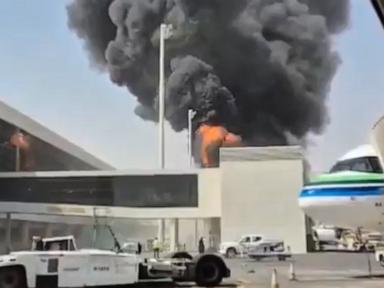
Look up. A jagged black scar of smoke was already unspooling against the pale blue, rising from the direction of the international airport.
For the people on the ground, life is measured in the fragile intervals between normal routines and the sudden intrusion of distant conflicts turned painfully local. Consider a hypothetical airport worker, a man named Tariq who has spent twelve years checking cargo manifests beneath the cavernous, air-conditioned arches of the terminal. To Tariq, the airport is an ecosystem of ticking watches, screeching baggage tugs, and the low murmur of travelers heading toward reunions or departures. On that day, the ecosystem fractured. A single, sudden impact turned concrete to dust, twisted corrugated steel into modern art, and extinguished twelve lives in a fraction of a second. Twelve human beings who woke up planning breakfast, worrying about flight delays, or bidding quiet farewells.
The Iran-backed Houthis claimed responsibility for the strike, adding another grim entry to a relentless ledger of cross-border drone and missile attacks originating from Yemen. But statistics do not bleed. Numbers on a news ticker fail to capture the profound vertigo of sitting in a living room miles away, watching a phone screen flicker with blurry footage of fireballs, wondering if the cousin who works the afternoon shift answered his phone yet.
This is the hidden cost of modern asymmetric warfare. It is not fought solely in remote mountain passes or barren border trenches. It reaches across hundreds of miles of empty sand to strike civilian hubs, transforming ordinary infrastructure into front lines. The strategy behind these attacks relies on a calculated psychological erosion. By targeting a capital city's primary aviation gateway, the perpetrators seek to project power far beyond their immediate geographic confines, signaling that no skyline is entirely out of reach, and no morning routine is truly safe.
To understand why these strikes carry such heavy geopolitical gravity, one must look at the geography of the conflict. Yemen’s protracted civil war has long since transcended a domestic power struggle. It operates as a crowded proxy theater where regional heavyweights clash through intermediaries. The Houthi movement, officially known as Ansar Allah, has steadily upgraded its military capabilities, transitioning from rudimentary field weapons to sophisticated loitering munitions and delta-wing cruise missiles. These systems, intelligence agencies report, rely on technical components and design architectures that trace back to foreign backing, primarily from Tehran.
When a drone travels hundreds of miles across the Empty Quarter before detonating against a civilian terminal, it represents more than a tactical assault. It is a failure of deterrence and a chilling demonstration of how easily lethal technology democratizes destruction. You do not need an air force with supersonic fighter jets to paralyze a metropolis; you need a garage, smuggled parts, and a calculated disregard for the Geneva Conventions.
Yet, standing in the aftermath, the policy debates in distant foreign ministries feel dizzyingly abstract. In the immediate aftermath, the atmosphere inside the city shifts from routine to a low-grade, persistent hyper-vigilance. Drivers check their rear-view mirrors more often. Parents hesitate before sending children out to play in courtyard gardens. Conversations in cafes drift away from commerce and weather toward the latest air defense interception rates.
People adapt. Human beings are terrifyingly resilient creatures, capable of normalizing the abnormal with heartbreaking speed. Within days, the shattered glass is swept away, structural engineers assess load-bearing beams with laser levels, and flights resume under heightened security protocols. The terminal reopens. The cargo manifests are signed. Tariq returns to work, his badge clipped to his collar, his eyes lingering just a fraction of a second longer on the eastern horizon whenever a jet engine whines overhead.
Security analysts often speak of regional stability as an architectural puzzle, a delicate arrangement of treaties, sanctions, and military posturing. They draw arrows on maps and calculate the trajectory of intercepted projectiles as if they were lines on a chalkboard. But architecture implies a foundation, and right now, the foundation is built on shifting sand. Every escalation invites a counter-escalation. Every civilian life lost in a transit lounge hardens positions, closes off diplomatic off-ramps, and pushes a negotiated settlement further into the hazy distance.
There is a strange loneliness that comes with living under the constant shadow of distant wars. You go about your day buying groceries, paying bills, and answering emails, while miles above your head, invisible currents of high explosives and electronic countermeasures slice through the stratosphere. You learn to live with the duality of an ordinary life punctuated by extraordinary dangers.
The smoke over the capital eventually dispersed, blown away by the relentless desert winds that care little for human grievances. But the questions it left behind remain suspended in the air, heavier than any drone, waiting for answers that no one seems able to provide.