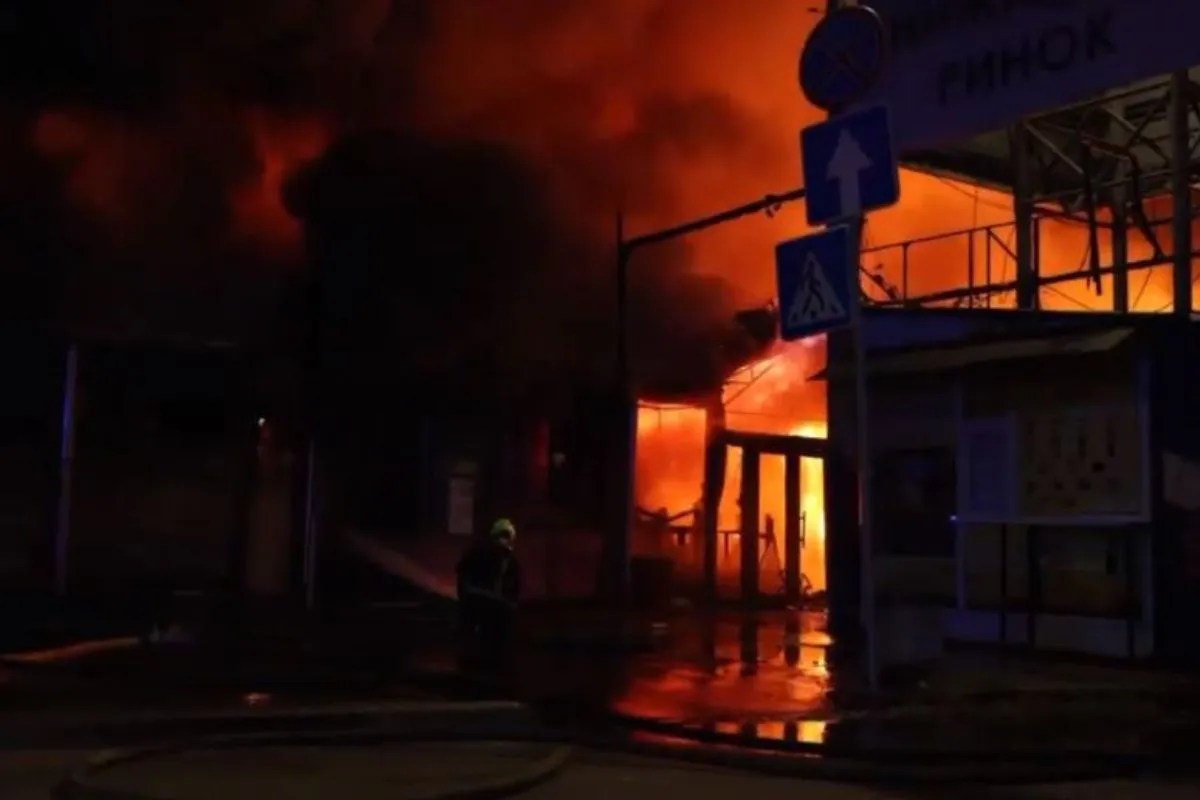
The Air Before the Storm
Silence is rarely empty. In the hours before midnight, just outside the glowing ring of Moscow’s grand avenues, the air holds a strange, heavy static. It is the kind of quiet that smells faintly of frozen tarmac and wet pine, the stillness right before a wave breaks.
Then comes the sound. You might also find this connected story interesting: The Strategic Cost of Asymmetric Retaliation in the Moscow Drone Campaign.
It is not the thunder of an approaching summer squall. It is a dry, insectoid buzzing, multiplying by the hundreds, stitching the dark horizon together with invisible, high-pitched threads.
To understand what happened on that night, you have to imagine standing in a kitchen in a quiet suburb south of the Russian capital. The kettle is cooling on the stove. The television hums softly in the corner, broadcasting late-night updates that everyone tries to ignore until they cannot. A flash flickers against the windowpane—not lightning, but an amber bloom of fire pulsing against the clouds. Seconds later, the shockwave hits, rattling the double-paned glass just enough to remind everyone inside that geography is no longer a shield. As highlighted in recent articles by Reuters, the effects are notable.
Six hundred.
That was the number whispered through encrypted channels and later confirmed by monitoring stations. Six hundred unmanned explosive vessels, carved from fiberglass and low-cost circuitry, drifting across the border under the cover of a moonless sky. They were not aiming for trenches on a distant front line. They were hunting for the spine of the capital itself.
Air defense systems woke up all at once. Tracers drew violet lines across the stratosphere. The smell of burnt sulfur replaced the scent of pine. For hours, the night sky turned into a violent mechanical theater, where cheap engineering met billion-dollar interceptors in a deadly game of attrition.
The Geometry of Retaliation
War has its own terrible arithmetic. Push a lever in one place, and a matching weight drops somewhere else.
If Moscow spent its night squinting upward at a swarm of mechanical hornets, Kyiv woke up to the dawn of a classic reckoning.
Morning in the Ukrainian capital usually begins with the steam rising from espresso cups in basement cafes and the slow rumble of the metro carrying people toward another day of defiant normalcy. But on this morning, the city didn't wake up to coffee. It woke up to sirens.
(Note: The following scene is a composite dramatization based on verified air-raid logs and civilian reports from the capital.)
Imagine sitting on the edge of a narrow cot in a windowless hallway, wrapped in a heavy wool blanket, listening to the metallic screech of an incoming cruise missile. You do not look at your watch. Time stops functioning during those forty seconds between the warning alarm and the impact. You measure life in heartbeats.
When the ballistic payload hit the outskirts of the city, the floorboards didn't just vibrate; they heaved upward. Dust fell from the ceiling like gray snow, settling into the hair of children who had learned to sleep through the tremor.
Russia’s response was swift, heavy, and predictable. The morning skies over Kyiv bloomed with white smoke trails where surface-to-air batteries intercepted incoming threats, but not all of them found their mark. Secondary explosions echoed through industrial zones and residential courtyards. Glass littered the streets like crushed diamonds, crunching beneath the boots of rescue workers who moved with the grim, practiced efficiency of people who have lived through a thousand variations of the exact same Tuesday.
The Invisible Stakes
Why these targets? Why now?
To look at the map is to miss the point. This conflict is no longer fought merely for fields of grain or ruined municipal buildings in the Donbas. It has evolved into a psychological endurance test, waged over civilian rooftops thousands of miles away from the primary trenches.
When a swarm of six hundred drones targets the Moscow region, the goal is not to level the Kremlin. The goal is to shatter the illusion of distance. For months, millions of citizens in Russia’s urban heartland could scroll past news of the front lines as if watching a foreign film. They could buy groceries, attend concerts, and pretend that the economic and human toll was something happening to someone else, somewhere far away.
Six hundred buzzing engines overhead end that illusion permanently.
Conversely, when morning missiles scream down on Kyiv, the objective is exhaustion. It is a calculated effort to grind down the collective nervous system of a nation, to make heating, electricity, and basic survival feel like privileges that can be revoked at any moment by a supersonic signature in the clouds.
This is the hidden architecture of modern attrition. It is fought not just with high explosives, but with anxiety, sleep deprivation, and the erosion of hope.
The Long Shadow
History teaches us that prolonged conflicts eventually stop being about territory and start becoming contests of institutional and emotional endurance. The side that wins is rarely the one with the loudest weapons; it is the one whose people can bear the silence after the explosion just a little bit longer.
Out on the balcony of a high-rise apartment in Kyiv, a lone cat picks its way carefully across a floor dusted with shattered windowpane fragments. Below, municipal workers are already sweeping up the debris, shoveling broken glass into metal bins with a rhythmic, indifferent scrape.
There are no speeches being given in the street. No crowds cheering. Just the cold morning wind sweeping down the avenue, carrying the faint, metallic scent of ozone and the quiet, persistent knowledge that the night will return again soon.