The asphalt didn't just crack. It groaned.
To anyone driving down Sunset Boulevard at two in the morning, the road looks like a permanent fixture of the universe, a neon-lit ribbon cut through the heart of Los Angeles. It feels invincible. But beneath the tires of the midnight cruisers and the late-shift Uber drivers, a century-old network of iron and rivets is holding back a monster.
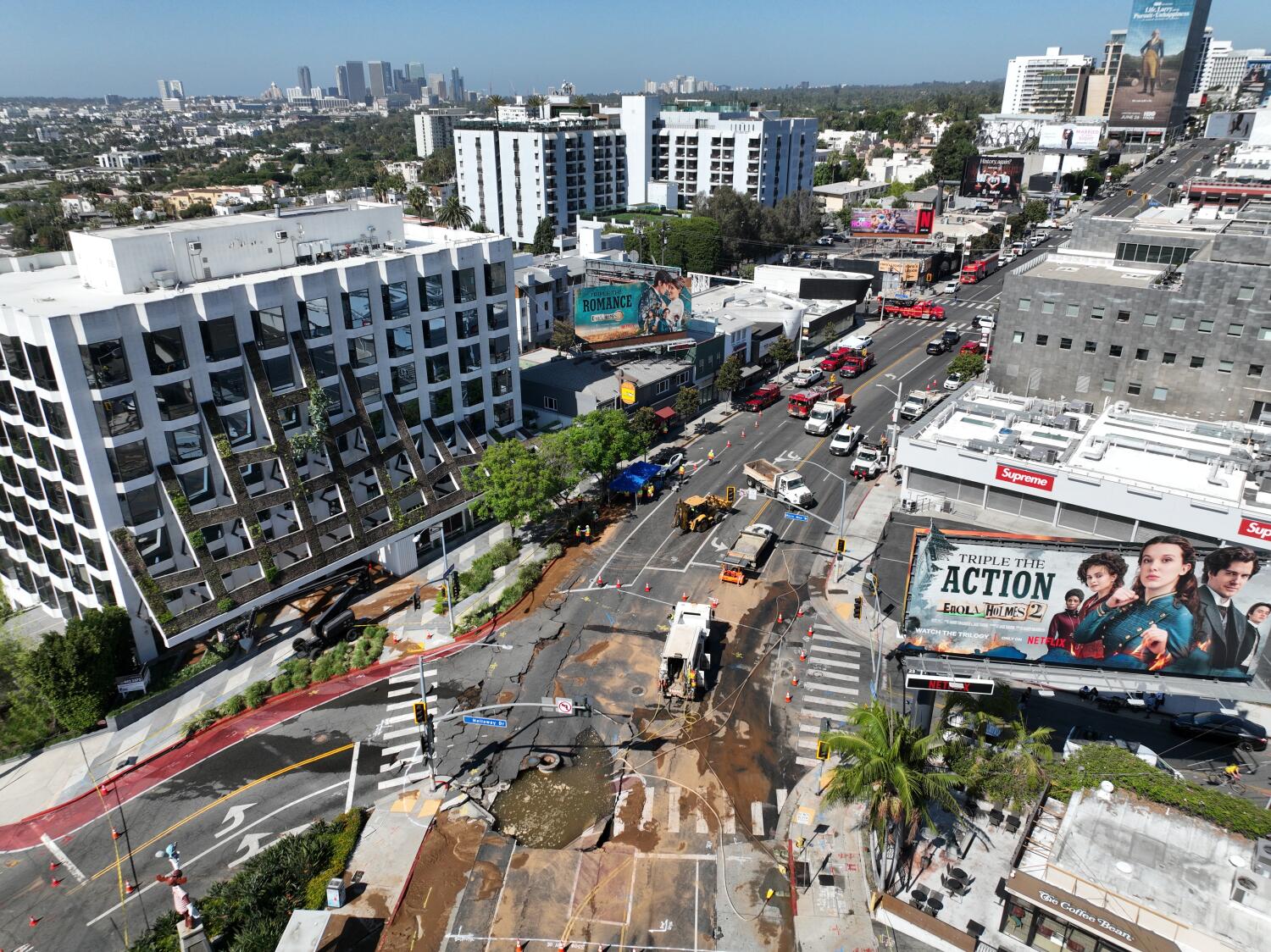
When a major water main ruptures beneath one of the most famous streets on earth, it doesn't look like a leaking faucet. It looks like an explosion in slow motion. Thousands of gallons of pressurized water rip through the dirt, turning the solid ground beneath the pavement into a subterranean soup. Within minutes, the street isn't a street anymore. It is a bridge over nothing.
Then comes the silence. Then, the flashing red lights.
By sunrise, a crucial stretch of Sunset Boulevard was completely dark, closed indefinitely. To the city planners, it was a logistical nightmare of diverted traffic and ruptured infrastructure. But to the people who actually live, work, and breathe on this corridor, the broken pipe was a sudden, violent pause button on life itself.
The Ghost Town in the Hills
Consider Marcus. He is a hypothetical composite of three different coffee shop managers along the affected stretch, but his panic at 6:00 AM was entirely real.
Marcus arrived at work to find his water pressure gone, his espresso machine wheezing, and a line of orange traffic cones stretching as far as the eye could see. No water means no coffee. No traffic means no foot traffic. In the restaurant business, a single day of forced closure can wipe out a month of razor-thin profit margins.
"You don't realize how fragile everything is until you turn the tap and nothing happens," Marcus says, looking out at an empty four-lane highway that usually throbs with the sound of sports cars and delivery trucks.
The silence is the eeriest part. Sunset Boulevard is defined by its noise. It is a symphony of honking horns, bass shaking from open windows, and the constant, low-frequency hum of a city that refuses to sleep. When you remove that noise, the neighborhood loses its pulse. Pedestrians walk the sidewalks with a strange, hesitant posture, like trespassers in a museum.
Further down the block, a boutique hotel found itself suddenly tasked with explaining to tourists from London and Tokyo why their luxury showers were sputtering rust-colored mud. The glamour of Hollywood evaporates instantly when you can't flush the toilet.
This is the invisible tax of aging infrastructure. We build empires of glass and digital billboards on top of plumbing systems designed during the administration of Calvin Coolidge.
The Anatomy of a Riptide Beneath the Concrete
To understand why a single pipe can paralyze a city, you have to look at what lies beneath the surface.
Los Angeles is a city built on an impossible dream. It is a desert metropolis that imported its water from hundreds of miles away through sheer political will and engineering audacity. Once that water arrives, it is distributed through thousands of miles of trunk lines.
Many of these pipes are made of cast iron, laid down in the 1920s and 1930s. Over decades, the soil shifts. The ground expands and contracts with the erratic rhythms of California weather—long stretches of bone-dry heat followed by sudden, torrential atmospheric rivers. The pipes endure constant pressure from within and relentless pounding from heavy transit above.
Think of it like an old rubber band stretched to its absolute limit. It can hold for years, looking perfectly fine from the outside. But a microscopic fracture develops. The water finds the weakness.
When a trunk line blows, the sheer velocity of the water acts like a hydraulic mining tool. It replaces the dirt supporting the road. The asphalt above, weighing several tons, suddenly has nothing holding it up. The road caves in on itself, creating a sinkhole that can easily swallow a mid-sized SUV.
Fixing it isn't as simple as slapping on a patch.
The Midnight Army
Step past the yellow police tape, and the scene changes from a disaster movie to an industrial ballet.
Crews work in twelve-hour shifts under the harsh glare of halogen work lights. The air smells of wet earth, diesel exhaust, and old asphalt. Heavy excavators claw at the muddy crater, their metal buckets scraping against stone with a sound that rattles your teeth.
The men and women in the pit are covered in gray sludge. They are working in a confined space, surrounded by high-voltage electrical lines, gas mains, and fiber-optic cables that connect the Westside to the rest of the world. One wrong move with a backhoe could plunge an entire zip code into darkness or trigger an explosion.
They are playing a high-stakes game of operation with heavy machinery.
"Everyone wants it done yesterday," says one veteran worker, pausing to wipe sweat and mud from his safety glasses. "But you can't rush this. If you don't compact the dirt perfectly before you pour the new asphalt, the road will just sink again in six months."
The complexity of the repair explains the word that every commuter dreads: indefinitely.
It is a word that offers no comfort. It means the city is refusing to guess. They have to dig down to the source, cut out the shattered section of the massive pipe, drop in a new multi-ton steel sleeve, weld it securely, test the water quality to ensure no bacteria entered the system, and then rebuild the layers of sub-base, crushed rock, and asphalt.
The Ripples Through the Valley
The consequences of a broken main on Sunset don't stop at the barricades. They cascade outward, choking the surrounding canyons and side streets.
Drivers trying to bypass the closure flood into the narrow, winding roads of the Hollywood Hills. Quiet residential avenues suddenly transform into gridlocked nightmares. Commutes that normally take twenty minutes stretch into agonizing two-hour crawls through exhaust-choked bottlenecks.
The frustration is palpable. You can see it in the white-knuckled grips on steering wheels, hear it in the synchronized chorus of horns echoing through the canyons.
But beneath the annoyance lies a deeper, more unsettling realization. This disruption is a reminder of how interconnected we are. A failure of a single pipe in one neighborhood alters the rhythm of life for someone miles away who just wants to get home in time to put their kids to bed.
We live our lives on the surface, entirely dependent on a subterranean world we choose to ignore until it forces its way into the light. We celebrate new skyscrapers and trendy restaurants, but the true measure of a city's health isn't what rises into the sky. It is what stays buried safely beneath our feet.
The sun begins to set again, casting long shadows across the empty pavement of Sunset Boulevard. The neon signs of the closed shops flicker on, casting a surreal pink and blue glow over the muddy construction pit. The workers keep digging, their silhouettes moving against the steam rising from the wet ground.
The city moves around the wound, scarred but stubborn, waiting for the heartbeat of the boulevard to return.