Two o'clock in the morning smells like stale espresso and burning silicon.
If you have ever sat inside a cramped Palo Alto conference room during a late-stage term sheet negotiation, you know the exact frequency of the fluorescent lights buzzing overhead. You know the cold sweat pooling at the base of your spine when a spreadsheet cell refuses to balance, and the quiet, suffocating dread of realizing that the rules you spent twenty years mastering just evaporated overnight. For a different look, see: this related article.
For half a century, Silicon Valley operated on a simple, comforting math. A handful of sharp-eyed partners in Sand Hill Road offices wrote checks for a few million dollars. Founders built software in garages. Seven to ten years later, an investment bank rang a bell in Manhattan, retail investors bought shares, and everyone went home rich. The risk was high, sure. Most startups died quietly in the dark. Yet the winners paid for the losers a hundred times over.
Then came the number that broke the chalkboard. One point five trillion dollars. Further coverage on this matter has been provided by Business Insider.
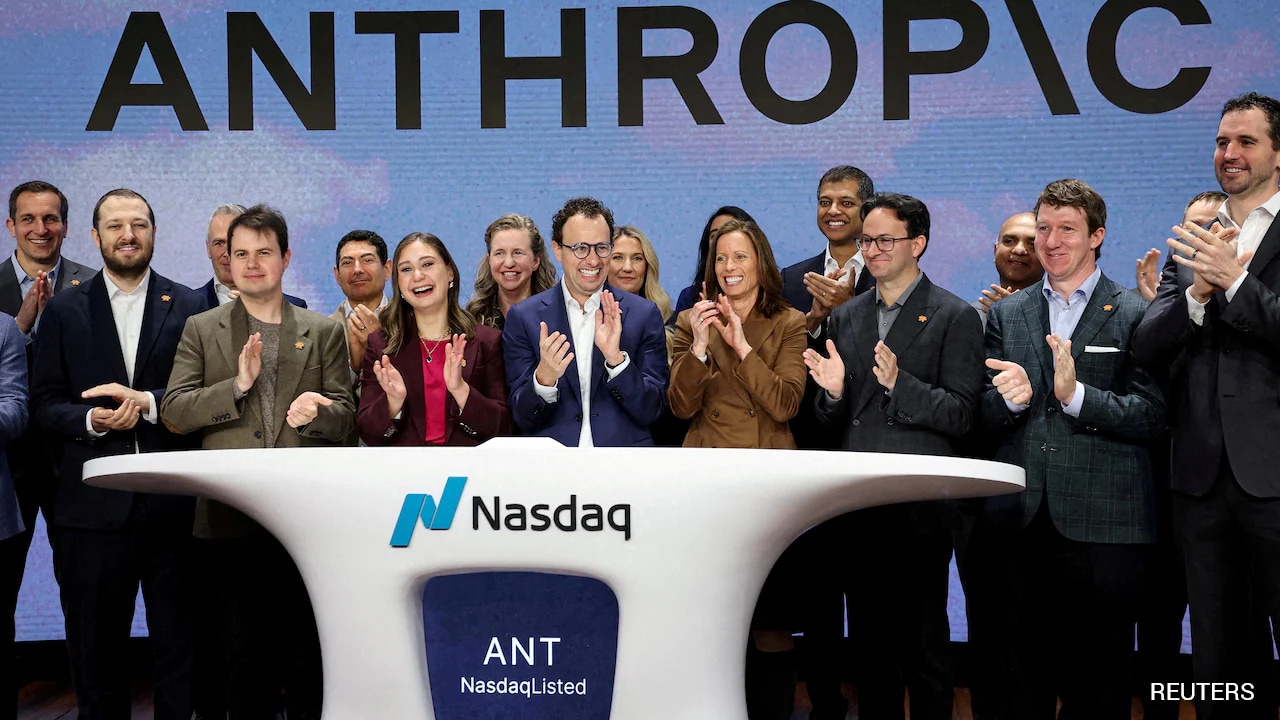
When Anthropic stepped onto the public stage with a valuation that dwarfed entire national economies, the celebration on Wall Street lasted about forty-five minutes. Inside the glass-walled offices of traditional venture capital firms, however, the champagne stayed in the fridge. Nobody popped a cork. Instead, partners stared at their monitors in stunned silence, doing mental arithmetic that made their stomachs turn. Because a $1.5 trillion debut does not validate the old venture capital playbook. It burns the book to ashes and scatters the cinders across San Francisco Bay.
The Ghost in the Spreadsheet
To understand why a massive payday feels like a funeral on Sand Hill Road, consider a hypothetical founder named Maya.
Let us put Maya in a rented loft in San Francisco's Mission District four years ago. She has two PhDs in distributed systems, three former colleagues from a major research lab, and an idea for a foundational reasoning engine that does not hallucinate medical diagnoses. Under the classic rules of venture capital—the rules forged during the rise of personal computing and the early consumer internet—Maya would raise three million dollars in seed funding. She would hire eight engineers. She would spend two years iterating, surviving on ramen and equity, before raising a fifteen-million-dollar Series A to scale her sales team.
Except Maya cannot build a frontier model on three million dollars. She cannot even buy the electricity to turn the servers on for three million dollars.
Training a competitive model in the mid-2020s requires clusters of tens of thousands of specialized chips, liquid-cooled data centers the size of small cities, and power contracts negotiated directly with utility monopolies. Before Maya writes a single line of commercial customer code, she needs five hundred million dollars. Six months later, she needs four billion.
Enter the sovereign wealth funds, the hyperscale cloud providers, and the multi-hundred-billion-dollar asset managers. When Anthropic’s valuation climbed into the stratosphere on its path to a $1.5 trillion debut, traditional venture capitalists discovered a brutal truth about their own business model. They had spent decades positioning themselves as the indispensable gatekeepers of innovation. Suddenly, they were merely brokers introducing brilliant researchers to balance sheets the size of sovereign nations.
Look at the mechanics of a traditional venture fund. A mid-sized Sand Hill Road firm raises five hundred million dollars from university endowments, pension funds, and charitable foundations. They promise those limited partners a three-to-five-times return over ten years. That math works brilliantly when you buy twenty percent of a software company for four million dollars and sell it for two billion.
Now try applying that math to an artificial intelligence titan whose private rounds require ten-billion-dollar checks just to keep pace with compute costs. A five-hundred-million-dollar venture fund cannot even afford a seat at the table. If they pool everything they have into a single round, they walk away with a fraction of a single percent of the company, diluted further every time a tech giant trades cloud credits for equity.
The Compute-for-Equity Trap
Here is where the story gets uncomfortable, and frankly, a little frightening for anyone who believes in free-market competition.
In the old days, cash was cash. You wired money into a startup's bank account, and the founder decided how to spend it. They could buy servers from Dell, rent office space in Austin, or hire marketers in New York. Capital was liquid, neutral, and liberating.
Anthropic’s ascent exposed an entirely different financial architecture. Throughout its private life, billions of dollars poured into the company from cloud titans like Amazon and Google. Yet much of that capital never really left the orbit of the investors who wrote the checks. It functioned like an elaborate, high-stakes company store.
Think of an old nineteenth-century mining town, where the coal company owned the general store, the housing, and the bank, paying miners in scrip that could only be redeemed at company counters. Now scale that dynamic up to planetary computing infrastructure. A cloud provider invests four billion dollars into a frontier lab. In return, the lab commits to spending four billion dollars on that provider's proprietary chips and cloud servers. The investor books massive future cloud revenue, watches the value of its equity stake soar as the lab's valuation climbs toward $1.5 trillion, and locks a generational customer into its ecosystem.
Where does that leave a traditional venture capitalist? Standing outside in the rain.
When a company’s primary currency is compute capacity rather than venture dollars, financial investors lose their sharpest weapon. You cannot out-hustle a data center. You cannot mentor your way around a shortage of high-bandwidth memory chips. During the late stages of Anthropic’s private run, venture partners found themselves reduced to cheerleaders, watching corporate giants and sovereign funds dictate governance, pricing, and public market timing.
What Everyone Missed About the Exit
Wall Street analysts spent months debating whether a $1.5 trillion debut made sense on paper. Could enterprise software contracts, automated coding agents, and scientific research subscriptions really justify a market capitalization rivaling the world's most entrenched monopolies?
The skeptics pointed to price-to-sales ratios that made the 1999 dot-com bubble look like a conservative value play. They argued that training costs were still rising faster than enterprise adoption, and that open-weight competitors were constantly nipping at the heels of proprietary labs. If an open model could perform eighty percent of the work for a tenth of the price, how could any single company command a $1.5 trillion price tag?
That question misses the psychological shift happening inside global boardrooms.
Corporate buyers do not purchase frontier intelligence the way consumers download photo-sharing apps. A chief information officer at a global bank or a pharmaceutical giant is terrified of two things: catastrophic liability and regulatory ruin. When a drug discovery pipeline or a trillion-dollar risk engine relies on an automated reasoning system, nobody gets fired for choosing the safest, most thoroughly audited model on earth.
Anthropic built its entire identity around constitutional safety, predictable behavior, and enterprise reliability while competitors chased viral consumer gimmicks. By the time the company approached the public markets, it had become the default nervous system for regulated industries. Switching away from a deeply integrated reasoning engine is not like canceling a software subscription. It is like attempting a heart transplant while running a marathon.
Once institutional investors grasped that lock-in effect, the $1.5 trillion figure stopped looking like a speculative bubble and started looking like an infrastructure tollbooth. If artificial intelligence becomes the underlying utility of white-collar labor, the companies owning the foundational reasoning layers collect a micro-tax on every contract drafted, every line of code shipped, and every molecule simulated.
The Hangover on Sand Hill Road
Step back into that Palo Alto conference room at two in the morning. The morning after the debut, the reality sets in.
If the biggest wealth-creation events in technology history now require tens of billions of dollars in private capital before ever reaching the stock market, what happens to the venture capital industry?
It fractures into two unrecognizable species.
On one side sit the mega-funds—behemoths managing fifty to a hundred billion dollars across every asset class imaginable. These firms no longer resemble the scrappy partnerships of the 1980s. They are sprawling financial institutions operating like private sovereign wealth funds, complete with geopolitical advisors, Washington lobbyists, and dedicated power-grid analysts. They survived the Anthropic wave because they had the sheer balance-sheet muscle to write billion-dollar checks alongside tech giants.
On the other side sits everyone else. Thousands of traditional venture firms suddenly realize they are playing a game whose top prize has been moved out of reach. If a startup needs billions to compete at the foundation layer, early-stage investors can no longer ride a company from a garage all the way to a generational public offering. Instead, they are forced into a game of musical chairs. They fund tiny application wrappers built on top of Anthropic's models, praying that Anthropic does not release a native feature six months later that wipes their startup off the map overnight.
I watched a veteran seed investor—someone who backed three household-name software companies over twenty years—stare at his phone on the day of the listing. He had passed on an early AI infrastructure deal four years prior because the valuation felt "frothy" at a few billion dollars. By his old metrics, he had been disciplined, prudent, and wise. By the new reality, his discipline had cost his partners generational returns.
"We spent twenty years learning how to spot a great captain," he told me quietly over lukewarm coffee. "We forgot to check whether the ocean was turning into lava."
The Invisible Price Tag
There is a human cost to this shift that rarely makes it into financial filings or celebratory interviews on business television.
When companies grow to $1.5 trillion before the everyday public ever gets a chance to buy a single share, wealth concentration stops being an abstract economic debate and becomes a structural feature of modern capitalism.
In 1997, Amazon went public at a valuation of roughly four hundred and thirty-eight million dollars. In 1980, Apple debuted at around one point eight billion. Even Google, considered a massive offering in 2004, entered the public markets at twenty-three billion dollars. In every single one of those cases, ordinary people—teachers, engineers, nurses, small-business owners—could buy stock in the public market and ride ninety-nine percent of the value creation over the next two decades.
A $1.5 trillion debut flips that social contract upside down.
By the time the ticker symbol flashes across screens in Times Square, the staggering bulk of the exponential growth has already been harvested behind closed doors by sovereign funds, corporate balance sheets, and ultra-high-net-worth private syndicates. Public market investors are no longer invited to fund the daring ascent of a young upstart. They are invited to provide liquidity so early insiders can cash out at the summit.
Meanwhile, the founders themselves carry a weight that previous generations of entrepreneurs never had to shoulder. Running a ten-billion-dollar software company is an exercise in product management and sales execution. Running a $1.5 trillion foundational intelligence company means negotiating energy treaties, testifying before panicked parliaments, managing national security clearances, and policing the boundaries of human cognition—all while quarterly earnings call analysts demand thirty percent year-over-year margin expansion.
The New Rules of the Jungle
Nobody on Sand Hill Road is going to pack up their Patagonia vests and go home quietly. Capital is endlessly adaptive; it flows around obstacles like water finding cracks in concrete.
Already, the sharpest investors are rewriting their internal playbooks in real time. Since they cannot outspend cloud giants on foundation models, they are hunting in the messy, physical world where trillion-dollar algorithms still stumble. They are pouring money into specialized robotics, industrial manufacturing, automated wet-labs, and custom silicon designed for the edge rather than the data center. They are looking for businesses where proprietary physical data—the messy friction of atoms moving through space—creates a moat that cannot be scraped from the open internet.
At the same time, the governance of venture capital itself is mutating. Firms are abandoning rigid ten-year fund cycles, creating evergreen vehicles that never have to force a premature exit, and partnering directly with industrial conglomerates to co-fund capital-intensive breakthroughs.
Yet beneath all the strategic pivots and newly minted investment theses lies an unspoken humbling. For decades, Silicon Valley mythologized the lone genius in a hoodie and the visionary investor who believed in them when nobody else would. That story was intoxicating because it felt democratic, nimble, and human.
Anthropic’s $1.5 trillion debut proved that intelligence at planetary scale does not belong to garages anymore. It belongs to factories of light and silicon, backed by treasuries that rival empires, governed by math that leaves traditional venture capitalists squinting at the fine print.
Somewhere in Palo Alto tonight, a junior partner is building a financial model for a promising young startup, plugging growth assumptions into neat little rows, convinced that if the founder just executes well enough, the old magic will work one more time. Outside the window, high-voltage transmission lines hum in the dark, carrying enough electricity to power a metropolis straight toward a windowless concrete warehouse in the desert, where the real decisions are already being made.