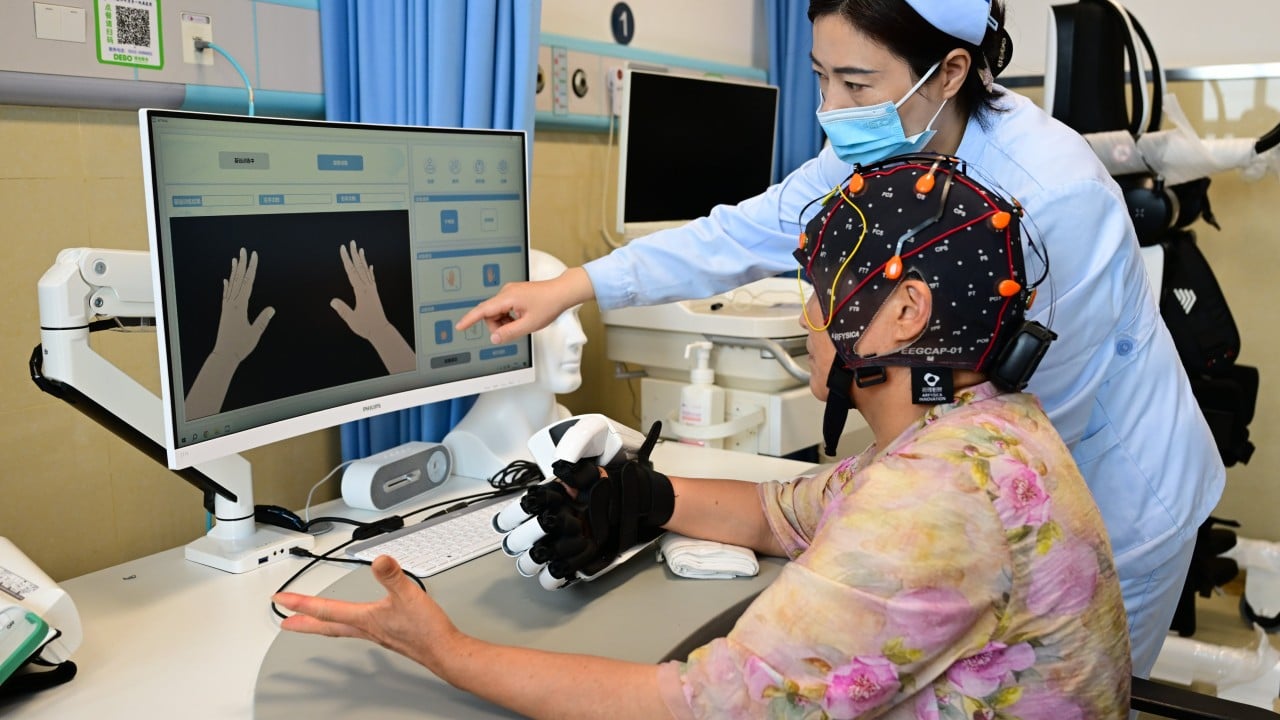
Achieving 94 percent mind-typing accuracy over a continuous 24-hour cycle using a non-invasive neural interface solves the primary hardware-software bottleneck that has stalled consumer neurotechnology for three decades. Until now, brain-computer interfaces (BCIs) operated on a rigid trade-off curve: invasive implants offered high signal-to-noise ratios (SNR) at the cost of neurosurgery and glial scarring, while wearable electroencephalography (EEG) caps suffered from rapid signal degradation, skin irritation, and high error rates caused by skull attenuation. A comfortable, wearable architecture sustaining 94 percent accuracy across a full circadian cycle proves that material science and adaptive machine learning decoders can compensate for the physical barrier of the human cranium.
To evaluate the commercial and clinical viability of this milestone, we must strip away the promotional framing and analyze the underlying physics, signal processing constraints, and economic trade-offs of continuous neural decoding. For an alternative look, check out: this related article.
The Fundamental Physics of the Skull Bottleneck
Non-invasive neural interfaces measure electrical potentials generated by synchronous postsynaptic activity in the cerebral cortex. Before these microvolt-level signals reach an external sensor, they must pass through three distinct layers: cerebrospinal fluid, the cranial bone, and the scalp. Each layer acts as a low-pass spatial filter, smearing the electrical field and reducing spatial resolution.
Historically, overcoming this attenuation required conductive wet gels to lower skin-electrode impedance below 5 kilo-ohms. Wet electrodes introduce two fatal operational flaws for day-long use: Related reporting on the subject has been shared by Ars Technica.
- Impedance Drift: As the aqueous gel dehydrates over four to six hours, electrode impedance spikes, causing the signal-to-noise ratio to collapse and forcing constant recalibration.
- Mechanical Trauma: Rigid sensor housings pressed tightly against the scalp to maintain contact induce localized ischemia, resulting in acute pain and tissue breakdown within hours.
Sustaining a 94 percent decoding accuracy over a full day indicates that the engineering architecture eliminated impedance drift without relying on high-pressure mechanical clamping. In modern wearable neurotechnology, this is achieved through dry or semi-dry elastomeric electrodes—often utilizing conductive polymers, carbon nanotube composites, or micro-structured hydrogel interfaces—that conform to the micro-topography of the skin and hair follicles. By maintaining a stable capacitive or resistive coupling under low mechanical pressure, the hardware preserves signal integrity while remaining imperceptible to the wearer.
Deconstructing the 94 Percent Accuracy Metric
In neural engineering, a raw percentage figure is meaningless without defining the Information Transfer Rate (ITR), the vocabulary size, and the error-correction protocols running beneath the user interface. A 94 percent accuracy rate in a closed-set four-choice paradigm is trivial; achieving it in open-vocabulary text generation is a major systems engineering feat.
When evaluating mind-typing systems, three operational variables govern real-world utility:
- Degrees of Freedom vs. Classification Space: Non-invasive BCIs typically rely on either Motor Imagery (MI)—where the user imagines moving specific limbs—or Steady-State Visually Evoked Potentials (SSVEP), where the user focuses on flickering visual stimuli at distinct frequencies. SSVEP offers higher accuracy and faster selection speeds but induces severe visual fatigue over extended periods. Pure motor imagery or imagined handwriting requires zero external visual stimulation, making it viable for day-long wear, but demands far more sophisticated feature extraction from the sensorimotor cortex.
- Language Model Priors: Raw neural signals rarely achieve 94 percent character-level precision on their own. Modern BCI decoders pair neural classifiers with large-scale statistical language models. The neural decoder outputs a probability distribution over potential characters or phonemes, and the language model resolves ambiguity using contextual priors. If the system achieves 94 percent accuracy, a substantial fraction of that precision stems from predictive algorithmic error-correction rather than pure raw signal clarity.
- Latency and Cognitive Load: High accuracy achieved at a rate of two characters per minute renders a system useless for practical communication. For a mind-typing interface to replace physical input devices for paralyzed patients or specialized operators, it must sustain an ITR above 40 to 60 bits per minute without inducing cognitive exhaustion.
The Trilemma of Wearable Neurotechnology
Every wearable BCI is constrained by three competing engineering requirements. Optimizing for any two traditionally degrades the third:
- Signal Fidelity (SNR): The ability to isolate target cortical oscillations from background noise and muscle artifacts.
- Wearability and Ergonomics: The physical comfort, weight distribution, and thermal dissipation required for uninterrupted multi-hour deployment.
- Environmental Robustness: The capacity to reject non-neural noise in uncontrolled, real-world settings outside a shielded Faraday cage.
Standard clinical EEG systems maximize signal fidelity while sacrificing ergonomics and environmental robustness. Consumer headbands maximize ergonomics at the expense of signal fidelity. Crossing the 90 percent accuracy threshold in a day-long protocol demonstrates that the system has balanced all three vertices simultaneously.
This equilibrium relies heavily on Artifact Subspace Reconstruction (ASR) and real-time blind source separation algorithms. Outside a laboratory, human movement generates massive electrical noise. Blinking produces electrooculographic (EOG) spikes orders of magnitude larger than cortical signals; jaw clenching and neck tension generate broadband electromyographic (EMG) interference. A system functioning throughout a normal day must dynamically identify, isolate, and subtract these physiological artifacts in milliseconds without stripping away the underlying neural intent.
Non-Stationarity and Adaptive Calibration
The hardest problem in continuous BCI operation is not hardware design; it is the biological non-stationarity of the human brain. Neural firing patterns shift continuously due to circadian rhythms, fatigue, shifts in attention, caffeine intake, and emotional states. A static machine learning model trained at 8:00 AM will fail by 2:00 PM because the statistical distribution of the user's brainwaves has drifted—a phenomenon known in machine learning as covariate shift.
Sustaining 94 percent accuracy over 24 hours proves the deployment of unsupervised domain adaptation or continuous online recalibration. Rather than forcing the user to stop every two hours to stare at calibration targets, the decoder monitors its own prediction confidence and user error-related potentials (ErrPs).
When a BCI makes a mistake, the user's brain automatically generates a distinct electrical signature—an Error-Related Potential—within 200 to 500 milliseconds of perceiving the wrong character on screen. Advanced decoders detect this involuntary neural feedback loop, discard the erroneous output, and update the classifier weights in real time. The interface literally learns from the user's subconscious reaction to its own mistakes, compensating for circadian neural drift without manual intervention.
Invasive vs. Non-Invasive Economics
This milestone forces a recalculation of the capital allocation and clinical risk models dominating the BCI sector. For the past five years, venture capital and institutional research have heavily favored invasive intracortical arrays (such as Utah arrays or flexible polymer threads) and endovascular stents. The thesis was straightforward: the skull blocks too much information, so surgical implantation is mandatory for high-bandwidth communication.
That thesis now faces a severe market segmentation challenge.
Invasive systems require neurosurgical teams, sterile operating theaters, FDA Class III medical device approvals, and lifelong monitoring for infection or hardware failure. Their total addressable market is strictly capped at patients with severe neurodegenerative conditions, such as amyotrophic lateral sclerosis (ALS) or high-cervical spinal cord injuries, where the clinical benefit outweighs surgical risk.
A non-invasive device capable of 94 percent accuracy operates under an entirely different economic model:
- Zero Surgical Risk: Eliminating craniotomies drops customer acquisition costs by orders of magnitude and removes the primary psychological barrier to adoption.
- Iterative Hardware Upgrades: When sensor materials improve, users simply replace a wearable headset rather than undergoing explantation surgery.
- Dual-Use Scalability: Regulatory pathways for non-invasive devices (typically FDA Class II or general wellness classifications depending on claims) allow manufacturers to subsidize clinical R&D through immediate deployment in industrial, defense, and high-performance enterprise environments.
Operational Limitations and Failure Modes
Despite the headline metric, non-invasive neural interfaces face hard physical boundaries that prevent them from achieving parity with invasive cortical implants. Strategists and product engineers must account for four structural limitations:
- Spatial Resolution Ceiling: Even with advanced dry electrodes and high-density sensor arrays, volume conduction through the skull limits non-invasive spatial resolution to roughly one square centimeter of cortex. Invasive microelectrode arrays resolve individual single-unit action potentials at the micron scale. Non-invasive systems will never decode complex, multi-dimensional motor kinematics—such as controlling individual prosthetic fingers with tactile feedback—at the speed of an implant.
- High-Frequency Attenuation: The cranial bone acts as a severe low-pass filter, heavily attenuating high-gamma band oscillations (above 70 Hz), which carry the richest information regarding localized cortical processing and fine motor intent. Non-invasive decoders are largely restricted to lower-frequency bands (alpha, beta, and low-gamma), capping the maximum theoretical bandwidth of the channel.
- Hair and Scalp Morphology Variance: Dry electrode performance remains sensitive to variations in hair density, follicle thickness, and sebum production. While controlled trials show high accuracy, deploying these devices across a heterogeneous global population introduces mechanical contact failures that degrade SNR.
- Silent Speech vs. Motor Imagery Constraints: True "mind-reading" of unconstrained internal monologue remains physically impossible via scalp sensors. Current 94 percent accuracy benchmarks rely on structured motor imagery, imagined handwriting, or visual attention paradigms. The user must actively and deliberately generate specific neural patterns; the device cannot passively transcribe stray thoughts.
Strategic Positioning for Neurotechnology Operators
The validation of high-accuracy, day-long non-invasive decoding marks the transition of wearable BCIs from academic novelties to viable human-machine interfaces. Organizations building, funding, or integrating neurotechnology must execute three immediate strategic adjustments:
Abandon general-purpose consumer positioning. Attempting to sell a mind-typing headset as a replacement for a smartphone touchscreen or mechanical keyboard is a losing play; physical thumb-typing and voice dictation remain faster, cheaper, and friction-free for able-bodied users in normal environments. Focus exclusively on high-friction operational environments where hands and voice are compromised: sterile surgical suites, high-G aerospace cockpits, noisy industrial floors, and assistive communication for motor-impaired populations.
Shift R&D capital from sensor hardware to adaptive edge-AI. Hardware impedance issues are reaching diminishing returns. The defensible intellectual property in non-invasive BCIs now resides in low-power, on-device neuromorphic chips capable of running real-time artifact rejection and continuous unsupervised domain adaptation without draining battery life or offloading sensitive neural data to the cloud.
Establish strict neural data privacy architectures immediately. A device worn for 24 hours that continuously monitors cortical states captures far more than intentional text input; it passively records biomarkers for fatigue, cognitive load, neurological decline, and emotional reactivity. Enterprise and clinical adoption will stall if manufacturers treat raw EEG streams as standard telemetry. Systems must process raw neural waveforms locally on secure enclaves, outputting only the final decoded text commands while purging underlying biometric signatures.