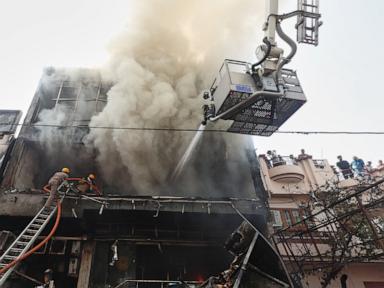
Whenever a fire rips through a commercial or educational facility in a rapidly developing urban hub, mainstream media follows a predictable, lazy script. They count the casualties—fourteen lives cut short, mostly students. They point fingers at local inspectors. They lament the lack of functioning fire extinguishers. Then, the public cycle of grief morphs into a toothless demand for "stricter enforcement."
This reaction is fundamentally flawed. It misses the structural reality of urban development.
Chasing down building owners for expired fire extinguishers or missing occupancy certificates is a losing strategy. It is security theater. The harsh reality of structural safety in fast-growing economic zones is that disasters are rarely caused by isolated negligence. They are baked into the economic layout of the infrastructure itself. We are measuring the wrong metrics, enforcing the wrong codes, and asking questions that guarantee more of the same tragedies.
The Illusion of Enforcement
The standard post-disaster autopsy goes like this: a building caught fire, the exits were blocked, the alarms failed, and the local municipality didn't do its job. The proposed solution is always a crackdown. More inspectors, higher fines, heavier bureaucracy.
I have spent two decades evaluating risk in industrial and urban infrastructure. I can tell you exactly why this approach fails. It treats safety as a checklist rather than a dynamic system.
When you impose highly complex, Western-style building regulations onto an economy where property margins are razor-thin and demand for cheap student housing or commercial space is skyrocketing, you do not create safety. You create a black market for compliance.
Imagine a scenario where a local building inspector faces a choice between shutting down a facility that houses dozens of low-income students or accepting a standard fee to look the other way on a narrow stairwell. The economic pressure will always favor the latter. Regulations that are detached from local economic reality simply drive non-compliance underground.
The core issue in the northern India tragedy—and countless others across developing urban landscapes—is not a lack of rules. It is the systemic failure of the load-to-exit ratio.
Most urban codes focus heavily on active fire protection: sprinklers, alarms, extinguishers. But active systems fail when maintenance budgets vanish. True structural resilience relies on passive safety—features built directly into the concrete and layout that require zero electricity, zero human intervention, and zero maintenance to work when things go wrong.
Active vs. Passive Safety Systems
| Safety Component | Active Systems (The Common Focus) | Passive Systems (The Real Savior) |
|---|---|---|
| Examples | Smoke detectors, fire alarms, automated sprinklers. | Compartmentation, fire-rated doors, independent stairwells. |
| Failure Point | Power outages, poor maintenance, water pressure drops. | Structural modification, physical blockage. |
| Economic Cost | High ongoing operational cost, requires technical talent. | High upfront design cost, near-zero operational maintenance. |
| Enforcement Style | Periodic manual inspections (highly corruptible). | Initial blueprint and structural sign-off (harder to fake). |
Dismantling the Premium on Open Layouts
Look at the architecture of modern commercial structures that get converted into student centers, coaching academies, or small tech offices. The premium is placed on maximizing square footage and creating open, flexible spaces.
This layout is a death sentence.
When a fire breaks out in a highly compartmented building, the structure itself fights the spread. A standard double-brick wall or concrete slab can resist fire for anywhere from one to four hours. That time is the difference between life and death.
However, modern renovations frequently strip away structural interior walls, replacing them with cheap, combustible plywood or drywall partitions to carve out as many classrooms or offices as possible. When a short circuit happens—the spark that triggers the vast majority of these incidents—the open or poorly partitioned space acts as a chimney. It feeds the fire oxygen and allows toxic smoke to engulf the entire floor within ninety seconds.
We must stop asking if a building has a valid fire safety certificate. That paper is meaningless. We need to start asking: What is the structural burn-rate calculation of the materials inside the building?
If a building is packed with synthetic materials, polyurethane foam partitions, and exposed wiring, it does not matter if there is an extinguisher on the wall. The air will become toxic long before anyone can reach it.
The Flawed Premise of Human Chaos
Mainstream coverage almost always blames "panic" for high death tolls. They claim that if the occupants had remained calm and evacuated in an orderly fashion, more would have survived.
This is a dangerous misunderstanding of human behavior under duress.
People do not freeze or stampede because they lack discipline; they do so because the architecture gives them conflicting signals. If a stairwell is dark, narrow, and filled with smoke because it lacks independent ventilation, descending it is an irrational act. The human brain naturally seeks alternative escape routes, which usually lead to dead ends like locked roof doors or window grates.
The design itself must dictate the evacuation, not the training of the occupants.
If a building requires an orientation video or a fire drill for someone to navigate their way out during a crisis, the design has already failed. True safe architecture uses intuitive pathway layout—structural cues like natural light or expanding hallway widths that instinctively pull a fleeing crowd toward safety without the need for signs, electricity, or clear vision.
The Cost of True Compliance
The contrarian truth that nobody wants to admit in the wake of these disasters is that safety costs money that the target demographic cannot afford.
If you strictly enforce every single modern international building code in regional education hubs, the cost of real estate will double. The coaching centers, small businesses, and affordable student hostels will shut down. The students who rely on these low-cost facilities to gain an education and lift themselves out of poverty will be priced out of the market entirely.
This is the trade-off that standard news reporting ignores. It is easy to demand absolute safety from a position of privilege. It is far harder to balance risk against economic survival.
The solution is not a blanket ban on low-cost commercial spaces, nor is it a blind eye to danger. The path forward requires a brutal prioritization of engineering over administration:
- Mandate passive venting over electronic alarms: Every multi-story commercial building must feature a permanent, non-closable structural smoke shaft at the highest point of the communal stairwell. Smoke kills far faster than fire; give it an immediate escape route.
- Enforce external egress over interior compliance: If internal stairwells are prone to blockage or corruption, bypass them entirely. Mandate simple, external, cantilevered metal fire escapes that cannot be easily blocked by storage or partitioned into extra office space.
- Target the power grid, not the building owner: The root cause of these fires is almost always overloaded, sub-standard electrical distribution networks. Local governments should focus their enforcement energy entirely on the point of entry—the electrical meter and circuit breaker systems—ensuring that a surge flips the main power before a wire can ignite internal materials.
Stop looking at the tragedy in northern India as an isolated failure of local bureaucrats or a simple lack of fire extinguishers. It was the predictable outcome of an infrastructure system that values superficial square footage over structural reality. Until we shift our focus from bureaucratic checklists to raw, unalterable passive engineering, we are simply waiting for the next spark to hit the next tinderbox.