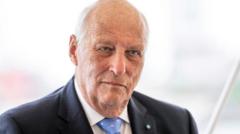
When news breaks that an eighty-something monarch steps back on medical leave, the mainstream media machine spins out a predictable script. We get the solemn bulletins, the hand-wringing over institutional stability, and the comforting clichés about the fragility of ancient traditions in a modern world.
Stop buying the sanitized narrative.
The media wants you to focus on the immediate health bulletin because it is safe, simple, and entirely misses the structural reality of modern European monarchies. King Harald V stepping back is not merely a medical footnote or an unfortunate bout of old age. It is a stress test of a system built on inherited optics, exposing how deeply vulnerable constitutional figureheads are when their primary currency is physical endurance.
The Lazy Consensus We Keep Buying
Every standard report on royal health follows the exact same playbook. They frame the monarch as an irreplaceable anchor, suggest that a temporary sick leave threatens the stability of the state, and treat medical bulletins as national crises.
This is institutional theater at its finest.
Modern Norway does not run on the physical heartbeat of an octogenarian in Oslo. The nation operates via a highly efficient parliamentary democracy, a trillion-dollar sovereign wealth fund managed by cold-eyed technocrats, and decentralized municipal governance. The King does not draft tax policy, sign emergency trade deals, or manage energy grids.
Yet, the press insists on treating a medical leave of absence as if the executive branch has been decapitated. Why? Because a functional democracy lacks the romantic narrative arc of a crown in peril. The lazy consensus relies on conflating personal health with systemic stability, keeping the public distracted from the actual mechanics of governance.
What the Commentators Missed Completely
Let us look at the structural mechanics of how constitutional monarchies handle succession and delegation. When a monarch takes sick leave, the crown prince steps in as regent. This is not an emergency improvisation; it is a designed constitutional redundancy.
The commentators hyperventilating over King Harald taking a step back ignore how institutional resilience actually works. True stability does not depend on a single human being enduring into their nineties. It depends on redundant fail-safes. Crown Prince Haakon has been groomed for this exact transition for decades. The handover is procedural, quiet, and legally airtight.
When analysts treat routine regency as a constitutional crisis, they insult the very legal frameworks that keep these countries stable. They treat the office of the head of state like a family-run corner shop where the manager's cold halts all business.
Real institutional strength is boring, bureaucratic, and entirely independent of one person's blood pressure.
The Cost of Mistaking Optics for Power
We live in an era obsessed with visibility. If a leader is not on camera waving from a balcony, the public panics. This obsession with constant presence is a disease born of twenty-four-hour cable news and social media validation.
I have watched corporate boards panic when a charismatic CEO takes medical leave, tearing up sound strategies because they confuse executive presence with operational execution. The same delusion applies to statecraft. We have been conditioned to believe that a monarch must be physically visible to be politically valid.
Think about what actually happens when the monarch steps aside. The administrative burden shifts entirely to the elected government. The Prime Minister and the Storting continue their work without missing a single legislative beat. The sovereign wealth fund continues investing globally. The fjords do not empty of tourists.
The only thing that suffers is the daily quota of royal gossip columns.
Rethinking the Role of the Modern Crown
If we want an honest conversation about the Norwegian monarchy, we need to strip away the sentimental veneer. The institution survives not because of the physical stamina of any specific king, but because it serves as an apolitical lightning rod, absorbing cultural friction so that elected politicians can fight over policy without dragging the national identity down with them.
When King Harald takes sick leave, it actually proves the viability of the model. A fragile institution demands perfection from its figurehead. A robust constitutional framework allows its figurehead to age, fall sick, and step back without the republic missing a single step.
The real story isn't that an elderly man needs medical rest. The real story is that our media is utterly incapable of discussing governance without projecting human melodrama onto cold machinery.
Stop looking at the hospital bulletin. Look at the balance sheet, the legislative calendar, and the silent, grinding gears of a state that functions perfectly well while the king rests.
Quit confusing a man's health with the health of a nation.