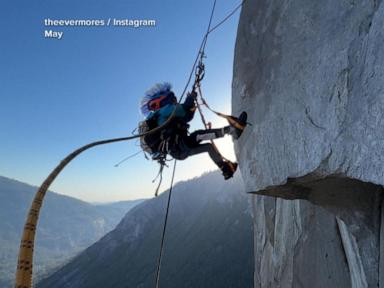
The internet lost its mind over a video of a father taking his seven-year-old son rock climbing. The comment sections filled up with the predictable shrieking of armchair safety officers. Professional panic merchants diagnosed the father as reckless, abusive, and dangerously unhinged. The consensus was swift and cowardly: children belong in padded rooms, bubbles, and rubberized enclosures until their prefrontal cortexes fully seal at age twenty-five.
We have built a civilization that treats physical risk as a moral failure. Also making waves in related news: Inside the Siberian Bio-Security Black Box That Has Global Health Officials on Edge.
Every time you shield a child from a scraped knee, a legitimate height, or the terrifying weight of their own bodily autonomy, you are not protecting them. You are amputating their capacity to cope with reality. The seven-year-old on that rock face was learning gravity, friction, fear management, and self-reliance. The pearl-clutchers online were learning how to raise adults who panic when the Wi-Fi drops.
Let us dismantle the sanitized mythology of modern risk aversion. More details regarding the matter are covered by Healthline.
The Sanitized Cage Is Not Safe
The foundational lie of contemporary parenting is that safety is a linear metric. The more padding you add, the safer the child becomes. The data says the exact opposite.
When you eliminate natural friction from an environment, you destroy a child's calibration mechanism. Kids who never fall off things never learn how to absorb an impact. Kids who never experience controlled terror never learn the neurological difference between actual mortal danger and garden-variety discomfort.
I have watched hyper-protected adolescents enter the real world and experience complete psychological paralysis over minor social rejection or a missed deadline. Why? Because their parents engineered a frictionless childhood. When every sharp edge is blunted, the first time the world pushes back with real force, the child shatters.
The rock climbing father understood something the critics refuse to acknowledge. Risk is not the enemy. Incompetence is the enemy. By giving his son a rope, a harness, and a vertical challenge, he was teaching the boy how to calculate hazard, manage adrenaline, and trust his own grip. That is not child abuse. That is an accelerated masterclass in competence.
The Bureaucracy of Risk Mitigation
Look at modern playgrounds. They are municipal apologies. Gone are the towering metal slides that baked in the summer sun, the asphalt surfaces that punished mistakes, and the high monkey bars that required actual upper-body strength. In their place stands a sterile ecosystem of molded plastic and thick rubber mulch designed to coddle mediocrity.
We traded structural resilience for liability insurance.
When you sanitize a child's world, you do not eliminate risk; you merely trade acute physical risk for chronic psychological frailty. The emergency rooms are not overflowing with kids who learned how to climb at age seven. They are overflowing with young adults suffering from acute anxiety disorders, catastrophizing ordinary stressors because they were never allowed to figure out how to stand back up after falling six feet into wood chips.
Physical risk is a proxy for agency. When a child stands at the base of a wall and chooses to look up, evaluate the height, and take the first step, a chemical transaction occurs in the brain. They discover that their survival is a function of their own focus. Take that away, make every climb impossible by default, and you teach a toxic lesson: you are fragile, incompetent, and entirely dependent on bigger people to keep you breathing.
The Illusion of Zero Harm
The critics of the rock-climbing video operate under the delusion of zero harm. They believe that if a child avoids every scrape and scare, they achieve a pristine state of optimal development.
This is biological illiteracy.
Muscles do not grow without micro-tears. Immune systems do not strengthen in sterile laboratories. Psychological fortitude does not materialize out of participation trophies and padded corners. It is forged in the crucible of legitimate, calculated exposure to consequence.
Imagine a scenario where a child is strapped into a stroller until age five, driven everywhere, enrolled exclusively in structured, adult-supervised activities with zero independent movement, and shielded from any environment where a stumble might draw blood. You do not get a healthy, balanced adult. You get an institutionalized dependent who treats minor inconveniences like catastrophic trauma.
The father on the rock wall was imposing a tax on his son's future weakness. He was paying upfront in anxiety so the kid wouldn't pay later in utter helplessness.
What Competence Actually Looks Like
Let us look at the mechanics of how children learn to survive.
Fear is an evolutionary alarm system. It is designed to sharpen focus, narrow attention, and prioritize survival. When a child feels genuine, manageable fear—standing ten feet off the ground with a rope system holding them—their brain goes through a rapid diagnostic. They test their grip. They look for the next foothold. They realize that whining changes nothing, but execution changes everything.
Remove that stimulus, and the alarm system misfires. Without real physical challenges to conquer, the modern adolescent brain invents threats out of thin air. It converts low-stakes social media interactions, academic pressures, and mild uncertainties into existential emergencies because it lacks a baseline comparison. It has never known what real, physical adrenaline feels like, so it panics over imaginary hazards.
If you want an independent, formidable kid, you have to let them get out of your reach. You have to let them experience the cold realization that if they let go, they fall. And then you have to let them hold on anyway.
The Cost of Cowardice
The people screaming about child endangerment online are projecting their own internal terror onto strangers. They are terrified of the world, so they demand that everyone else's children be muzzled, harnessed, and immobilized to match their own comfort level.
It is a profound form of cultural cowardice.
We are raising a generation conditioned to outsource every discomfort to an authority figure or an institutional safety protocol. We teach them that danger is something to be avoided at all costs, rather than something to be assessed, mitigated, and mastered.
The seven-year-old on that rock face has a better chance of navigating the brutal, unpredictable realities of the twenty-first century than a thousand kids raised in climate-controlled nurseries by parents who track their heart rates via smartphone.
Stop confusing comfort with safety. Stop confusing your own panic with your child's well-being. Let them climb the damn wall.