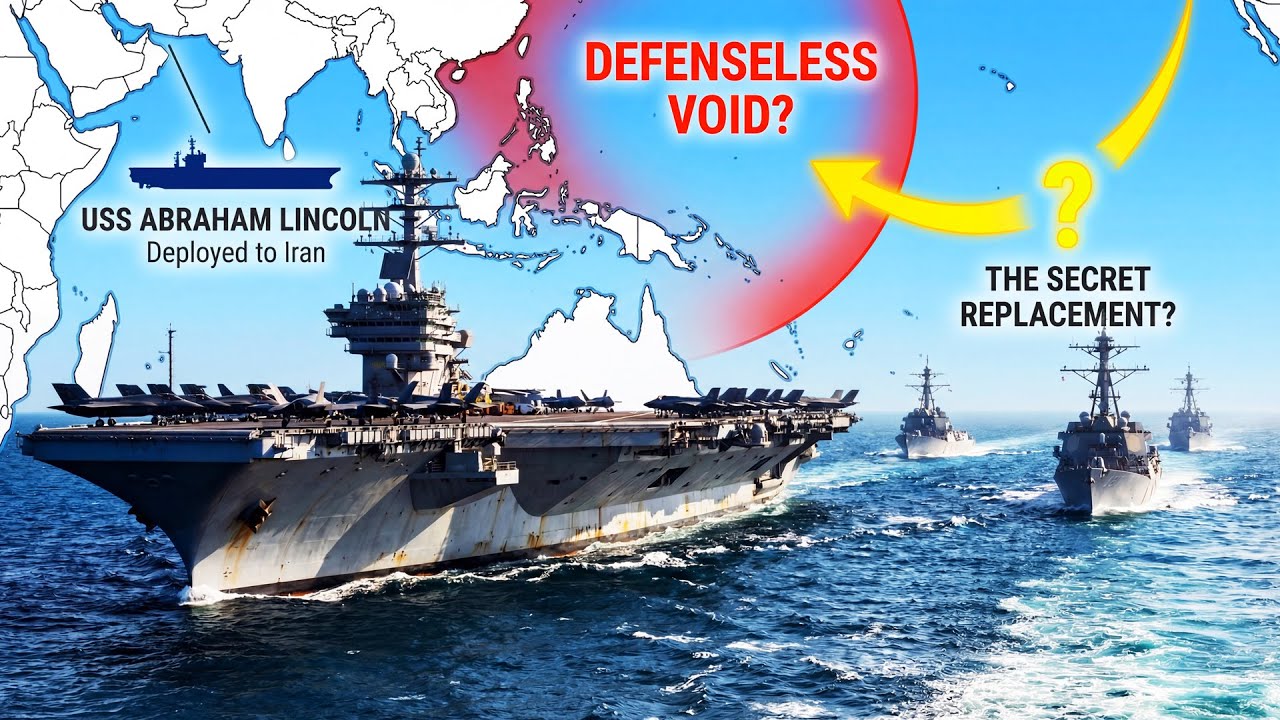
Strategic discipline is easy to proclaim when the map is quiet. It collapses entirely when an open-ended intervention bleeds the logistics chain dry. By ordering the nuclear-powered aircraft carrier USS George Washington out of the western Pacific and toward the Arabian Sea, Washington has stripped its primary Asian theater of its most visible maritime deterrent. This redeployment is designed to relieve the battered crew of the USS Abraham Lincoln, which has endured an extraordinary deployment exceeding 260 days in support of military operations against Iran. Yet trading a security anchor in Asia to feed a protracted quagmire in the Middle East exposes a fundamental structural failure in American force management, granting Beijing an unearned diplomatic and psychological windfall.
The immediate consequence of this movement is a rare carrier gap in the western Pacific. For decades, the continuous presence of a forward-deployed flat-top served as the physical manifestation of American security commitments to regional partners like Japan, South Korea, and the Philippines. When that deck disappears from regional waters, the power equation shifts.
Beijing does not need to launch an amphibious assault across the Taiwan Strait to capitalize on this vacuum. Psychological dominance in maritime geopolitics rarely arrives via sudden invasion; it accumulates through uncontested assertion.
The Anatomy of Logistical Overstretch
To understand why the USS George Washington was pulled from its station, one must examine the quiet breakdown of naval endurance. Modern carrier strike groups are extraordinarily complex ecosystems requiring continuous maintenance, logistical resupply, and mental bandwidth that finite hull numbers cannot indefinitely sustain. The USS Abraham Lincoln arrived in the Middle East ahead of the formal outbreak of hostilities, and the subsequent intensity of operations disrupted traditional supply networks in the region.
Combat actions forced naval logisticians into brutal triage. Essential munitions and operational capabilities took absolute precedence, while secondary needs—ranging from fresh provisions to mail delivery and standard crew rotation cycles—suffered profound degradation. When sailors spend upwards of eight months trapped in a high-threat combat zone under deteriorating quality-of-life conditions, operational readiness degrades from the inside out.
The Pentagon faces an unyielding mathematical reality. The United States Navy operates a finite number of nuclear carriers, and decades of high-tempo global commitments have worn down the maintenance rotation wheel. When a war in the Middle East demands continuous capital-ship presence, something elsewhere has to give.
That "something" is the Indo-Pacific, the very theater that successive administrations have officially designated as America's absolute top priority.
Beijing Quietly Rewrites the Regional Narrative
For the People's Liberation Army Navy, the temporary absence of an American carrier is an opening for narrative and operational expansion. China commands the world's largest naval force by sheer hull count, boasting more than 370 battle-force ships against a shrinking American inventory. While the United States retains an undisputed qualitative edge in nuclear propulsion, global logistics, and raw carrier aviation experience, numbers matter immensely in waters close to the Chinese mainland.
In regional flashpoints, perception dictates alignment. Smaller nations navigating the shadow of a rising superpower look to American naval power as the ultimate insurance policy against coercion. When that insurance policy temporarily sails west toward the Persian Gulf, regional capitals take notice.
Beijing can leverage this window to normalize aggressive gray-zone maneuvers. Enhanced patrols near the Scarborough Shoal, joint exercises with regional actors, and live-fire drills close to Japanese territory are executed not merely as tactical training, but as strategic signaling. The core message transmitted to Manila, Tokyo, and Jakarta is direct: Washington is chronically distracted by foreign adventures in distant deserts, while Beijing remains the permanent, unmovable geographic fixture of the neighborhood.
The Modern Utility of Floating Airfields
Beyond the immediate tactical optics, this crisis forces a hard analytical look at the survivability and utility of aircraft carriers in high-end peer conflicts. Defense strategists have long debated whether massive, 100,000-ton supercarriers are becoming liabilities rather than assets when facing sophisticated anti-access/area-denial networks equipped with precision long-range missiles and drone swarms.
An aircraft carrier represents an immense concentration of strategic value and vulnerability. In a confined theater like the western Pacific, keeping a multi-billion-dollar deck within range of sophisticated land-based strike systems carries severe risk. Conversely, shifting that same asset to the Middle East to fight a regional adversary exposes the fragility of a global force posture stretched too thin across multiple simultaneous crises.
The United States cannot maintain global hegemony through sheer kinetic exhaustion. Every month a carrier spends patrolling the Arabian Sea is a month its crew absorbs punishing wear, its nuclear reactor ticks closer to overhaul limits, and its presence is conspicuously absent from the geopolitical chessboard where the century's defining competition is actually unfolding.
Washington entered the Iran conflict with promises of focused deterrence, yet it is repeating the historical trap of getting sucked backward into Middle Eastern quicksand. As the USS George Washington steams across the Indian Ocean, the waters off the Asian coast grow quieter for American power, and much louder for Beijing.