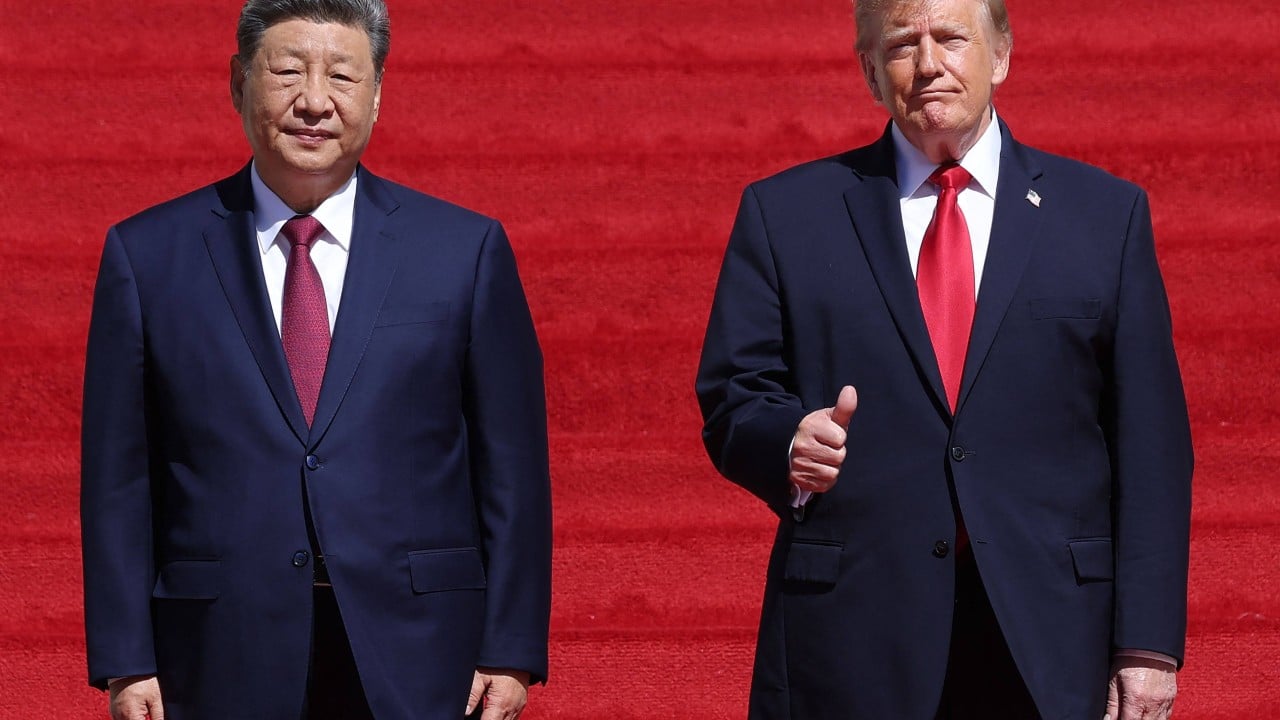
Financial officials love a good fairy tale. Paul Chan steps up to the microphone, adjusts his notes, and tells the business world that a handshake between Xi Jinping and Donald Trump is going to light a fire under market sentiment. It is a comforting narrative. It assumes that superpowers operate like corporate boardrooms, where a quick chat over canapés smooths out structural friction and restores the good old days of predictable trade flows.
It is completely detached from reality. If you liked this article, you should read: this related article.
I have watched executives flush millions down the drain waiting for geopolitical weather to clear while their underlying business models rotted from neglect. Markets do not run on optimism from Hong Kong financial secretaries. They run on capital allocation, margin pressure, and structural reality. The lazy consensus says a summit sparks a rally. The brutal truth is that summits in the current era of great power competition are little more than theatrical pauses in a permanent cold war.
Let us dismantle the core fallacy driving this institutional delusion. The assumption is that trade tensions are a temporary policy glitch. Fix the leaders' relationship, fix the trade deficit, fix the market. This view ignores the legal, technological, and security architectures that have been erected over the past decade. Export controls on semiconductors, supply chain decoupling, and national security vetting are not negotiable bargaining chips you trade away for a photo op. They are permanent fixtures of a fragmented global economy. For another angle on this development, refer to the recent coverage from Forbes.
When a finance minister predicts a positive market response to a summit, ask yourself what they are actually measuring. Short-term algorithmic bounces? Sure. Sentiment surveys filled out by corporate optimists who refuse to look at balance sheets? Absolutely. But real asset pricing cares about earnings, cash flow, and regulatory risk. None of those metrics improve because two leaders agree to establish a working group. In fact, uncertainty has become the baseline operating environment. Pretending otherwise is professional malpractice.
Consider the structural mechanics of cross-border capital right now. Foreign direct investment into mainland markets has slowed to a crawl, not because investors are waiting for a summit, but because structural risk pricing has permanently shifted. Compliance costs, data security laws, and geopolitical overhang mean that historical return-on-equity calculations no longer apply. A smiling handshake in Geneva or San Francisco does not repeal domestic security legislation or reverse capital flight restrictions.
The professional investors who actually make money in this environment stopped waiting for political breakthroughs years ago. They build redundancy into supply chains. They treat geopolitical friction as a fixed cost of doing business, like logistics or corporate tax. They do not reweight portfolios based on diplomatic communiqués. When retail investors and hopeful officials pile into a rally sparked by summit optimism, smart money uses that liquidity to exit vulnerable positions.
The obsession with top-level diplomacy also obscures the real ground-level dynamics. While officials talk about market access, local regulatory shifts and industrial policy are moving in the opposite direction. Both Washington and Beijing are doubling down on industrial self-sufficiency. That means protectionism is baked into domestic politics in both capitals. No amount of diplomatic charm is going to convince US lawmakers to hand over critical technology sectors or persuade Chinese planners to abandon import substitution goals.
If you build your portfolio strategy around the idea that a summit will reset the clock to 2015, you are positioning yourself for a brutal drawdown. The structural decoupling of the world's two largest economies is not a political whim. It is a tectonic shift driven by national security imperatives.
Stop treating geopolitical theater as a macroeconomic catalyst. Look at the balance sheets, evaluate the regulatory walls, and accept that the old rules are gone for good.