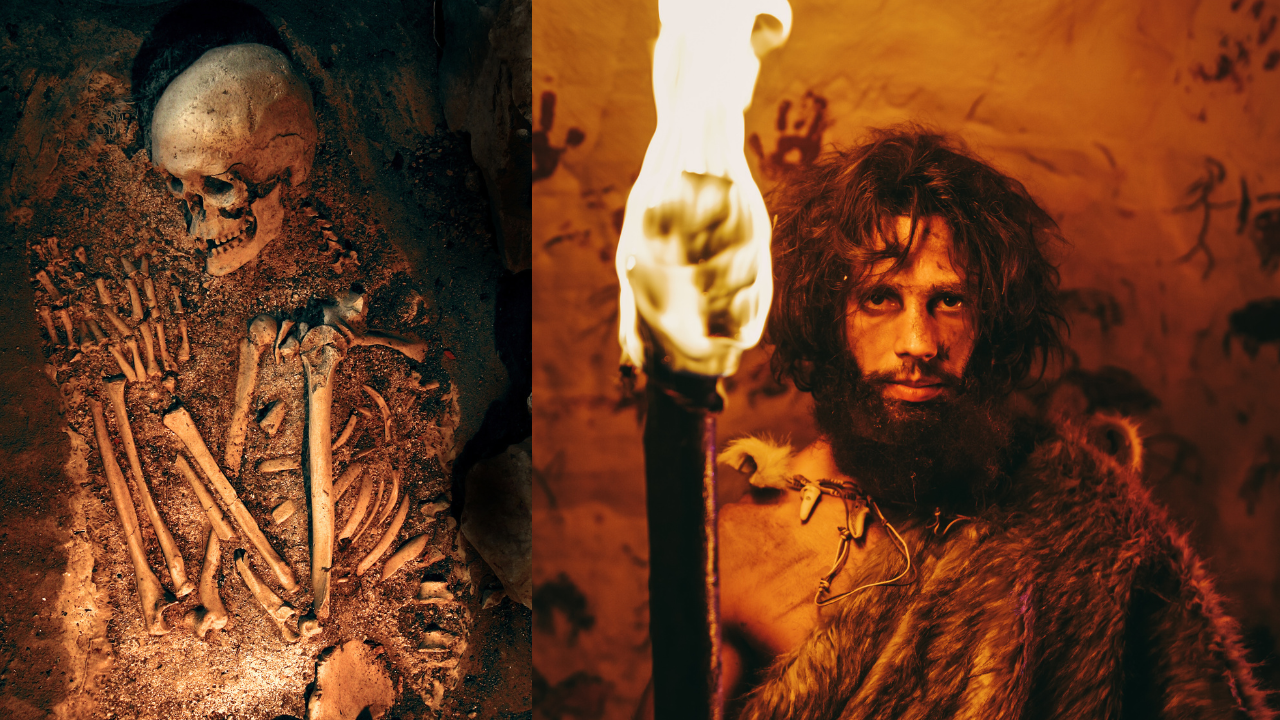
When you picture a Neanderthal getting hurt, you probably imagine a chaotic ambush involving a charging woolly mammoth or a cornered cave bear. We've spent decades assuming their brutal, short lives were mostly defined by wrestling massive Ice Age beasts at close quarters. That standard story just took a massive hit.
A Neanderthal who died 75,000 years ago may have been killed by a wooden spear deliberately aimed at his heart. Scientists examining the skeletal remains found evidence of a high-precision, lethal thrust straight into the chest cavity. That single anatomical detail changes how we look at interpersonal conflict among our closest evolutionary cousins.
It wasn't a random hunting accident. It was targeted, deliberate violence.
Why a Wound Near the Heart Changes Everything
Hunting accidents leave messy, unpredictable trauma. When an animal gores a hunter or a spear deflects off thick hide during a chaotic chase, the damage rarely looks like a surgical strike to a vital organ. A thrust aimed squarely at the heart requires intent, anatomical awareness, and close-range confrontation between individuals who knew exactly how to kill.
Let's look at the mechanics of a wooden spear in the Middle Paleolithic. Neanderthals didn't use lightweight throwing javelins like Homo sapiens later developed. They relied on heavy, thrusting spears—like the famous 300,000-year-old spruce spears recovered from Schöningen in Germany. You don't chuck a seven-foot wooden pike across a valley and accidentally hit a five-inch target between two ribs.
You drive it in with both hands.
When researchers analyze ancient rib cages, they look closely at the angle of entry, the fracture patterns on the bone, and the healing—or total lack of healing—around the lesion. An unhealed puncture wound aligned with the left thoracic cavity points to a fatal blow delivered face-to-face or in a tight, deliberate ambush. The victim didn't survive long enough for new bone tissue to form.
Honestly, this kind of forensic archaeology requires immense patience. When you're staring at mineralized bone fragments that have sat in cave sediment for seventy-five millennia, distinguishing post-mortem rockfall damage from a perimortem weapon strike is brutal work. Soil pressure crushes ribs all the time. Scavengers gnaw on fresh carcasses and leave circular pits that mimic spear tips.
To prove a wooden weapon caused the damage, paleoanthropologists have to rule out hyena teeth, limestone collapses, and excavation trowel marks. They use high-resolution micro-CT scanning and experimental archaeology—literally thrusting replica wooden spears into animal carcasses—to match microscopic bone striations. When the angles line up with the heart, the accident theory falls apart.
The Famous Precedent at Shanidar Cave
This 75,000-year-old case doesn't exist in a vacuum. If you want to understand how rare—and yet undeniable—targeted weapon trauma is in the Neanderthal fossil record, you have to look at Shanidar 3.
Discovered in Iraqi Kurdistan in the 1950s, Shanidar 3 was an older adult male Neanderthal who lived roughly 45,000 to 50,000 years ago. On his left ninth rib, archaeologists found a deep, V-shaped groove. For decades, researchers argued over what caused it. Was it a leaping leopard? A clumsy fall onto a sharp branch?
In 2009, paleoanthropologist Steven Churchill and his colleagues at Duke University ran ballistic and thrusting experiments to settle the debate. They tested stone-tipped projectiles launched at high velocity against heavy thrusting spears pushed with human muscle power. The fracture mechanics on Shanidar 3's rib matched a low-kinetic-energy projectile or a targeted thrust—not an animal claw, and not a fall.
Even wilder? Shanidar 3 actually survived the initial wound for a few weeks. Bone remodeling around the rib showed early signs of healing before he finally died, likely from a collapsed lung or secondary infection.
Compare that to this 75,000-year-old victim. While Shanidar 3 took a glancing blow to a lower rib and lingered, a strike aimed directly at the heart offers zero margin for survival. You pierce the pericardium or sever the major vessels around the heart, and massive internal hemorrhage kills you in minutes. No herbal poultice or group care saves you from that.
Debunking the Peaceful Noble Savage Myth
For a long time, popular science swung between two extremes when talking about Neanderthals. First, Victorian-era thinkers painted them as mindless, club-wielding brutes who bashed each other over the head for fun. Then, starting in the late twentieth century, the pendulum swung hard the other way.
Archaeologists discovered that Neanderthals buried their dead, cared for disabled elders like the famous blind, amputee individual Shanidar 1, made jewelry from eagle talons, and painted cave walls in Spain. Suddenly, the prevailing narrative turned them into gentle, misunderstood hippies of the Pleistocene.
Both extremes are wrong.
Empathy and lethal violence aren't opposites in human evolution—they are two sides of the exact same coin. The same tight-knit social bonds that motivated a Neanderthal clan to feed a crippled relative for years also fueled fierce territoriality, resource competition, and bitter blood feuds against rival groups.
Look at the broader trauma data across Eurasian Neanderthal skeletons:
- High rates of cranial fractures: Studies comparing Neanderthal skulls to early modern humans show an unusually high frequency of healed blunt-force trauma to the head, particularly on the left side—the exact spot you hit when facing a right-handed opponent.
- The St. Césaire blade wound: In France, a roughly 36,000-year-old Neanderthal skeleton bore a massive, healed cleft across the top of the skull caused by a sharp stone implement, almost certainly wielded by another hominin.
- Evidence of cannibalism: Sites like El Sidrón in Spain and Goyet in Belgium show clear cut marks, percussion fractures for marrow extraction, and signs of nutritional stress, proving Neanderthals occasionally butchered and ate their own kind.
Still, confirmed cases of fatal, weapon-inflicted chest trauma remain extraordinarily scarce. Most skeletal injuries we find are healed fractures—broken arms, cracked ribs, smashed noses. Finding the smoking gun of a lethal, targeted thrust to the heart is like finding a needle in a Pleistocene haystack.
Why Wooden Spears Were Deadlier Than You Think
People hear "wooden spear" and picture a flimsy pointed stick. That's a massive mistake.
Without stone tips, a fire-hardened wooden spear is still a terrifyingly effective weapon at close range. Experimental archaeologists who replicate Middle Paleolithic weaponry have shown that a heavy spear carved from dense wood like yew, spruce, or boxwood can easily penetrate tough animal hide, muscle, and rib cartilage when driven with full body weight.
Neanderthals had the upper-body musculature to make those weapons devastating. Their humeral bones—the upper arms—were significantly thicker and denser than ours, with massive muscle attachment ridges. They weren't built for long-distance marathon running like modern humans; they were built like compact, explosive powerlifters.
Imagine someone with that kind of upper-body strength driving a dense wooden point straight into an opponent's chest.
There's also a practical forensic reason we rarely see wooden spear trauma in the archaeological record. Stone points shatter on impact and leave microscopic flint chips embedded in bone—which is how archaeologists proved weapon violence at sites like Sunghir or Jebel Sahaba. Wood doesn't shatter into mineralized shards. Wood rots away within a few centuries unless trapped in an oxygen-free peat bog.
So when a wooden spear pierces soft tissue and slips between two ribs without hitting bone directly, it leaves almost zero trace on a skeleton. For a wooden spear strike to register 75,000 years later, the tip has to scrape, notch, or fracture a rib on its way toward the heart. That means for every one case scientists successfully identify, dozens of similar killings probably vanished without a skeletal trace.
Who Wielded the Spear
Whenever a 75,000-year-old Neanderthal murder mystery hits the headlines, one question immediately pops up: was this Neanderthal-on-Neanderthal violence, or did early Homo sapiens do it?
Let's look at the timeline and geography. Seventy-five thousand years ago sits squarely in Marine Isotope Stage 5a, right as the world was sliding back into harsher glacial conditions. At that exact time, Neanderthals were the undisputed masters of Europe and much of western Asia.
While modern humans had briefly ventured into the Levant (modern-day Israel and Palestine) around 100,000 to 120,000 years ago—leaving remains at Skhul and Qafzeh—those early populations largely retreated or died out before 75,000 years ago. The major wave of Homo sapiens expansion into Eurasia didn't kick off until roughly 50,000 to 60,000 years ago.
That timeline narrows the suspect list dramatically.
Unless this specific skeleton comes from a narrow geographic overlap zone in the Near East where stray populations briefly crossed paths, the killer was almost certainly another Neanderthal. Even in the Levant, there's zero archaeological evidence of large-scale inter-species warfare during this window.
Instead, we're looking at internal conflict. Maybe it was a territorial dispute over prime river-valley hunting grounds as cooling temperatures squeezed food supplies. Maybe it was a personal vendetta inside a small clan of fifteen or twenty individuals. When you live in tiny, isolated bands where everyone knows everyone, interpersonal friction has nowhere to go.
The Limits of Paleolithic Forensics
We need to stay honest about what science can and cannot tell us from a single damaged skeleton. Scientists use cautious words like "may have been killed" for a very good reason.
Paleoanthropology isn't CSI. We don't have eyewitnesses, soft tissue, or crime scene photos. Even with advanced 3D surface scanning and scanning electron microscopy, interpreting ancient bone trauma comes with built-in uncertainty.
Here's what experts have to weigh before calling a 75,000-year-old rib notch a deliberate spear thrust:
- Taphonomy vs. Trauma: Everything that happens to a body after death—water transport, sediment weight, trampling by cave bears, mineral crystallization—is called taphonomy. A sharp limestone edge pressed against a rib under ten feet of dirt can mimic a puncture wound if you don't examine the fracture margins under high magnification. Fresh bone bends and splinters differently than dry, mineralized bone.
- Hunting Accident vs. Homicide: Could another member of the hunting party have accidentally impaled him while both men lunged at a cornered red deer or bison? It's physically possible, though the steep downward or straight-on trajectory required to target the heart usually looks very different from the wild, upward angles seen during chaotic animal takedowns.
- Post-Mortem Mutilation: Could someone have thrust a spear into a corpse after death? Without vital signs or blood pressure, bone reacts the same way immediately after death (perimortem) as it does seconds before death.
Acknowledging these caveats doesn't weaken the discovery. It makes it stronger. Good science thrives on ruling out alternative explanations until the most plausible scenario stands alone.
How to Follow Ancient Forensic Discoveries Without Falling for Clickbait
Every few months, a sensational headline about ancient violence makes the rounds online, and half the time the actual peer-reviewed paper says something way more nuanced than the press release. If you want to read these discoveries with a sharp, critical eye, check three things before buying the hype:
- Look for the word "perimortem" versus "antemortem." Antemortem means the bone started healing, proving the victim survived the initial attack. Perimortem means the damage happened right around the time of death, which is much harder to separate from post-burial rock damage.
- Check whether the study used experimental replication. The strongest trauma papers—like the work done on Shanidar 3—don't just eyeball a hole in a bone. They build replica weapons, measure impact velocities, and test them on fresh bone to match the exact microscopic wear patterns.
- Pay attention to the archaeological context. A skeleton found dumped unceremoniously in a trash pit tells a wildly different story than a skeleton carefully placed in a flexed burial position with grave goods, even if both show lethal wounds.
Next time you read about a prehistoric skeleton, skip past the dramatic artist illustrations and look straight at the fracture mechanics on the bone itself—that's where the real story hides.