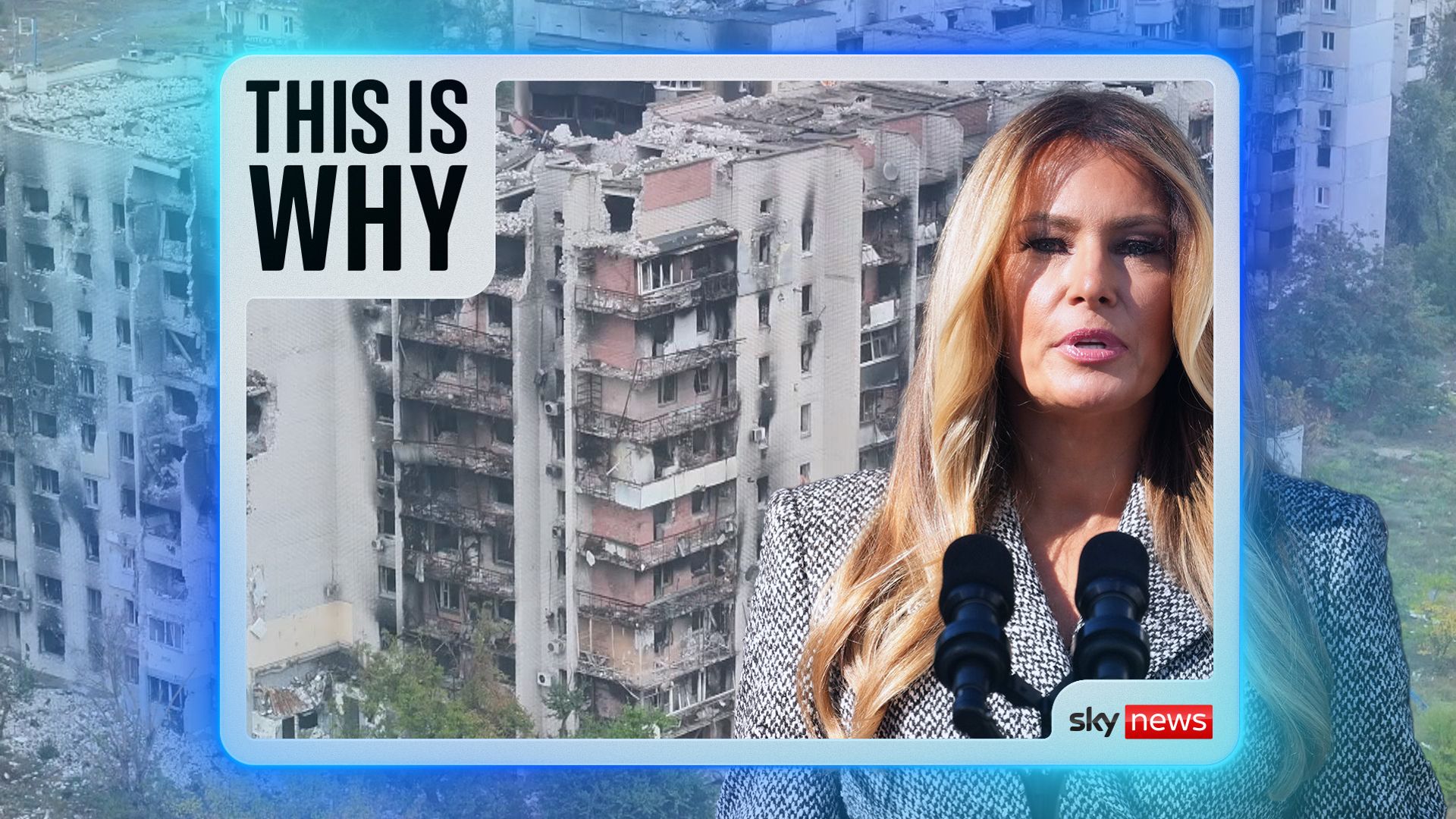
When news broke that First Lady Melania Trump had brokered a localized ceasefire in southern Ukraine, Washington pundits barely knew how to react. For years, diplomatic heavyweights had failed to pause the artillery along the Dnipro River. Then, quietly, a five-day humanitarian corridor opened in Oleshky.
It worked. Nearly 800 trapped civilians—mostly elderly residents and children—got out alive.
Yet the media coverage surrounding the Oleshky truce mostly missed the real story. Analysts spent days debating political optics in Washington while ignoring the brutal reality on the ground in Kherson Oblast. If you actually look at the geography, the logistics, and the human toll inside Oleshky, you realize this wasn't just a diplomatic novelty. For the people trapped behind Russian lines without water, heat, or medicine, Melania Trump's ceasefire was the difference between freezing to death this winter and surviving.
Why Oleshky Became a Humanitarian Death Trap
To understand why a localized pause in fighting mattered so much, you have to look at a map of southern Ukraine. Oleshky sits directly across the Dnipro River from the Ukrainian-held city of Kherson. Before Russia's full-scale invasion in February 2022, roughly 24,000 people called it home. Russian forces captured the town on day one of the war, turning a quiet riverfront community into a fortified frontline buffer zone.
Then came the June 2023 destruction of the Kakhovka Dam. Floodwaters swallowed roughly 90 percent of Oleshky's territory.
Since that disaster, the city has existed in a state of slow-motion collapse. Because Ukrainian forces hold the elevated right bank of the Dnipro while Russian troops occupy the low-lying left bank around Oleshky, the town sits directly beneath constant crossfire. Neither side could easily move heavy supply convoys through the area.
By autumn 2026, conditions inside the city had deteriorated past the breaking point. Residents lived without running water, electricity, or central heating. Food and basic medications had been scarce for months. Even worse, leaving wasn't a simple matter of packing a bag and walking away. Roads leading out of town were heavily mined, choked with burned-out civilian vehicles, and watched around the clock by FPV attack drones.
When winter approaches in southern Ukraine, a town without power or intact windows becomes uninhabitable. In Kyiv, desperate relatives of trapped Oleshky residents staged public rallies in October 2026 begging for a humanitarian corridor before freezing temperatures arrived. Without an explicit, enforceable pause in hostilities, any evacuation attempt was practically a suicide mission.
How Melania Trump's Ceasefire Came Together
Most people assume diplomatic breakthroughs happen in grand conference rooms with flags and cameras. This one started much more quietly.
According to White House briefings and reporting by the Associated Press, Melania Trump initiated discussions after learning about the worsening crisis in Oleshky during an event she hosted on the sidelines of the U.N. General Assembly. Rather than treating it as a symbolic talking point, her office opened direct backchannel coordination with both Russian and Ukrainian leadership.
She already had rare credibility with both sides. Over the preceding months, Melania Trump had quietly facilitated multiple child and family reunification missions between Moscow and Kyiv—a delicate diplomatic track that required trust from officials who barely spoke to each other. Ukrainian Parliament Commissioner for Human Rights Dmytro Lubinets, who served as Kyiv's chief negotiator for the Oleshky talks, publicly thanked the First Lady for stepping in while acknowledging how difficult the operation would be to pull off.
On October 23, 2026, the White House officially announced the localized truce. Four days later, at 0100 GMT on October 27, the guns around Oleshky fell silent.
The Mechanics Behind a Five-Day Truce
Anyone who has studied conflict zones knows that announcing a ceasefire is easy. Making it hold for five straight days on an active frontline is extraordinarily hard.
Melania Trump later noted that she stayed involved in the operational planning—and the specific details explain why the corridor actually worked. A real humanitarian evacuation requires far more than telling soldiers to stop shooting. Both militaries had to assign dedicated technical teams to handle four concrete problems:
- Demining access routes: Combat engineers had to clear anti-personnel and anti-tank mines from exit roads before buses or ambulances could safely move.
- Drone deconfliction: With reconnaissance and strike drones constantly buzzing over the Dnipro, both sides needed strict airspace protocols so operators wouldn't mistake evacuation vehicles for military targets.
- Medical triage and hospital access: Many of the civilians trapped in Oleshky were elderly or chronically ill, requiring immediate medical stabilization and pre-arranged hospital beds once they cleared the gray zone.
- Staged aid delivery: Under the terms outlined by Lubinets, the ceasefire took effect first, followed by trucks carrying food and medical supplies into the town, and finally the gradual extraction of civilians.
From October 27 through November 1, that choreography held. Nearly 800 civilians left Oleshky, and emergency supplies reached those who remained behind.
Why Localized Truces Beat Grand Peace Summits Right Now
Here is the uncomfortable truth that foreign policy purists hate admitting. Waiting for a comprehensive, war-ending peace treaty between Moscow and Kyiv has cost thousands of civilian lives while diplomats argue over borders, NATO membership, and security guarantees.
Grand summits stall because neither side wants to concede strategic territory. A localized humanitarian ceasefire sidesteps those existential deadlocks completely.
Think about what the Oleshky deal actually accomplished. Russia didn't surrender Kherson Oblast. Ukraine didn't abandon its sovereign claims. Yet by narrowing the scope strictly to one battered river town for 120 hours, negotiators removed the strategic stakes that usually poison diplomacy. Both sides could agree to let grandmothers and kids ride out on buses without feeling like they lost the war.
Honestly, this micro-diplomacy model is probably the most practical tool available in late 2026. Dmytro Lubinets explicitly pointed out that the Oleshky operation could serve as a blueprint for future humanitarian missions in other occupied settlements. When traditional statecraft hits a brick wall, unconventional envoys—especially a First Lady operating outside standard Pentagon or State Department friction—can sometimes pry open doors that career diplomats cannot.
The Limitations Nobody Should Ignore
Still, it would be reckless to pretend the Oleshky ceasefire solved Ukraine's humanitarian crisis. It didn't.
First, rescuing nearly 800 people is a monumental achievement for those families, yet thousands of vulnerable civilians remain trapped across occupied Kherson, Zaporizhzhia, and Donetsk regions under similar conditions. Even inside Oleshky itself, some elderly or immobile residents either couldn't reach collection points in time or refused to abandon their homes.
Second, temporary truces carry real operational risks. Skeptics in Kyiv and Western capitals rightly worry that localized pauses can be exploited by military commanders to rotate troops, repair fortifications, or resupply frontline positions under the cover of humanitarian aid. Verifying compliance in a heavily mined, drone-saturated river delta requires constant vigilance.
Third, a five-day pause doesn't rebuild a shattered city. Oleshky still lacks power grids, clean water infrastructure, and flood recovery. As long as artillery sits within range on both banks of the Dnipro, civilian life there remains impossible.
By November 21, 2026, Melania Trump publicly stated that negotiations are already underway for another ceasefire before Christmas on December 25, noting that a deal could happen quickly if both Moscow and Kyiv show willingness. Whether that next corridor opens in time for the holidays depends on whether both capitals keep treating humanitarian corridors as non-political lifelines rather than bargaining chips.
How to Follow and Support Verified Evacuation Efforts
If you're tracking the next round of humanitarian negotiations or looking for ways to support displaced families from Kherson Oblast, skip unverified social media fundraisers and stick to primary channels:
- Monitor official human rights briefings: Follow updates directly from Ukraine's Office of the Parliament Commissioner for Human Rights (led by Dmytro Lubinets) and the International Committee of the Red Cross, which verify actual corridor openings and civilian transit numbers.
- Verify where your donations go: If you donate to winter relief for evacuees leaving towns like Oleshky, prioritize established organizations operating reception centers in Kherson, Mykolaiv, and Odesa—such as the Ukrainian Red Cross Society or UNHCR—that provide immediate heating, trauma care, and temporary housing.
- Watch the technical markers, not just headlines: When new ceasefire talks are announced ahead of Christmas, look for concrete operational signs—specifically demining agreements, hospital readiness, and named transit routes. Without those logistics in place, a ceasefire announcement is just talk.
For deeper context on how this localized truce took shape, watch Melania Trump touts Oleshky ceasefire as spark for lasting Russia-Ukraine peace, which covers the First Lady's direct involvement in coordinating evacuation logistics and humanitarian aid.


