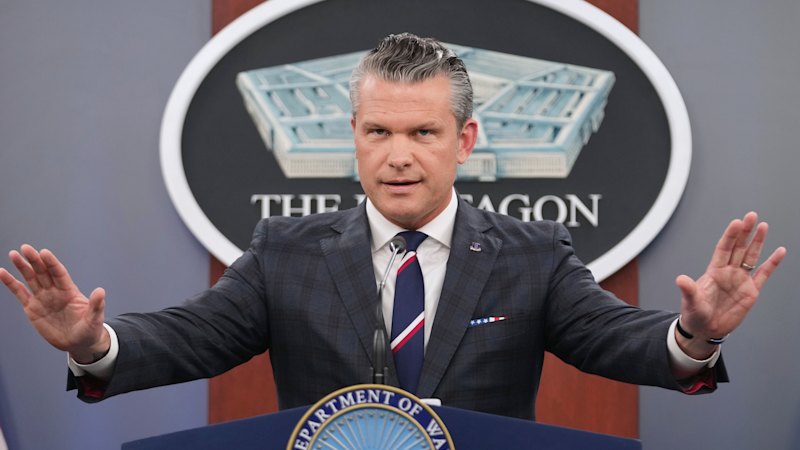
"We didn't start this war. Iran did 47 years ago."
Defense Secretary Pete Hegseth dropped that line while staring down an impeachment resolution from inside his own party. On the surface, it sounds like standard Washington spin—a Pentagon chief deflecting blame during a messy foreign conflict. Look closer, though, and you'll realize his defense isn't really aimed at historians or legal scholars. It's a calculated political shield built to survive a lame-duck Congress after a bruising midterm election. Meanwhile, you can explore other stories here: Why Trump Just Resurrected the 1983 Beirut Bombing to Justify War With Iran.
Most coverage of the November 2026 showdown between Hegseth and outgoing Republican Representative Thomas Massie treats it like a simple shouting match over history. That completely misses the constitutional fight happening underneath. Massie didn't accuse Hegseth of starting a cultural feud with Tehran in 1979. He accused him of violating the War Powers Resolution, ignoring a direct congressional withdrawal order, and running unauthorized military campaigns across three different countries.
Why Hegseth's 47-Year Argument Dodges the Real Charge
When Hegseth told reporters that Iran started the conflict 47 years ago, he was pointing back to the 1979 Islamic Revolution and the Tehran hostage crisis. Politically, it's a clean soundbite. It frames seven months of U.S. combat operations—dubbed Operation Epic Fury—as the final chapter of a half-century grievance rather than a brand-new war of choice. To explore the complete picture, we recommend the excellent report by NPR.
Legally? It doesn't answer a single question in Massie's resolution.
Under Article I of the U.S. Constitution, Congress holds the sole power to declare war. To enforce that boundary after Vietnam, lawmakers passed the War Powers Resolution of 1973, which requires a president to notify Congress within 48 hours of committing armed forces and limits unauthorized deployments to 60 days—plus a 30-day withdrawal window.
Here's where Hegseth's timeline runs into trouble. You can't use a hostage crisis from 1979 to bypass a 60-day statutory clock in 2026. Massie's resolution, introduced on November 9, 2026, laid out eight specific articles of impeachment against Hegseth. Three of those articles targeted the Iran war directly:
- Launching major combat operations against Iran without prior congressional authorization.
- Defying H. Con. Res. 86, a concurrent resolution passed by both chambers directing the removal of U.S. forces.
- Continuing military hostilities well past the War Powers Resolution's mandatory statutory deadlines.
Notice the gap between the charge and the defense. Massie brought a stopwatch and a copy of the U.S. Code. Hegseth answered with a history lecture and a press conference—his first formal Pentagon briefing in over six months.
The Other Conflicts Buried in the Impeachment Resolution
If you only read the headlines about Iran, you missed half of what put Hegseth in the crosshairs. Massie's eight articles weren't just about Tehran. They painted a picture of a Defense Department operating completely outside congressional guardrails on multiple fronts.
First, there's Venezuela. One article specifically targeted Hegseth's role in the unauthorized military operation that captured Venezuelan President Nicolás Maduro. While President Donald Trump praised Hegseth in the Oval Office for having "won the war" in Venezuela, critics in Congress pointed out that lawmakers never authorized an intervention there either.
Second, Yemen made the list. U.S. strikes against Iranian-backed Houthi rebels dragged on without a fresh Authorization for Use of Military Force, another point Massie cited as a direct violation of federal war powers law.
Third, the resolution went beyond troop deployments to examine how Hegseth ran the Pentagon internally. The remaining charges included ignoring legal requirements meant to minimize civilian casualties and retaliating against Democratic Senator Mark Kelly—a retired Navy captain—over a video reminding service members of their duty to refuse unlawful orders.
Calling all of that "partisan policy disagreements," as Hegseth did, is a classic Washington move. If you frame a constitutional dispute over war authority as mere bickering over strategy, you turn a legal question into a loyalty test.
How the Troops Became a Political Shield
Watch how Hegseth pivoted whenever reporters pressed him on the specifics of the resolution. Instead of debating the text of the War Powers Resolution, he made the impeachment push about the soldiers on the ground.
"These resolutions tell every one of them that their service was a crime," Hegseth argued. "Their service was not a crime. These are heroes." He went even further, calling the effort "sabotage" that handed a propaganda victory to American adversaries and amounted to punishing America's own warriors.
I've watched Pentagon officials deploy this exact rhetorical maneuver across multiple administrations, and it works for one simple reason: nobody in Congress wants to look like they're attacking the troops. By fusing his own job security with the honor of rank-and-file service members, Hegseth forced wavering Republicans into a corner. Voting to advance the articles meant risking headlines claiming you voted against American soldiers during an active war.
It's worth noting, though, that not everyone in uniform bought the framing. Janessa Goldbeck, CEO of the Vet Voice Foundation, pushed back hard against the idea that impeaching a Cabinet secretary equals attacking the military. Her group argued that the articles were strictly about whether Hegseth abused the powers of his office in ways that damaged the constitutional system itself. Even within the Pentagon's own history, Hegseth's claim that no defense chief had ever faced impeachment scrutiny for military operations glosses over how rare Cabinet impeachments actually are—only two Cabinet secretaries in U.S. history have ever been impeached.
The Midterm Fallout Nobody in the GOP Wants to Admit
You can't separate this impeachment drama from what happened at the ballot box just days earlier. In early November 2026, Republicans suffered a brutal midterm defeat, losing control of both the House and the Senate ahead of the new Congress convening in January 2027.
Why did voters punish the party in power? Look at the numbers. According to an AP Voter Poll surveying more than 100,000 Americans, roughly 6 in 10 voters said the United States made the wrong decision taking military action against Iran. Seven months into the conflict, shipping disruptions in the Strait of Hormuz—a chokepoint where roughly a fifth of the world's oil moved before the fighting—had driven up energy costs and squeezed household budgets. Meanwhile, Pentagon figures put the direct price tag of the Iran war at over $48 billion.
Even President Trump privately and publicly grappled with the political damage, though he flatly ruled out firing Hegseth. Instead, Trump stood by his Pentagon chief, boasting that Hegseth had "done a fantastic job" and had successfully purged "woke" four-star generals from the brass.
That dynamic explains why Massie's timing was so explosive. Massie wasn't a random backbencher; he was an outgoing Kentucky Republican who had lost his primary earlier in 2026 after Hegseth personally campaigned for his opponent, Ed Gallrein. Critics dismissed Massie as a "disgruntled defeated congressman" settling a personal score before leaving office in January. Massie didn't even deny the personal history, telling reporters dryly that he was indeed defeated, though not disgruntled.
Personal grudge or not, Massie found a nerve. Plenty of Republicans blamed the unpopular Iran war for their midterm wipeout, yet almost none of them wanted to break ranks publicly while Trump still held the Oval Office.
Why the House Vote Saved Hegseth Only Temporarily
On November 10, 2026, the House voted 211 to 204 to refer Massie's impeachment resolution to the Republican-controlled House Judiciary Committee. In congressional procedure, sending a privileged resolution to a friendly committee during a lame-duck session is the polite way of suffocating it. Seven Republicans and eleven Democrats missed the vote entirely, and GOP leadership successfully shielded Hegseth from a humiliating floor rebuke.
Trump immediately celebrated on social media, declaring that the impeachment push had "miserably FAILED!" Hegseth's allies inside the Pentagon flooded social media with graphics reading "Stand. Fight. Defend the Republic."
Here's the catch they're ignoring: a procedural block in November 2026 isn't an acquittal. It's a two-month delay.
Come January 2027, Democrats take control of both chambers of Congress. House Minority Leader Hakeem Jeffries made it clear right after the vote that the fight was just getting started. Representative Adam Smith, lined up to chair the House Armed Services Committee once Democrats take the gavel, has already promised aggressive oversight into the Iran war, the firing of senior military planners, and what he described as the erosion of the military's nonpartisan foundation.
Even if a Democratic House votes to impeach Hegseth in early 2027, removing him from office remains a steep uphill climb. Conviction in the Senate requires a two-thirds supermajority—67 votes—which means at least a dozen Republicans would have to vote to oust a sitting president's Defense Secretary. Unless the war spirals dramatically worse or public pressure becomes unbearable, those Senate votes simply aren't there.
How to Read the Next Phase of the Iran War Standoff
If you're trying to follow where this goes from here without getting lost in partisan noise, watch three specific pressure points over the next sixty days:
- War Powers Resolutions in the Lame-Duck Session. Massie noted after the impeachment vote that he still intended to force votes on standalone War Powers resolutions. Unlike impeachment, a War Powers vote doesn't require accusing anyone of high crimes—it simply forces lawmakers on the record about whether U.S. troops should stay in combat without congressional approval.
- White House Signals on Winding Down Operations. Trump has swung between threatening fresh strikes and hinting that the U.S. is close to meeting its objectives and winding down major operations. Watch whether the administration quietly scales back strikes before January so Democrats inherit a de-escalating conflict rather than an active shooting war.
- Subpoenas Over Congressional Briefings. Once Democrats take committee gavels in January, expect immediate subpoenas for Pentagon legal memos justifying Operation Epic Fury, the Maduro capture, and the Houthi strikes. The real battle won't be a Senate trial—it'll be forcing the Defense Department to hand over the legal paperwork it kept hidden throughout 2026.
Hegseth won the news cycle by turning a constitutional crisis into a soundbite about 1979. Whether that soundbite survives contact with subpoena power in January is a completely different question.