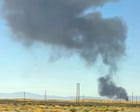
A massive plume of black smoke over the Mojave Desert just exposed the severe strain on American air power. On Monday, June 15, 2026, a B-52 Stratofortress crashed seconds after taking off from Edwards Air Force Base in California. All eight people on board died instantly. The aircraft, a giant eight-engine bomber designed in the Cold War era, was completely destroyed, leaving behind a charred scar larger than a football field.
Military officials already admitted the investigation could take up to six months. Aviation experts point toward immediate controllability issues, but the real story goes much deeper than a simple mechanical malfunction. This tragedy reveals the dangerous reality of pushing seventy-year-old airframes to their absolute limits while simultaneously asking a shrinking fleet to police global conflicts.
The defense infrastructure is struggling. We need to look at what actually happened and why keeping these flying fortresses in the air is becoming an existential gamble.
The Tragic Flight of the BUFF
The aircraft took off at 11:10 a.m. local time on what the Air Force called a routine test mission. It didn't last long. Radar tracking data reveals that the plane initially headed northeast, creeping up in altitude before making a sharp, unnatural hook to the northwest. Seconds later, it plunged toward the desert floor at a terrifying rate of more than 5,000 feet per minute.
It hit the ground at 11:20 a.m. The impact was catastrophic.
Colonel James Hayes, deputy commander of the 412th Test Wing at Edwards, confirmed that the crash was entirely unsurvivable. The crew was a mixed group. It included active-duty military personnel, civilian government workers, and defense contractors. Aerospace giant Boeing confirmed that two of its own employees were among the dead.
When an aircraft that size drops out of the sky right after takeoff, you aren't looking at a minor pilot error. You are looking at a system failure. Jeff Guzzetti, a former accident investigator for the Federal Aviation Administration, noted that the immediate loss of altitude suggests a severe controllability issue. It could be a catastrophic engine failure, a complete loss of flight control surfaces, or a major issue with new experimental hardware installed on the plane.
The Upgrades Driving Ancient Bombers to the Edge
The specific B-52 involved in Monday's disaster was flying in support of the Air Force's Radar Modernization Program. The military has been aggressively trying to swap out the aircraft's antiquated, decades-old radar systems with a modern Active Electronically Scanned Array system. Boeing had delivered a modified test aircraft to Edwards recently to push through these exact flight trials throughout 2026.
The goal sounds great on paper. The Pentagon wants to keep the B-52 fleet flying until 2050. Think about that for a second. By 2050, some of these airframes will be nearly a century old.
The Air Force loves the B-52 because it's a legendary workhorse. It carries massive payloads and flies across continents. But structural fatigue is real. Metal gets tired. Wiring degrades. When you pack cutting-edge electronics and heavy modern systems into a fuselage manufactured during the Kennedy administration, you introduce unpredictable variables.
We don't know yet if the radar modification directly caused the crash. Investigators will spend months sifting through the blackened debris to find out. But the rush to modernize an aging fleet highlights a desperate bottleneck in American defense procurement.
An Overstretched Fleet Reaching Its Breaking Point
This isn't an isolated incident happening in a vacuum. The U.S. military is currently operating under massive operational pressure. Right now, the Air Force is deploying bombers, fighters, and refueling tankers all over the Middle East to support heavy combat campaigns. B-52s have been flying intense missions overseas, serving as a blunt instrument of American air dominance.
But maintaining that dominance comes at a brutal cost. Retired Air Force officials are starting to speak out about the state of the fleet. The current Air Force is the smallest and oldest it has ever been since its inception in 1947.
Look at the timeline of recent mishaps. Just a few months ago, in March, six American troops died when two KC-135 refueling tankers collided midair over Iraq during operational missions. Now, we have eight more lives lost in the Mojave Desert. The planes are old, the crews are tired, and the operational tempo isn't slowing down.
When you ask a shrinking inventory of ancient planes to meet non-stop global demands, accidents happen. Maintenance schedules get squeezed. Test missions get compressed. The system breaks.
What Happens Next on the Flight Line
Do not expect the Air Force to ground the B-52 fleet anytime soon. They can't afford to. Even as the military prepares to slowly introduce the new B-21 Raider stealth bomber, the B-52 remains the backbone of the strategic bomber trio.
Over the coming weeks, the Air Force Safety Investigation Board will secure the site, recover data logs, and analyze the engine cores. If you run a defense facility or work within aerospace contracting, expect a massive tightening of safety protocols around experimental flight testing immediately. Ground crews will likely face mandatory inspections on all B-52 control linkages and engine cowlings across every base from Barksdale to Minot.
The tragedy at Edwards should serve as a stark warning. Modern technology can do incredible things, but it cannot completely outrun the laws of physics and structural aging. If Washington wants to maintain a global presence, it has to stop relying entirely on upgrading museum pieces and start properly funding a modern fleet before more lives are lost in the desert dirt.