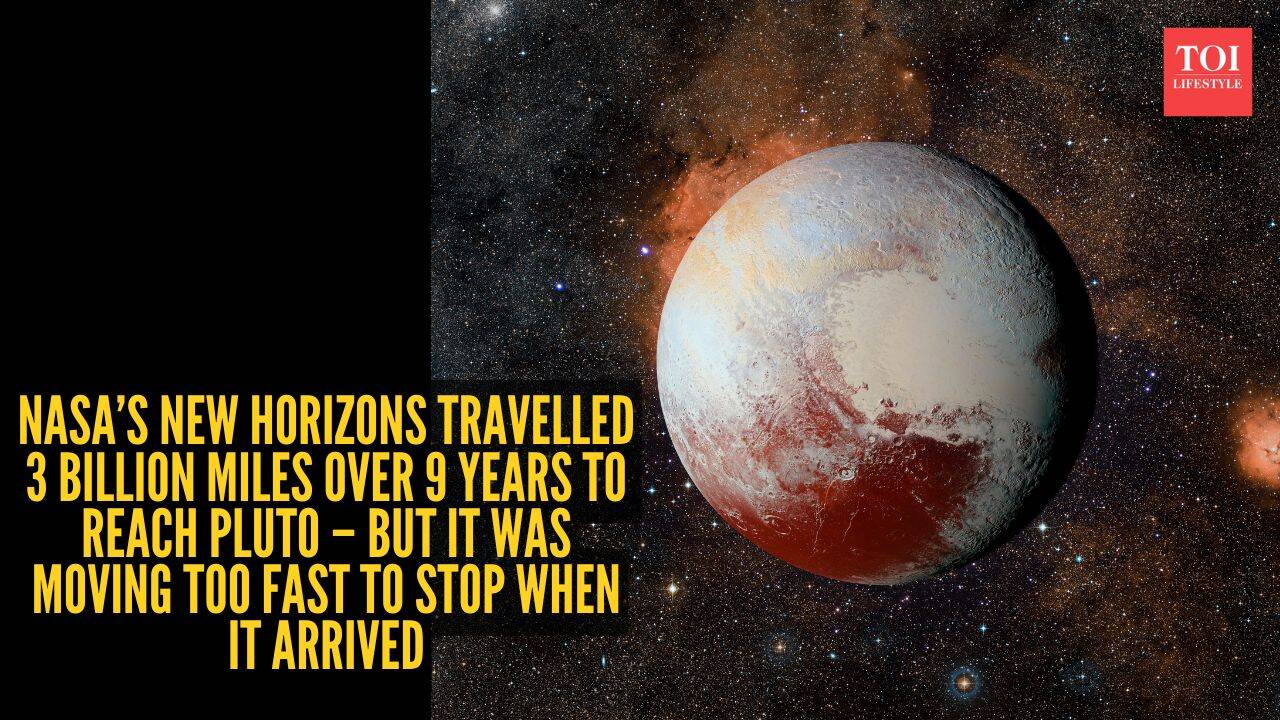
The narrative surrounding NASA’s New Horizons mission often carries a note of tragic irony. A spacecraft travels three billion miles over nearly a decade, executing a flawless cosmic sprint, only to flash past its primary target in a matter of hours. To the casual observer, it looks like a design flaw. Newspapers framed it as a missed opportunity, asking why we spent hundreds of millions of dollars just to take a few hurried snapshots of Pluto before plunging into the dark abyss of the Kuiper Belt.
The truth is far more calculated. New Horizons didn't stop at Pluto because stopping was physically impossible under the laws of modern rocketry. From its very inception, the mission was designed as a high-speed flyby, a deliberate compromise forced by the brutal mathematics of orbital mechanics and the limits of chemical propulsion.
The Tyranny of the Rocket Equation
To understand why New Horizons blew past Pluto at a staggering 31,000 miles per hour, you have to look at how it left Earth. Rocket science is governed by a ruthless mathematical boundary known as the Tsiolkovsky rocket equation. In simple terms, if you want a spacecraft to go faster, you need more fuel. But fuel has weight. So to carry that extra fuel, you need even more fuel just to lift the weight of the fuel itself.
NASA launched New Horizons in January 2006 atop an Atlas V rocket, paired with a powerful Centaur upper stage and a solid-propellant booster. It was the fastest object ever launched from Earth, clearing the Moon's orbit in just nine hours.
Speed was the absolute priority. If the spacecraft had traveled at the leisurely pace of the Voyager probes, the journey to Pluto would have taken two decades. By that time, Pluto’s highly elliptical 248-year orbit would have carried it further away from the Sun, causing its thin atmosphere to freeze completely and collapse onto the surface. Scientists needed to get there fast to witness the planet's atmospheric dynamics before they vanished.
The immense speed required to reach Pluto within nine years created an insurmountable problem for the arrival phase. To slow down and enter orbit around Pluto, New Horizons would have needed to execute a massive "burn" of its engines, firing them in reverse to shed that 31,000 miles per hour of velocity.
Doing that requires a colossal amount of propellant. To carry enough fuel to decelerate a piano-sized spacecraft from interplanetary speeds into a gentle orbit, the launch vehicle back on Earth would have needed to be impossibly large. We would have needed a rocket the size of a skyscraper just to send a tiny camera to the edge of the solar system.
Gravity Assists and the Tradeoff of Distance
Space agencies regularly bypass fuel limitations by using gravity assists, stealing a bit of orbital momentum from massive planets like Jupiter to whip a spacecraft toward its destination without burning a drop of fuel. New Horizons did exactly this in 2007, using Jupiter's gravity to shave three years off its transit time to Pluto.
Gravity can give, but it can also take away. To slow a spacecraft down using a planet's gravity, you have to approach the planet from a specific angle that bends your trajectory into a deceleration curve.
Pluto lacks the gravity required for this maneuver.
It is a dwarf planet, possessing only a fraction of the mass of Earth's Moon. When New Horizons arrived, Pluto’s gravitational pull was far too weak to capture a spacecraft moving at interplanetary speeds. The probe was simply moving too fast, and Pluto was too small to act as an effective brake. The spacecraft zipped through the Plutonian system like a bullet passing through a cloud of smoke.
What a Flyby Captures That an Orbiter Misses
While the public lamented the brief duration of the encounter, planetary scientists recognized that the high-speed flyby offered distinct operational advantages.
An orbiter gets trapped in a specific gravitational well, spending months or years looking at the same body from varying angles. A flyby, however, provides a continuous, dynamic shift in perspective over a short window. As New Horizons swept past, it was able to look at Pluto’s backlit atmosphere against the Sun. This specific alignment, known as solar occultation, allowed the onboard Alice spectrometer to map the composition and structure of Pluto's atmosphere with incredible precision, measuring how atmospheric gases absorb sunlight.
This architecture also enabled the spacecraft to study Pluto's five moons—Charon, Styx, Nix, Kerberos, and Hydra—in rapid succession. A traditional orbital insertion around Pluto would have required so much trajectory manipulation that visiting or imaging these smaller, chaotic moons at close range would have been secondary to fuel conservation.
The High Stakes of the Flyby Window
Operating a spacecraft that cannot stop means your margin for error drops to zero. During the approach phase in July 2015, the mission team faced a terrifying reality. If New Horizons struck a piece of debris as small as a grain of rice while traveling at 31,000 miles per hour, the kinetic energy would have obliterated the probe instantly.
Because Pluto is so far away, radio signals take roughly 4.5 hours to travel one way to Earth. Real-time piloting was impossible. The entire flyby sequence had to be pre-programmed into the spacecraft's flight computer months in advance.
Every second was choreographed. The instruments had to pivot, image, measure, and store data on internal flash drives without a single hiccup. If a camera missed its cue by two minutes, it would end up photographing empty space, and nine years of travel would yield nothing but blurry gradients.
The strategy paid off. The data retrieved transformed our understanding of the outer solar system. Instead of a dead, cratered ice ball, New Horizons revealed a geologically active world featuring vast plains of nitrogen ice, towering water-ice mountains, and a hazy, blue atmosphere.
Beyond Pluto and Into the Kuiper Belt
Had New Horizons slowed down to enter orbit around Pluto, its mission would have ended there. The spacecraft would have eventually run out of maneuvering fuel or succumbed to the extreme cold, remaining a permanent satellite of the dwarf planet.
Because it maintained its velocity, New Horizons kept going. It utilized its remaining fuel not for a massive deceleration burn, but for minor course corrections that directed it toward Arrokoth, a primitive Kuiper Belt object located a billion miles beyond Pluto.
In January 2019, New Horizons achieved the most distant flyby in human history, capturing images of a contact binary object that looks like a pristine space snowman. This second encounter offered insights into the building blocks of the solar system that an orbiter at Pluto could never have gathered.
The engineering behind New Horizons was an exercise in extreme realism. It accepted the limits of propulsion technology to maximize scientific output within a human lifetime. It was a sprint, not a marathon, and the velocity that prevented it from stopping was the exact tool that made the entire journey possible.

:max_bytes(150000):strip_icc():focal(842x0:844x2)/twin-peaks-billy-zane-040425-70a37fe9a7cb4ffb9e7821106c80f296.jpg)

