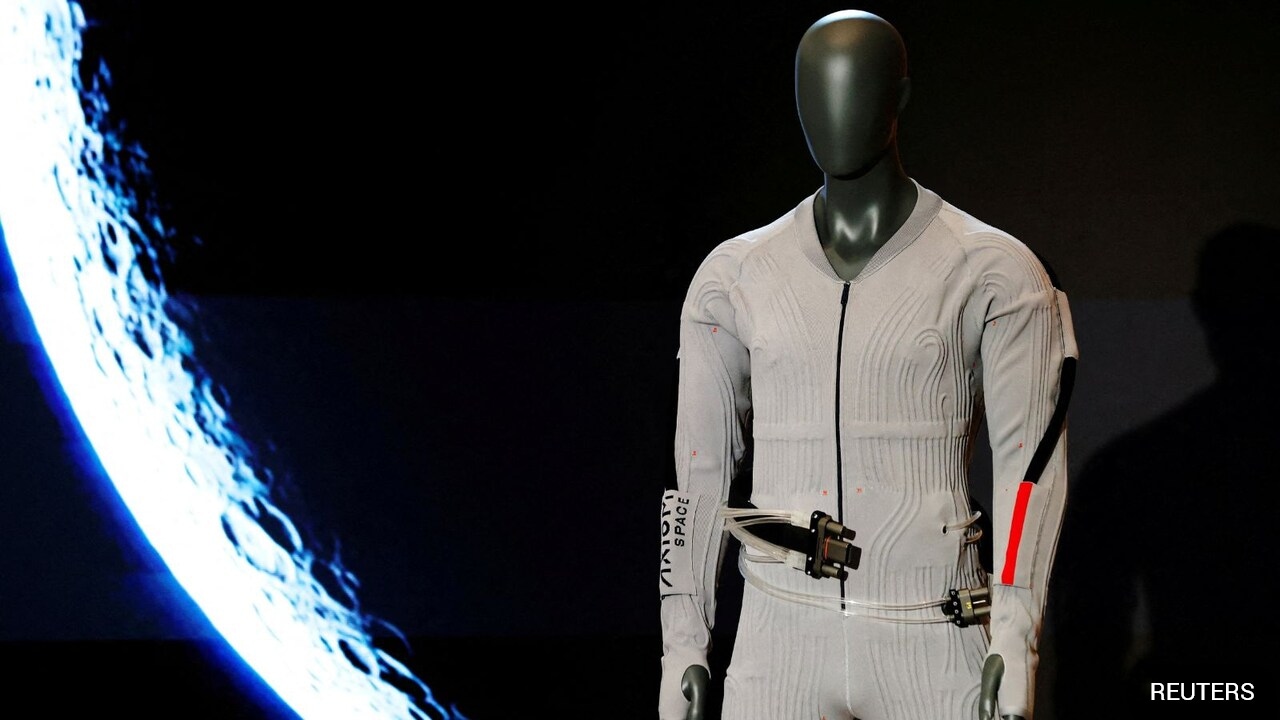
The media is swooning over high fashion in low gravity. When Axiom Space partnered with Italian luxury house Prada to design the outer layers of the Axiom Extravehicular Mobility Unit for the upcoming lunar missions, tech journalists and style columnists alike fell over themselves. They called it a historic convergence of engineering and haute couture. They praised it for making spaceflight cool again.
They bought the PR stunt hook, line, and sinker.
The collective infatuation with luxury spacesuits masks a grim reality about modern aerospace procurement. We are celebrating a cosmetic veneer while ignoring a staggering systemic stagnation. The Prada partnership is not evidence that we are living in the future; it is definitive proof that we have run out of ideas for how to actually build it.
For decades, the aerospace sector operated under a rigorous, utilitarian ethos. Form followed function because any deviation meant catastrophe. Today, a worrying shift toward aesthetics over engineering substance threatens to slow down actual exploration.
The Golden Cage of Aesthetic Engineering
Let us strip away the marketing gloss. What does a luxury fashion house actually contribute to a pressurized life-support system designed to withstand extreme thermal swings from minus 250 to plus 250 degrees Fahrenheit?
Very little. Axiom itself admits that Prada’s role was heavily focused on the outer layer and design touches. The critical engineering—the portable life support system, the pressure bladder, the joint articulation mechanics—remains the grueling work of aerospace engineers who do not show their work on Milan runways.
I have spent years watching defense and aerospace contractors manage complex programs. When a project starts leaning heavily on external lifestyle branding, it is almost always a diversionary tactic. It suggests the core technology is either behind schedule, over budget, or failing to deliver the revolutionary breakthroughs originally promised. You do not need a luxury logo to validate a machine that works flawlessly.
Consider the baseline mechanics of a spacesuit. It is essentially a human-shaped spacecraft. It requires meticulous layering of aluminized Mylar, Kevlar, Nomex, and specialized elastomers. The challenge in modern suit design is not making the shell look sleek. The challenge is managing mobility under pressure. When a suit inflates to its operating pressure of roughly 4 to 5 pounds per square inch relative to a vacuum, it becomes rigid. Moving a finger or bending a knee requires fighting against the internal pressure of the suit. This causes intense physical fatigue.
Prada's expertise in textiles does not solve the physics of torque at the elbow joint. It does not solve the problem of lunar dust mitigation, where jagged, electrostatic particles threaten to shred fabric seals and clog mechanical bearings. By focusing the public conversation on the elegant stitching and tailored silhouette of the outer layer, we are prioritizing how an astronaut looks over how long an astronaut can survive on the lunar surface without exhausting their life support reserves.
The Flawed Premise of the Space Tourism Economy
The underlying justification for these branding exercises is that space exploration needs to appeal to the commercial market. The argument goes that as space travel democratizes, private citizens will demand comfort, style, and brand recognition.
This is a fundamental misunderstanding of the current state of technology. Spaceflight is nowhere near democratization. It remains an incredibly hazardous, low-margin, high-risk endeavor where every extra ounce of weight costs thousands of dollars to loft into orbit.
When you look at the questions people ask about modern space programs, you see a flawed premise repeated constantly. People want to know when spacesuits will become as comfortable as athleisure. They ask why NASA cannot just outsource all design to commercial entities to speed up production.
The honest answer is brutal: you cannot optimize a life-support system for comfort or style without directly compromising its redundancy and safety margins. The moment you introduce a design constraint based on visual appeal, you constrain the engineering team. If a specific routing for an oxygen line or a backup communication antenna ruins the clean lines of a fashion brand's aesthetic vision, a conflict arises that should never exist in a high-hazard environment.
The Danger of Commercial Distractions
NASA's shift toward the Commercial Crew program and commercial lunar contracts was intended to reduce costs through competition. Instead, it has created a corporate ecosystem that prioritizes optics and shareholder-facing milestones over raw technical capability.
When contractors spend valuable time and capital negotiating intellectual property agreements, branding guidelines, and co-marketing campaigns with luxury conglomerates, they are diverting intellectual bandwidth away from the hard problems. The United States has struggled for over a decade to produce a reliable, next-generation spacesuit to replace the aging Extravehicular Mobility Units currently used on the International Space Station. The current suits are decades past their design lifespan, suffering from water leaks and component degradation.
The solution to a critical shortage of operational hardware is not a high-profile fashion collaboration. It is rigorous testing, manufacturing scale, and relentless focus on life-support reliability.
There is an inherent downside to taking this contrarian, purely utilitarian stance. It makes the engineering process look boring. It does not generate viral social media impressions. It does not attract the casual observer who cares more about the lifestyle of an astronaut than the delta-v required to get them home. But boring engineering is what keeps people alive in places where there is no air.
Strip Away the Gloss
The aerospace industry needs to stop trying to look like a science fiction movie and start delivering on the basic metrics of reliability and cost efficiency. The metrics that matter for Artemis are simple:
- Total hours of EVA capability per suit before requiring depot-level maintenance.
- Resistance to lunar regolith abrasion over extended deployments.
- Mass efficiency relative to payload constraints.
Nowhere on that list will you find a metric for brand equity or silhouette symmetry.
If we continue down the path of valuing the superficial presentation of technology over its structural integrity, we will end up with beautifully photographed missions that cannot sustain a prolonged human presence beyond low Earth orbit.
Stop celebrating the logos on the outside of the suit. Start interrogating the life-support metrics on the inside. Turn off the runway lights and turn back on the thermal vacuum chambers.