A whistle blowing through a limestone sinkhole in 1990 changed global geography, though nobody knew it at the time. A local logger named Ho Khanh was seeking shelter from a sudden, violent storm deep within the primary rainforest of central Vietnam. He stumbled upon an opening in the karst cliffs, feeling a blast of cold wind and hearing the roar of an invisible river rushing through the dark. When he returned to his village, the exact location slipped from his memory, swallowed by the dense canopy of the Phong Nha-Ke Bang region. It would take nearly two decades, an obsessive search, and a team of British cave experts to relocate the mouth of Hang Son Doong. When they finally mapped it, they discovered a subterranean world so vast it defies standard geology, containing chambers that could hold a 40-story skyscraper or an entire fleet of commercial aircraft.
But the real story of Son Doong is not its staggering scale. The true narrative lies in the high-stakes geopolitical and environmental battle required to keep it pristine.
The Logistics of Seclusion
The world largest cave is not an attraction you simply buy a ticket to see. Access is strictly governed by a single operator, Oxalis Adventure, working in direct partnership with the Vietnamese government. Only 1,000 permits are issued annually. The entire calendar for the next two years is already completely filled, driven by high-end adventure travelers willing to spend thousands of dollars for a four-day trek.
This hyper-restricted model was born out of a bitter lesson learned from other global natural wonders. Mass tourism destroys delicate ecosystems. The human footprint—sweat, breath, trash, and physical contact—alters microclimates that took millions of years to stabilize. To prevent this, a massive human apparatus accompanies every ten tourists who enter the cave. A team of nearly thirty people, including safety experts, guides, rangers, and local porters, guides each small group through the jungle and into the abyss.
Every ounce of waste, including human waste, is packed out of the cave. Nothing stays behind. This intensive management protocol makes the expedition one of the most exclusive and strictly regulated treks on earth.
The Subterranean Ecosystem
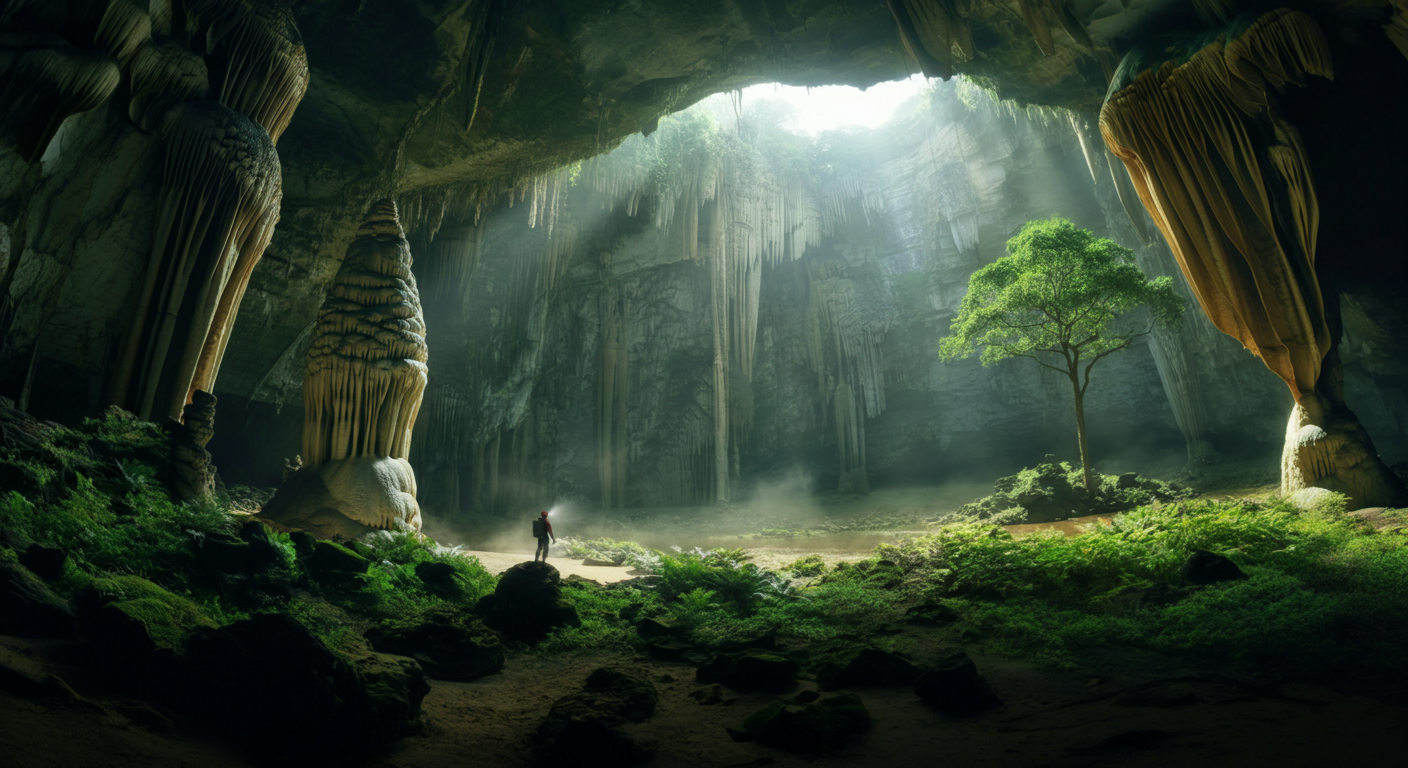
Son Doong is separate from the world above. It is so immense that it generates its own localized weather systems. Clouds form inside the massive passages, rising up toward the surface through giant dolines—massive sinkholes where the limestone ceiling collapsed hundreds of thousands of years ago.
These dolines act as natural skylights. They allow shafts of brilliant sunlight to pierce the eternal darkness of the cave floor. Where light meets moisture, a thriving underground rainforest has taken root. Trees reaching up to thirty meters tall grow hundreds of feet below the surface of the earth, home to flying foxes, monkeys, and birds that navigate the subterranean canopy.
+-------------------------------------------------------------------+
|                     SON DOONG CAVE BY THE NUMBERS                 |
+------------------------------------+------------------------------+
| Total Explored Length              | Over 9 kilometers            |
+------------------------------------+------------------------------+
| Maximum Internal Height            | 200 meters                   |
+------------------------------------+------------------------------+
| Maximum Internal Width             | 150 meters                   |
+------------------------------------+------------------------------+
| Total Estimated Volume             | 38.5 million cubic meters    |
+------------------------------------+------------------------------+
| Tallest Measured Stalagmite        | Over 70 meters               |
+------------------------------------+------------------------------+
| Annual Visitor Cap                 | 1,000 people per year        |
+------------------------------------+------------------------------+
Deep in the dark zones, where the sun never penetrates, evolution has taken a different path. Biologists have discovered completely new species of translucent cave fish, white woodlice, and blind insects that rely entirely on the organic matter carried in by the roaring Rao Thuong river.
The Cable Car Threat
The current state of preservation was not achieved easily. A few years ago, provincial authorities and corporate developers proposed a massive $200 million cable car project. The plan aimed to string mechanical lines through the national park and directly into the heart of Son Doong, opening the fragile cave system to thousands of mass tourists every single day.
A fierce international and domestic backlash followed. Environmentalists, scientists, and a dedicated citizen-led movement fought back against the corporate interests. They argued that building heavy concrete towers and introducing massive crowds would permanently destroy the cave delicate microclimate, pollute the underground river, and erode the ancient limestone formations.
The proposal was eventually shelved, representing a rare victory of long-term ecological conservation over immediate, short-term corporate profit.
Economic Transformation of the Karst Region
The conservation of Son Doong did something unexpected. It saved the surrounding community. Before the cave global recognition, the people of the Quang Binh province lived in extreme poverty, relying on illegal logging and poaching inside the national park to survive. They were trapped in a cycle of environmental destruction driven by economic necessity.
Today, those same former poachers and illegal loggers are employed as highly paid porters, cooks, and safety guides. They have a vested, personal interest in protecting the forest. The premium adventure model ensures that high spending from a small number of visitors goes directly back into the local economy.
The economic reality is clear. A living forest and an untouched cave system generate far more sustainable wealth for the community than timber and poached wildlife ever could.
The Great Wall
The final barrier within Son Doong is the Great Wall of Vietnam. This is a towering, 90-meter-high calcite flowstone wall that blocked the path of the original 2009 British expedition during their first attempt to map the system. It requires technical rope climbing and immense physical stamina to conquer.
Reaching the top of the wall leads explorers to the final exit point, stepping out of the dark chasm directly back into the dense jungle canopy. This physical barrier serves as a fitting metaphor for the entire cave system. It is a place that demands respect, immense effort, and a willingness to leave the modern world completely behind.
Whether the local government can withstand future corporate pressure to commercialize this natural miracle remains an open question, but for now, the world largest cave remains wild, dark, and fiercely protected.