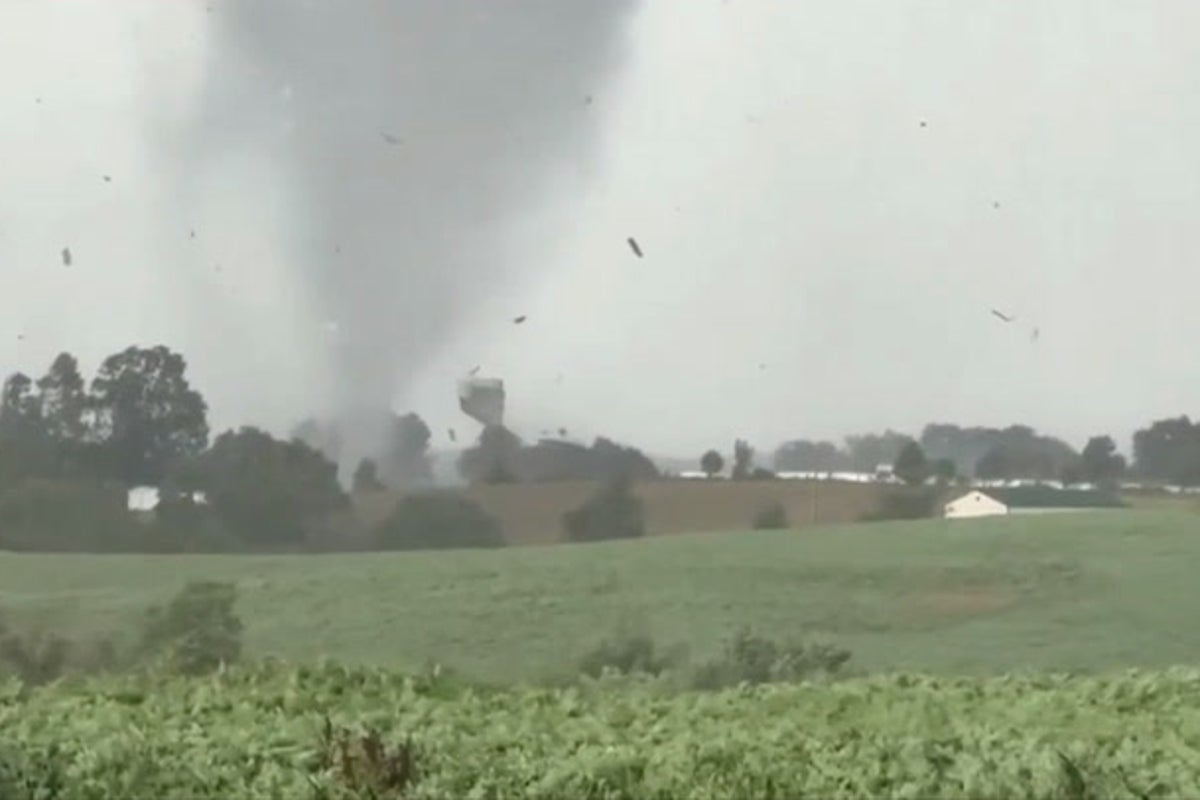
Severe convective storms across the Ohio Valley regularly convert high-value agricultural assets into complete operational losses within seconds. When a tornado intersects a rural farming operation, the damage extends beyond immediate capital asset destruction; it triggers a cascade of supply chain disruptions, biological asset loss, and long-term capital degradation. Evaluating these events requires moving past dramatic imagery and analyzing the underlying physical mechanisms of structural failure, the financial mechanics of agricultural recovery, and the operational protocols required to mitigate multi-million-dollar exposures.
Mechanics of Structural Envelope Failure
Agricultural buildings—predominantly pole barns, livestock confinement facilities, and grain storage structures—are engineered under distinct design standards compared to residential or commercial real estate. Most farm structures rely on post-frame construction, which optimizes for cost per square foot and clear-span interior space rather than structural redundancy.
The breakdown of these envelopes under tornadic wind fields occurs in predictable sequence:
- Aerodynamic Uplift and Pressure Differential: As severe rotational winds pass over a low-pitch roof, velocity increases according to Bernoulli's principle, inducing a steep drop in static pressure above the structure. Simultaneously, windward wall pressures rise dramatically. If localized debris breaches a window, door, or wall panel, internal pressure spikes instantaneously. This internal pressurization combined with external suction creates an envelope uplift force exceeding the mechanical tensile strength of roof-to-wall fasteners.
- Shear Resistance Collapse: Post-frame buildings utilize the roof diaphragm to transfer lateral wind loads into shear walls and embedded posts. Once the roof assembly detaches or buckles, the vertical posts lose their lateral brace points. Unbraced length increases, leading to elastic buckling of ground-anchored timber posts under remaining vertical loads.
- Debris Missile Impact: Structural failure accelerates through high-velocity debris impacts. Unanchored machinery, corrugated metal sheeting, and timber beams become kinetic projectiles capable of penetrating secondary structural elements, compromising adjacent buildings even if those secondary structures were outside the primary vortex path.
Grain bins present a distinct structural profile. Empty or partially filled steel grain silos experience shell buckling under asymmetrical wind loading. High external pressure on the windward side creates membrane stresses that exceed the thin-gauge corrugated steel's buckling threshold. Once the cylindrical geometry collapses, the structure's load-bearing capacity drops to zero.
Disruption Vectors across the Agricultural Value Chain
Structural destruction represents only the primary layer of loss during a severe weather event. The secondary and tertiary impacts often exceed direct facility replacement costs due to time-sensitive operational dependencies.
Direct Livestock Mortality and Animal Welfare Crises
In dairy, poultry, and swine operations, structural collapse inflicts immediate mechanical trauma on livestock. However, post-event operational failure causes severe secondary loss:
- Environmental Control Failure: Intensive livestock production relies on automated HVAC, continuous water feed, and regulated temperature systems. Structural destruction or total power grid failure causes lethal heat stress or ammonia buildup within confinement buildings inside six hours.
- Biosecurity Breakdown: Structural exposure converts closed containment systems into open environments. Surrounding wildlife vectors, water contamination, and uncontained carcass degradation trigger disease outbreaks across surviving herds.
- Feed and Water Supply Disruption: Destroyed grain augers, ruptured water mains, and buried feed lines prevent basic animal maintenance, forcing emergency liquidation or off-site relocation at fire-sale prices.
Capital Asset Depreciative Spikes
Machinery and heavy equipment stored within collapsed structures suffer severe mechanical damage. Combustible fluids leaking from crushed engines create immediate environmental hazard zones. Furthermore, exposure to high-moisture ambient conditions following a storm rapidly accelerates oxidation on precision electrical and hydraulic systems, converting repairable assets into total scrap losses if recovery protocols delay past 48 hours.
Financial Risk Transfer Mechanics and Policy Blind Spots
Standard agricultural property and casualty insurance policies frequently fail to cover the true economic exposure of an EF2 to EF5 tornado strike.
Total Economic Loss = Direct Physical Asset Loss + Debris Removal Expenses + Business Interruption / Stoppage + Asset Relocation Costs - Policy Payout Limitations
The gap between gross financial loss and actual indemnification stems from specific policy structures:
- Debris Removal Caps: Severe structural destruction scatters building material, metal framing, and continuous insulation across hundreds of acres of arable land. Removing sub-surface debris from crop fields to prevent machinery damage during planting or harvest routinely costs tens of thousands of dollars per field. Standard policies routinely cap debris removal reimbursement at a small fraction of total structural coverage, forcing operators to absorb field remediation out of pocket.
- Actual Cash Value vs. Replacement Cost Valuation: Older post-frame structures are frequently insured under Actual Cash Value (ACV) frameworks. Because agricultural buildings depreciate rapidly due to constant exposure to humidity, dust, and corrosive fertilizers, the ACV payout represents only 20% to 40% of the capital required to construct a modern facility compliant with updated local building codes.
- Business Interruption Exclusions: Unlike industrial manufacturing firms, many family-operated and mid-sized agricultural enterprises lack business interruption endorsements. The halt in production during a six- to twelve-month rebuilding timeline leads to direct cash flow failure, defaulting on operating loans despite eventual structural insurance settlements.
Operational Protocol for Hardening and Post-Event Recovery
Reducing structural vulnerability and preserving capital requires targeted engineering interventions alongside explicit operational workflows executed before and immediately after an extreme wind event.
Engineering Interventions for Post-Frame Hardening
To increase the structural capacity of post-frame buildings against convective wind shear:
- Continuous Load Path Upgrades: Install heavy-gauge steel hurricane ties and tension straps connecting roof trusses directly to embedded posts, replacing simple toe-nailed connections.
- Enhanced Post Anchorage: Concrete-embedded posts or steel-bracket post bases attached to reinforced concrete footings provide significantly higher uplift resistance than direct soil-embedded timber.
- Impact-Resistant Wall Assembly: Retrofit interior wall bases with heavy plywood or OSB shear panels to maintain wall diaphragm integrity if exterior metal cladding yields to flying debris.
The First 72-Hour Operational Recovery Plan
Executing a systematic operational response limits secondary damage and establishes clear documentation for financial recovery.
- Zone Containment and Hazard Isolation: Shut down incoming utility lines, isolate damaged electrical lines at main disconnects, and clear primary field access routes to allow heavy equipment access.
- Biological Hazard Mitigation: Execute emergency carcass disposal in strict compliance with state agricultural guidelines to prevent groundwater contamination and biosecurity vector propagation.
- Asset Stabilization and Preservation: Cover high-value machinery with heavy-duty tarps, flush hydraulic systems exposed to rainfall, and apply corrosion inhibitors to open mechanical components.
- Photographic and Geospatial Damage Inventory: Document all structural framing, equipment serial numbers, grain loss estimates, and field debris fields using high-resolution video and drone photography before moving debris or altering the site.
- Parametric and Indemnity Claim Filing: Initiate contact with primary insurance adjusters immediately, providing detailed asset inventories supported by pre-event baseline maintenance records.
Farms that integrate structural load path engineering into facility construction while maintaining structured contingency plans recover capital capacity significantly faster than operations relying entirely on post-event insurance payouts. Mitigating windstorm risk requires treating agricultural infrastructure not as passive storage space, but as critical industrial nodes requiring explicit physical and financial defense strategies.