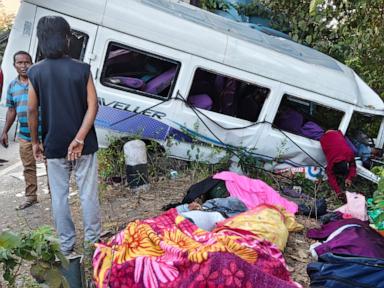
Two headlights.
That is usually all you see in the final three seconds before a night bus meets a freight truck on a two-lane highway in Upper Assam, when the river mist clings low to the asphalt and the tea gardens on either side vanish into ink. If you found value in this article, you should check out: this related article.
When a bus and a truck collide in Assam and kill at least twenty-four people, the news arrives in the morning as a single, numbing wire dispatch. Twenty-four dead. Several injured. A district magistrate orders an inquiry. A chief minister expresses grief on social media. Within forty-eight hours, the headline slides down the page, replaced by cricket scores, election rallies, or a monsoon flood somewhere else.
We treat these crashes like sudden weather. Unpredictable. Tragic. Over. For another look on this story, refer to the latest update from NBC News.
They are none of those things.
If you have ever ridden an overnight bus between Guwahati and Tinsukia, or stood beside a smoking wreck on National Highway 37 while villagers pry open twisted sheet metal with iron crowbars, you know that twenty-four deaths do not happen in three seconds. They are assembled, piece by piece, hours and months before the steel ever bends.
The Anatomy of a Four-AM Collision
To understand how twenty-four lives vanish before sunrise, consider a composite, hypothetical journey along the Brahmaputra valley—built from the exact patterns documented in Assam police crash reports and transport safety audits.
Call the bus passenger Rina. She is thirty-four, a schoolteacher returning from a wedding in Jorhat with a tin of homemade pitha tucked under her seat. Around her are forty-two other people: a young soldier heading back to his posting near the Arunachal border, two brothers traveling to Guwahati for a hospital appointment, a family of four sharing blankets against the January chill.
None of them are wearing seatbelts. Most intercity buses in the region either lack them entirely or have buckles wedged beneath vinyl cushions so stained and stiff they have not clicked shut since the chassis left the body shop.
Fifty kilometers away, moving in the opposite direction, is a twelve-wheeler truck hauling coal or river sand. Call the driver Manoj. He has been behind the wheel for fourteen hours, fueled by sweet roadside tea, betel nut, and the simple economic math of Indian freight: if he misses his unloading window, he loses two days of pay.
The highway between them is a lifeline, a narrow ribbon of tarmac carrying the commercial weight of the entire Northeast. In some stretches, four-lane expansion work has left abrupt, unmarked diversions where two lanes of fast-moving traffic suddenly funnel into one. In others, dense winter fog reduces visibility to twenty feet.
At 3:45 AM, Rina is asleep with her forehead resting against the vibrating window glass.
On a straight stretch flanked by paddy fields, Manoj’s truck drifts three feet across the center line—perhaps to dodge a cratered shoulder, perhaps because his eyelids closed for a fraction of a second, or perhaps because another vehicle was parked without hazard lights on the verge. At the same moment, the bus driver—pushing to make up forty minutes lost at a rail crossing—swings wide to overtake a slower tempo.
Physics does the rest.
When a twelve-ton bus traveling at seventy kilometers per hour strikes a twenty-five-ton loaded truck head-on, the closing speed exceeds one hundred and thirty kilometers per hour. Think of dropping a passenger car from the roof of a twenty-story building onto concrete. That is the kinetic energy absorbed by thin aluminum panels, wooden seat frames, and human bone in less than two-tenths of a second.
Why the Death Toll Climbs So High
People outside the region often ask the same question when they read these numbers: How does a single road crash kill two dozen people at once?
The answer lies in a brutal chain of engineering and regulatory failures that turn survivable impacts into mass-casualty events.
First, there is the structure of the bus itself. Across India, thousands of sleeper and semi-sleeper buses are built by local body-builders atop commercial truck chassis, often bypassing strict crash-worthiness standards. When a head-on or side-swipe impact occurs, the passenger cabin does not crumple around a rigid safety cage. It shears away from the floorboard. Roof pillars collapse inward like cardboard, trapping passengers inside before rescue teams even know a crash has occurred.
Second is the illusion of enforcement. India accounts for roughly one percent of the world’s vehicles, yet it suffers more than ten percent of global road traffic fatalities—over 160,000 deaths every year. In Assam, steep terrain in the hill districts, heavy monsoon erosion, and high-speed straightaways in the plains create a uniquely volatile mix. Speed governors are routinely tampered with. Night-driving fatigue goes unmonitored because electronic logging devices barely exist in the unorganized trucking sector.
Third—and perhaps most devastating—is what happens during the "Golden Hour."
In trauma medicine, the first sixty minutes after a severe crash determine whether a victim with internal bleeding or a compromised airway lives or dies. On a rural stretch of highway in Assam at four in the morning, there are no trauma centers five minutes away. The first responders are almost always local villagers woken by the sound of tearing metal—a sound survivors describe as a freight train derailing inside a tin shed.
Without hydraulic cutters, neighbors use axes, bamboo poles, and bare hands to pull injured strangers out of the wreckage. Victims are loaded onto the beds of pickup trucks or the backseats of private cars and driven forty, sometimes sixty kilometers to the nearest district hospital, where an overwhelmed night-duty doctor must triage twenty critical patients with limited blood supplies and no neurosurgeon on call.
By the time the official tally is released at noon, half of the twenty-four dead did not die on impact. They died waiting for a cutter, or in the back of a hatchback on the way to a clinic that lacked a ventilator.
The Invisible Ledger Behind the Headline
I still remember the silence that follows a highway crash once the sirens fade. It is not a peaceful silence. It is thick with the smell of spilled diesel, crushed marigold garlands from a dashboard shrine, and damp earth. Years ago, standing beside a mangled commuter bus on a rain-slicked highway in eastern India, what struck me wasn't the twisted steel—it was the small, absurdly ordinary objects scattered across the gravel. A single plastic sandal. A half-eaten packet of biscuits. A laminated school ID card.
That is the part a wire headline can never hold.
When twenty-four people die in a single collision in Assam, the grief does not stay neatly contained inside the district morgue. It ripples outward into dozens of villages where a single paycheck kept three generations fed. A masonry worker in Nagaon dies, and his daughter drops out of college six months later. A young nurse traveling home for Bihu never arrives, leaving elderly parents without care.
We have a habit of calling these tragedies "accidents."
The word itself is a small act of dishonesty. An accident implies a bolt of lightning—something random, blameless, beyond human design. Road safety researchers stopped using the word years ago for a reason. When you put exhausted drivers on unlit, undivided highways in vehicles built without structural cages, you are not witnessing an accident. You are watching a predictable outcome play out on schedule.
What Actually Stops the Bleeding
The tragedy is not that we lack solutions. The tragedy is how stubbornly we treat basic safety as a luxury rather than infrastructure.
Countries that have slashed highway fatalities over the past three decades did not rely on drivers becoming more virtuous. They changed the physical and legal environment so that a single human mistake does not carry a death sentence:
- Physical median barriers: Divided highways with concrete Jersey barriers make head-on collisions nearly impossible. Where four-laning in Assam remains incomplete, temporary high-visibility steel dividers and rumble strips drastically cut center-line drift.
- Strict bus-body codes: Enforcing the Automotive Industry Standard (AIS-052) for bus construction—requiring emergency exits that actually open, flame-retardant interiors, and reinforced rollover structures—turns a collapsing tin box into a survivable cabin.
- Automated highway enforcement: Speed cameras with automatic e-challan systems, paired with mandatory rest-stop verification for commercial trucks traveling overnight, remove the economic incentive to drive sixteen hours straight.
- Stationed trauma ambulances: Placing equipped ambulances with trained paramedics at known highway blackspots—rather than waiting for calls from district headquarters—cuts response times from forty-five minutes to ten.
None of this requires futuristic technology. Every single measure exists right now, tested on highways from Tamil Nadu to Scandinavia.
Before the Next Morning Dispatch
Tomorrow or next month, another overnight bus will pull out of a crowded terminal in Guwahati, Silchar, or Dibrugarh. The conductor will tap twice on the side panel. Passengers will pull shawls over their shoulders, check their phones one last time before the signal drops between tea estates, and lean their heads against the glass.
Down the road, in the dark, a pair of headlights is already turning onto the highway.
Until the steel cages are built, the medians are poured, and the rest laws are enforced, those twenty-four names in Assam are not a closed chapter. They are simply the latest entry on an open ledger—waiting for the next fog, the next diversion, and the next three seconds in the dark.