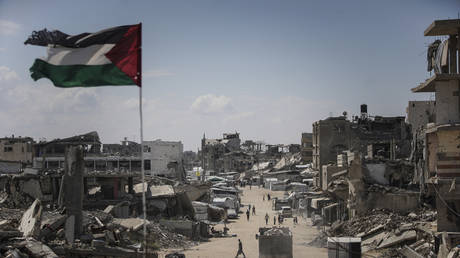
Silence.
That is the first thing you notice when the drones finally pull back to higher altitudes, leaving behind a sky that looks deceptively blue over the Mediterranean, though the air tastes permanently of pulverized concrete and copper. To someone watching a cable news ticker from three thousand miles away, a reduction in high-decibel airstrikes looks like a pause, perhaps even a peace. A diplomatic phrasing shifts from active warfare to post-conflict management. The headlines move on to elections, interest rates, or the latest tech rollout. If you liked this article, you might want to look at: this related article.
Inside the strip of land between the sea and the wall, however, the calendar did not turn a page.
When the United Nations Independent International Commission of Inquiry on the Occupied Palestinian Territory released its findings declaring that Israel’s genocide in Gaza never stopped, the statement landed in Western capitals like a heavy stone dropped into deep water—a brief splash, followed by the rapid closing of the surface. Bureaucratic language has a way of anesthetizing horror. Words like "commission," "jurisdiction," and "systemic" feel sterile, suited for air-conditioned conference rooms in Geneva rather than the dust-choked ruins of Rafah or Jabalia. Yet beneath the clinical phrasing of international law lies a raw, uninterrupted human reality that refuses to fit neatly into a ceasefire timeline. For another perspective on this development, check out the latest update from NPR.
To understand what "never stopped" actually means, we have to step away from the podiums and look at the ground.
Consider a hypothetical composite character, whom we will call Tariq—a forty-two-year-old civil engineer from Khan Younis whose life mirrors the documented testimonies compiled by UN investigators and humanitarian field workers. Before October 2023, Tariq spent his days calculating load-bearing capacities for municipal water towers. Today, his calculations are vastly simpler and infinitely more desperate. He measures the distance between his family’s tarpaulin shelter and the nearest functioning desalination point. He divides four liters of brackish water among six people. He watches his seven-year-old daughter, Layla, grow quieter each week, her hair thinning not from a bomb blast, but from a slow, engineered deficit of protein and clean water.
Tariq’s story is a narrative device, an amalgam of thousands of real case files, yet the physics of his survival are entirely factual. The UN commission’s central argument hinges on a crucial distinction that most casual observers miss. Genocide, under the 1948 Convention on the Prevention and Punishment of the Crime of Genocide, is not defined solely by the immediate spectacle of mass killing through explosives. Article II(c) explicitly defines it as deliberately inflicting on the group conditions of life calculated to bring about its physical destruction in whole or in part.
Read that clause again. Conditions of life calculated to bring about physical destruction.
Think of it like a slow-acting poison compared to a gunshot. A gunshot demands immediate attention; it is loud, dramatic, and undeniable. A poison introduced into the water supply works quietly in the dark, dismantling organs one cell at a time while onlookers argue about whether the victim looks sick enough to warrant intervention. When bombs fall, the world counts bodies. When water treatment plants, sewage networks, hospitals, and agricultural fields are systematically dismantled and kept offline through blockades and bureaucratic strangulation, the world often stops counting altogether.
The killing simply changes its instrument.
I remember standing near border crossings in the region years ago, watching the endless rows of white flatbed trucks idling in the sun, their drivers smoking cigarettes while manifest papers sat on desks waiting for stamps that took weeks to materialize. Even then, the machinery of control was breathtaking in its precision. Every calorie, every cubic meter of concrete, every spare part for a generator was logged, weighed, and rationed. What the UN commission documented in its latest assessment is the weaponization of that exact administrative apparatus—pushed past containment and into total structural collapse.
Let us look at the verified mechanics of this collapse. According to UN assessments, satellite imagery analysis, and reports from the World Health Organization, the destruction in Gaza was never random collateral damage. Over eighty percent of Gaza’s water and sanitation infrastructure has been damaged or destroyed. Agricultural land—the orchards, greenhouses, and fertile soil that once fed a dense population—has been systematically razed, turning green fields into barren moonscapes incapable of sustaining life for a generation. Hospitals were not merely caught in crossfires; they were besieged, raided, and stripped of power and oxygen until neonatal units became morgues.
When a society loses its hospitals, its clean water, its arable land, and its shelter simultaneously, what happens next is not an accident of war. It is a mathematical certainty.
Epidemiologists call it the mortality multiplier. For every person killed directly by shrapnel or collapsing masonry, public health experts estimate that three to fifteen additional people will eventually die from preventable infectious diseases, untreated chronic conditions, starvation, and maternal complications. Cholera, hepatitis A, and acute watery diarrhea do not sign ceasefires. A diabetic grandmother without insulin does not care whether a diplomatic summit in Doha ended with a handshake. A premature infant in an incubator without electricity dies just as surely as one struck by a missile, only without the televised smoke plume to prove it happened.
Why, then, does the outside world struggle so deeply to process this ongoing reality?
Part of the answer lies in human psychology and the architecture of modern media. Our brains are wired to respond to sudden, acute threats—a tiger leaping from the brush, a building collapsing on live television. We are notoriously bad at perceiving slow-moving catastrophes, whether they are environmental collapses or drawn-out human rights atrocities. When the intensity of aerial bombardment fluctuates, news editors reassign correspondents. The crisis is downgraded from "breaking news" to "ongoing situation."
Another part of the answer is deliberate political framing. Words carry legal obligations. Under the Genocide Convention, once states acknowledge that a genocide is occurring, they are legally bound to act to prevent and punish it—which includes halting arms transfers, imposing sanctions, and intervening diplomatically. Acknowledging that the genocide never stopped would force powerful governments in Washington, London, and Berlin to confront their own complicity. It is far more comfortable to speak of "humanitarian challenges," "complex security environments," and "post-war reconstruction" than to admit that the destruction of a people is continuing in slow motion.
We have seen this exact pattern before in modern history. Look back at Srebrenica in 1995, or Rwanda in 1994, or the long, agonizing siege of Sarajevo. In every instance, diplomatic euphemisms served as a buffer between comfortable Western consciences and unbearable realities on the ground. Officials debated terminology while graveyards expanded. Only years later, after the soil had settled and the survivors were scattered across the globe, did those same institutions erect memorials and solemnly intone the words "never again."
The UN commission’s report strips away that comfortable distance in real time. By documenting the uninterrupted continuity of forced displacement, starvation tactics, destruction of cultural and educational institutions, and the targeting of reproductive healthcare, the investigators connected the dots that political leaders desperately want left scattered.
Consider what happens to a people when you erase their universities, libraries, archives, and mosques alongside their homes. You are not merely clearing territory; you are severing the thread between a community’s past and its future. You are ensuring that even if the survivors remain breathing, the society itself cannot reconstitute. A generation of children—hundreds of thousands of kids like our composite Layla—has now lost multiple years of schooling, burdened with severe psychological trauma and stunted physical development from malnutrition.
There is a particular cruelty in survival under these conditions. To wake up every morning in a flooded tent, to dig through rubble with bare hands for firewood, to watch elders die of infections that a ten-dollar course of antibiotics would have cured—this is not living. It is an endurance test designed with no finish line.
Yet if we stop at despair, we miss the most vital truth of all. International law, however battered and selectively enforced, exists precisely because human beings recognized our capacity for systematic cruelty and tried to build a dike against it. The findings of the UN commission are not merely an obituary for Gaza; they are an indictment and a legal instrument. Every documented denial of aid, every destroyed desalination plant, every public statement of dehumanization by officials becomes evidence in the docket of history—and increasingly, in the chambers of the International Court of Justice and the International Criminal Court.
For the reader sitting far from the Mediterranean coast, the temptation is to feel paralyzed by the sheer scale of the tragedy. What can one person do against geopolitical alliances, veto powers, and military-industrial juggernauts?
Start by refusing the sedative of forgetting. The machinery of erasure depends entirely on public exhaustion. It counts on you growing tired of the vocabulary, confused by the legal jargon, and numb to the casualty figures. When you insist on calling things by their true names—when you recognize that the absence of headlines does not mean the presence of peace—you disrupt the quiet normalization of atrocity.
Back in our imagined shelter in Khan Younis, night falls quickly once the sun drops into the sea. There are no streetlights left to flicker on. Tariq pulls a thin, damp blanket over Layla’s shoulders, listening to the distant, mechanical hum of surveillance drones circling endlessly above the dark horizon like metallic insects that never sleep. Outside the canvas flap, the wind blows dust across the empty foundations of what used to be a neighborhood, carrying the faint, persistent sound of waves breaking against a shore no one is allowed to leave.