Cold.
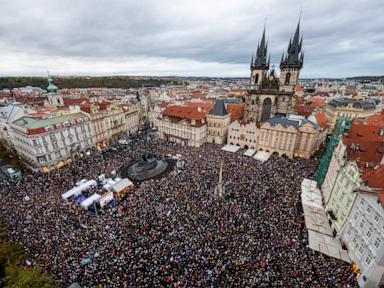
That is the first thing you notice when you stand on Old Town Square in Prague in the late autumn wind, your fingers tucked deep into your coat pockets while the astronomical clock ticks toward the top of the hour. You do not come out into that kind of chill for an abstract accounting debate. You do not hold a hand-painted cardboard sign above your head for three hours because you have strong feelings about municipal tax collection or broadcasting infrastructure budgets.
Yet there they were, thousands of Czech citizens packed shoulder to shoulder across the cobblestones, their breath rising in white plumes against the Gothic spires. According to wire reports from Reuters and the Associated Press, demonstrators gathered in the Czech capital to protest a government-backed overhaul of how the nation funds its public broadcaster, Czech Television, and its public radio network, Czech Radio.
To an outsider glancing at a dry news ticker, the dispute looks almost aggressively mundane. A parliament debates replacing a household license fee with direct funding from the state budget. Budget lines shift. Bureaucrats argue over percentages. People go home.
Except in Central Europe, nothing about who pays for the news is ever just about money.
The Architecture of a Household Fee
To understand why thousands of people stood freezing in Prague, you have to look at a small, unassuming bill that arrives in Czech mailboxes every month. For decades, the Czech Republic—much like the United Kingdom with its BBC license fee or Germany with its broadcasting contribution—relied on a direct household fee to keep its public media running. Every home with a television or radio receiver paid a modest, fixed sum directly to the broadcasters.
Consider a hypothetical family living in a third-floor walk-up in Brno. Let us call them Petr and Jana. Every month, a few hundred Czech koruna leave their bank account automatically. They rarely think about it while drinking their morning coffee or watching the evening news. To Petr and Jana, that fee feels like another utility bill, indistinguishable from water or electricity.
Behind that boring bank transfer, however, sits an intentional firewall.
When citizens pay a public broadcaster directly, the money never passes through the hands of the prime minister, the finance ministry, or the ruling party in parliament. If an investigative reporter at Czech Television uncovers a scandal involving a cabinet minister's private business dealings, that minister cannot quietly threaten to trim the network's budget during the next fiscal review. The editors do not have to glance nervously over their shoulders at who won the last election before greenlighting a documentary.
Direct funding from the state treasury changes the plumbing entirely. Once a broadcaster's survival depends on an annual vote in parliament, the relationship shifts from a public trust to a political negotiation. Even if no politician ever picks up the phone to demand softer coverage, the mere possibility hangs in the newsroom air like static. Journalists begin to ask themselves quiet, corrosive questions. Will this story cost us ten percent of our operating budget next spring? Should we soften the headline just enough to keep the finance committee happy?
Critics of the government's proposal, including opposition lawmakers, media watchdogs, and the protesters filling Old Town Square, argued that abolishing the direct fee strips away that structural shield. In their view, moving Czech Television and Czech Radio onto the state budget hands future governments a financial leash.
The Case for Scrap and Reform
Walk across the Vltava River to the government benches, however, and you hear an entirely different story—one that also resonates with plenty of ordinary voters.
Supporters of the overhaul point out that the traditional license fee model was built for a world that no longer exists. It was designed when a family gathered around a single wooden box in the living room to watch two or three terrestrial channels. Today, millions of young Czechs do not own a traditional television set at all. They stream video on laptops, tablets, and smartphones. Trying to police who owns a receiver, tracking down non-payers, and administering millions of tiny monthly transactions creates a massive, expensive bureaucratic machine.
Proponents of the reform, including members of the governing coalition who campaigned on modernizing state finances and easing the cost of living, argue that funding public media through the central budget is cleaner, fairer, and more efficient. Under a state-funded model, families struggling with inflation no longer face a flat, regressive tax that hits a retired pensioner on a fixed income just as hard as a wealthy executive in a Prague villa. Instead, public broadcasting is paid for through progressive general taxation, just like schools, hospitals, and highways.
Government officials have also pushed back against accusations of political meddling, pointing to proposed statutory safeguards and multi-year funding formulas meant to prevent sudden, arbitrary cuts. From their perspective, critics are clinging to an outdated 20th-century payment mechanism and mistaking administrative modernization for authoritarianism.
Both arguments carry real weight. On one side sits a legitimate desire to eliminate an antiquated, regressive household tax and streamline how public institutions are financed. On the other sits a deeply rooted fear of what happens when politicians hold the purse strings of the press.
Why Central Europe Remembers
If this debate were taking place in a vacuum, it might remain a polite policy seminar between economists and media scholars. It is not taking place in a vacuum.
Across Central and Eastern Europe, the memory of state-controlled media is not buried in history textbooks; it lives in the muscle memory of anyone over the age of forty. Before the Velvet Revolution of 1989, Czechoslovak television was an arm of the Communist state. News anchors read party-approved scripts while cameras carefully avoided showing the reality of empty store shelves or environmental decay. People tuned into clandestine radio broadcasts from abroad just to find out what was happening in their own country.
More recently, Czech citizens have watched neighboring countries grapple with similar battles over public broadcasting. In Hungary, Prime Minister Viktor Orbán's government consolidated public media under a centralized state funding and oversight structure over a decade ago, a move that international press freedom organizations such as Reporters Without Borders and the European Federation of Journalists have repeatedly criticized for turning public outlets into mouthpieces for the ruling party. In Poland, successive governments fought bitter, protracted wars over the control and financing of public television, resulting in dramatic purges of newsroom staff whenever power changed hands in Warsaw. And in Slovakia, just across the Czech Republic's eastern border, the government of Prime Minister Robert Fico moved to overhaul its own public broadcaster, RTVS, replacing its leadership and restructuring its oversight in ways that drew tens of thousands of protesters onto the streets of Bratislava and sparked warnings from European Union officials.
When Czech protesters look at a proposal to fold public media into the state budget, they are not just reading the fine print of their own parliament's bill. They are looking across the border at Bratislava, Warsaw, and Budapest, wondering how quickly a technical budget adjustment can turn into a political takeover.
The Invisible Stakes in the Living Room
Think back to Petr and Jana in their apartment in Brno.
In a healthy media ecosystem, you barely notice the referee. You watch the evening weather forecast, listen to a radio debate between two rival economists during your morning commute, and let your children watch an animated bedtime story free of commercial advertisements. You might occasionally grumble that the news is too dry or that a certain commentator annoys you. That mild, everyday irritation is actually the sign of a functioning public square—a space that belongs to everyone and therefore pleases no one completely.
The danger of a compromised public broadcaster is rarely a sudden, dramatic blackout where tanks roll up to the studio gates. Usually, it is far quieter. It is the investigative unit that gets reassigned to cover local flower festivals. It is the hard-hitting political interviewer who quietly leaves for a private podcast because her airtime was cut in half. It is the slow, imperceptible tilt of the camera lens until uncomfortable questions simply stop being asked on the evening news.
For a society, losing an independent public broadcaster is like losing a shared mirror. Without a common, trusted source of basic facts that answers to the public rather than to a party chairman or a billionaire media mogul, citizens retreat into fragmented digital echo chambers. Neighbors stop arguing over what to do about the facts and start arguing over whether the facts exist at all.
At the same time, ignoring the genuine flaws of the old license fee system carries its own risks. When a public institution refuses to adapt to how people actually live and consume information, it slowly loses public legitimacy. If younger generations feel forced to pay a monthly fee for services they rarely use, resentment builds, making the broadcaster an easy target for populist politicians promising to abolish the fee altogether.
A Question Left Hanging in the Cold
That tension—between modernizing an outdated funding model and protecting a fragile democratic safeguard—is why the debate in Prague refuses to die down. Neither side has a monopoly on common sense. A flat household tax really is clunky in the streaming era. And state budget dependency really does create a vulnerability that future leaders, perhaps far less restrained than the current ones, could exploit.
As the crowd in Old Town Square eventually dispersed into the narrow medieval streets, wrapping their scarves tighter against the November chill, the parliament's legislative process continued grinding forward. Votes were scheduled. Amendments were drafted.
The protesters went back to their apartments, turned on their kettles, and switched on the evening news—watching a broadcast whose future was being decided in real time, wondering whether the voice coming through the speakers would still sound the same five years from now.