At 8:42 on a Tuesday evening in Central, Hong Kong, the harbor lights bleed across the glass of a thirty-fourth-floor conference room. Inside, the air conditioning hums at a frequency designed to keep tired brains awake.
David stares at an organizational chart projected onto the wall. Thirty-two years old. Seven years at the firm. Two promotions under his belt, and a lingering ache between his shoulder blades that never quite disappears, even on Sundays.
Consider David as a composite—a hypothetical stand-in for thousands of mid-career professionals pacing the glass towers of Victoria Harbour, Canary Wharf, and Midtown Manhattan right now. Look closely at what he is actually looking at. Above his name sits a single box: Senior Vice President. The woman currently occupying that box is forty-one, fiercely competent, and has zero intention of leaving for at least a decade.
David is stuck. Not because he lacks talent. Not because he missed his targets. He is stuck because the architecture of modern ambition was designed for an economy that no longer exists.
Wait.
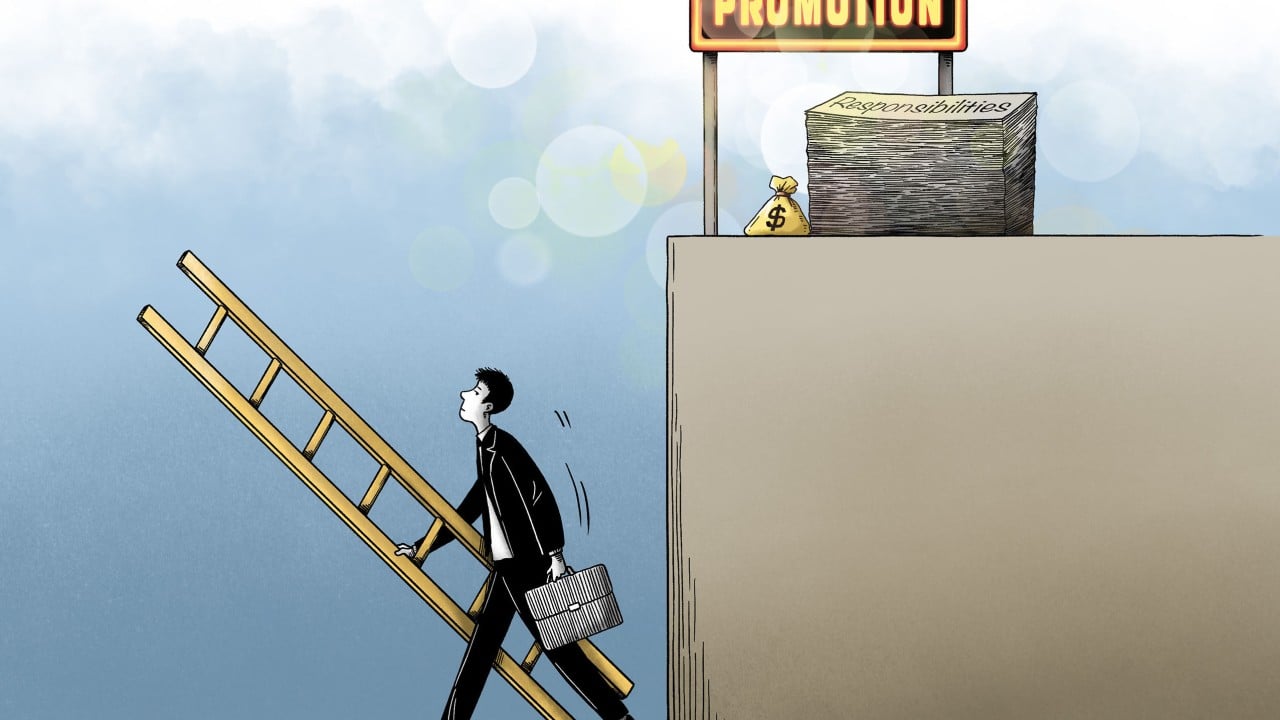
Think about the metaphor we have used for a century to describe professional growth. The ladder. It is a deceptively simple piece of hardware. Two vertical rails, evenly spaced rungs, one direction of travel. You put your foot on the bottom, you pull yourself up, and eventually, if your grip holds and your knees don't give out, you reach the roof.
For decades, that bargain held in Hong Kong and across the developed world. You traded your twenties and thirties—your evenings, your weekends, your undivided attention—for the promise of steady vertical ascent. Each rung brought a predictable bump in title, status, and compensation.
That contract has quietly dissolved. And most employers are pretending they didn't notice the ink fading.
The Architecture of a Trap
To understand why the ladder broke, you have to look at the geometry of modern organizations. Throughout the late twentieth century, corporations were built like thick, sprawling pyramids. There were dozens of middle-management layers—assistant managers, deputy directors, regional coordinators—creating a staircase with shallow, frequent steps. Every two or three years, someone retired or moved on, and the entire column shifted upward by one notch.
Then came three decades of relentless restructuring.
Driven by shareholder pressure, automation, and now artificial intelligence, companies flattened their hierarchies. They stripped out middle management to cut overhead and speed up decision-making. According to workforce analytics from firms like Korn Ferry and Gartner, the span of control for the average manager has widened dramatically over the past fifteen years, while the number of executive seats at the top has remained practically frozen.
At the exact same time, people started living longer and working longer. In Hong Kong, where life expectancy ranks among the highest on Earth and housing costs punish early retirement, senior leaders routinely hold onto top positions well into their sixties.
Do the math. Fewer rungs in the middle. More people holding onto the top. And a massive generation of workers in their late twenties, thirties, and forties pressing up from below.
The result is not a ladder anymore. It is a bottleneck.
I remember the exact afternoon I realized my own career had hit a structural wall. I was sitting across from a managing director who genuinely liked my work. He praised my latest project, poured two cups of lukewarm green tea, and then delivered the verdict with an apologetic shrug. "There's nowhere to put you right now," he said. "Just keep doing what you're doing. Something will open up eventually."
Eventually. That word tastes like rust when you are thirty-five and watching your peers in other industries leapfrog your earning power while you polish the same brass doorknob year after year.
When high performers hit that ceiling, they rarely throw a tantrum. They do something far more expensive for the company. They quietly disengage. Gallup’s global workplace reports consistently show that employee engagement hovers around a dismal twenty-three percent worldwide, with East Asia frequently trailing even lower. Burnout isn't just caused by working sixty hours a week; it is caused by working sixty hours a week toward a destination that has been bricked over.
Why Money Alone Stops Working
When faced with an exodus of restless mid-career talent, the default reflex in financial and commercial hubs like Hong Kong has always been transactional. Throw cash at the problem. Offer a retention bonus. Bump the base salary by eight percent and hope the employee forgets they have been doing the exact same job since 2021.
It works for about ninety days.
Human beings are wired for momentum. Behavioral psychologists have spent decades studying what actually sustains motivation once basic financial security is met. In his foundational research on self-determination theory, Edward Deci demonstrated that extrinsic rewards—bonuses, titles, corner offices—have a remarkably short half-life. What keeps people deeply invested over years is a sense of mastery, autonomy, and forward motion.
If you pay a brilliant software architect or a seasoned logistics strategist more money to stay trapped in a narrow, repetitive lane, you haven't solved their frustration. You have simply gilded their cage. Eventually, a competitor calls—not necessarily with a bigger paycheck, but with a bigger problem to solve—and your best person walks out the door.
In Hong Kong, this dynamic has become an acute vulnerability. Between shifting geopolitical winds, talent migration, and fierce competition from regional hubs like Singapore, companies across the city cannot afford to bleed institutional knowledge. Yet many local and multinational offices still cling to rigid, seniority-based promotion cycles that treat career progression like a waiting room. You take a number. You sit quietly. You wait for someone ahead of you to leave.
It is an insult to human potential. And frankly, it is terrible business.
Reimagining the Climbing Wall
So what happens if we throw the ladder in the dumpster?
Let’s use an analogy that actually fits the twenty-first-century economy. Stop building ladders. Start building climbing walls.
On a ladder, there is only one path up, and if someone is standing on the rung above you, your climb is over. On a climbing wall, there are dozens of holds scattered across the surface—some higher, some lateral, some requiring you to reach diagonally across unfamiliar territory. You might move sideways for six months to find a better grip before ascending again. You build strength in muscles you didn't know you had.
In organizational terms, this is the shift from linear promotion to skill-based mobility and career lattices.
Imagine a different Tuesday evening for David, our hypothetical manager in Central. Instead of staring at a blocked org chart, he sits down with his division head to map out a six-month rotation. His core expertise is corporate risk, which he can now do in his sleep. So the company detaches him from his routine reporting line for forty percent of his week and embeds him inside a cross-functional task force launching a sustainable finance product.
He doesn't get a new title on his business card. He doesn't get a corner office.
Instead, he gets something infinitely more valuable: steep, terrifying, exhilarating learning. He has to negotiate with software engineers, pitch skeptical institutional investors, and figure out regulatory frameworks that didn't exist three years ago. Six months later, David isn't the guy waiting for his boss to retire. He is one of the only people in the firm who understands both legacy risk and green finance. He has made himself indispensable without anyone above him having to vacate a chair.
This is not utopian theory. Forward-thinking organizations are already dismantling their rigid job architectures to make this standard practice.
Unilever, for instance, famously introduced an internal talent marketplace powered by matching algorithms that connect employees with short-term projects across departments and borders—unlocking hundreds of thousands of hours of hidden capacity while slashing external hiring costs. Standard Chartered and Schneider Electric have built similar internal mobility ecosystems, allowing employees to bid on stretch assignments, shadow leaders in entirely different functions, and pivot careers without having to quit their employer first.
Notice the profound psychological shift that occurs when a company operates this way. The question changes from "When do I get promoted?" to "What am I capable of building next?"
The Three Myths Holding Leaders Back
If this lattice approach solves retention, accelerates innovation, and develops multi-dimensional leaders, why are so many companies—especially traditional firms in Asia and legacy corporations worldwide—still clinging to the old ladder?
Because letting go of the ladder requires managers to surrender three deeply ingrained habits.
First, the myth of talent hoarding.
Walk into almost any mid-sized or large company and you will find department heads treating their best people like private property. If a manager has a superstar analyst who makes their life easy, the last thing that manager wants is for the analyst to spend three months helping another division. It takes genuine leadership maturity to say, "I will absorb the short-term inconvenience of losing my best person for a quarter because it makes the entire company stronger—and keeps them from quitting altogether." Until companies reward managers for exporting talent rather than hoarding it, internal mobility remains a hollow slogan on an HR slide deck.
Second, the obsession with credentials over capability.
We still hire and promote as if a resume is a crystal ball. If a role opens up in product strategy, HR filters for people who have already held the title of Product Strategist for five years. That logic guarantees stagnation. If you only let people do jobs they have already done, nobody ever grows. Progressive employers are stripping degree requirements and rigid tenure rules from internal postings, evaluating employees instead on adjacent skills, curiosity, and track record of learning under pressure.
Third, the failure to decouple compensation from management.
This might be the single biggest structural flaw in corporate life. In most firms, the only way for a brilliant engineer, designer, researcher, or financial specialist to earn executive-level pay is to stop doing the craft they love and become a people manager.
Think about how absurd that is. You take your best surgeon and force them to spend their days approving vacation requests and mediating office thermostat disputes. Half the time, they hate managing, their team suffers, and the company loses its sharpest technical mind.
Leading technology and engineering firms solved this years ago by creating dual career tracks. An individual contributor can rise to the level of Principal or Fellow, commanding the exact same compensation, prestige, and strategic influence as a Vice President, without having a single direct report. If banks, law firms, logistics giants, and retail conglomerates in Hong Kong and beyond adopted dual tracks tomorrow, half their middle-management logjam would evaporate overnight.
What This Demands of Us
There is an uncomfortable truth tucked inside this evolution, and we shouldn't gloss over it. A climbing wall is more exciting than a ladder, yes—but it is also more disorienting.
On a ladder, you never have to wonder where to put your foot next. The path is dictated for you. When organizations dismantle rigid ladders in favor of fluid projects, skill marketplaces, and lateral pivots, employees can no longer sit back and wait for a syllabus. You have to take ownership of your own trajectory. You have to raise your hand for messy, undefined problems. You have to get comfortable feeling like a beginner again at thirty-eight or forty-five, sitting in a room where people ten years younger know the tools better than you do.
That takes courage. I won't pretend otherwise. Watching a clear, predictable track dissolve beneath your feet feels precarious, especially when you have a mortgage to pay, aging parents to support, or school fees looming on the horizon.
Yet clinging to a broken ladder doesn't offer safety. It only offers the illusion of it—right up until the day the industry shifts and leaves you stranded on a rung that leads nowhere.
The View From the Harbor
Let’s return to that thirty-fourth-floor conference room overlooking Victoria Harbour.
Imagine it is a year later. The fluorescent overheads are still humming, and the ferries are still carving white wakes across the dark water below. David is back in that room, standing beside the whiteboard.
He still doesn't have the Senior Vice President title. The woman who held it is still there, still thriving.
Nobody in the room cares. Over the past twelve months, David led a cross-border task force that redesigned how the firm prices climate risk across Southeast Asia. He mentored four junior analysts from three different departments, picked up fluent command of data modeling tools he couldn't even spell two years ago, and just negotiated a compensation band aligned with his expanded impact rather than his place in a hierarchy.
The invisible ceiling above his head didn't come crashing down. It simply became irrelevant, because he stopped looking straight up and started moving in every direction at once.
Somewhere across the harbor, in another glass tower, another bright, exhausted thirty-something is staring at an organizational chart tonight, wondering if this is all there is for the next ten years. The employers who figure out how to hand that person a map instead of a waiting-room ticket won't just win the war for talent. They will build companies nimble enough to survive whatever comes next.
The ladder is gone. Stop waiting for the next rung to appear, and start looking for the next hold.