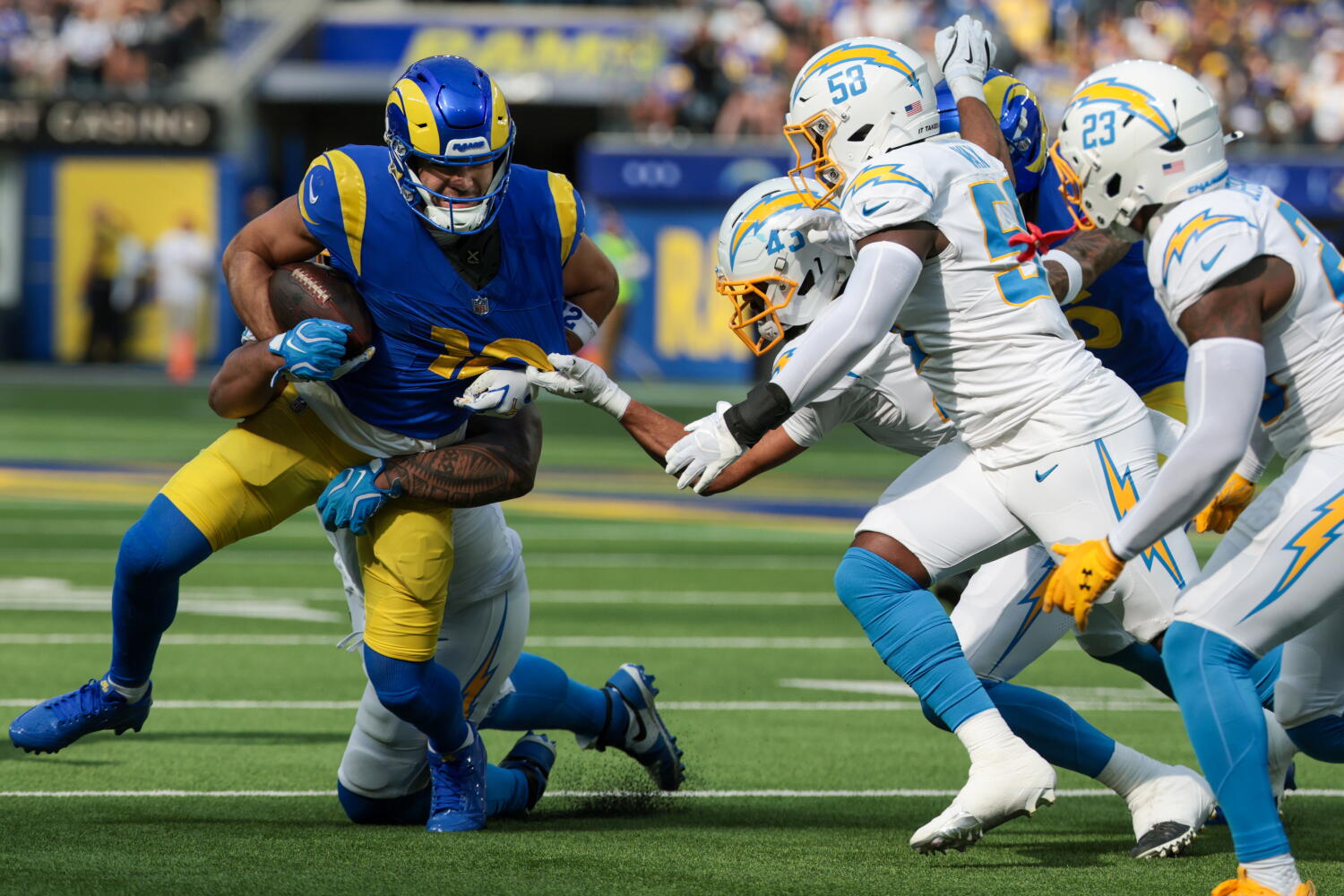
Silence.
That is the sound nobody talks about when a football stadium empties out, when the stadium lights click off one by one, and a twenty-three-year-old kid sits on the edge of a stainless-steel training table with an ice bag wrapped tightly around his right knee.
Outside the locker room walls in Detroit, the roar of Ford Field was still vibrating in the concrete. Inside, the air smelled of sharp wintergreen liniment, damp wool, and the metallic tang of adrenaline wearing off. Puka Nacua had just spent the first half of the 2024 season opener doing what Puka Nacua always does. He threw his 212-pound frame into traffic without flinching. He took hits that made the press box wince. He caught four passes for 35 yards, absorbed a vicious blow on an incomplete target late in the second quarter, and then—in a move that looked routine on television and felt catastrophic in real time—went down clutching the side of his knee.
At first, the Los Angeles Rams tried to sell hope. Head coach Sean McVay stood at the podium on Monday, his voice carrying that familiar cadence of optimism coaches use like a shield against bad news. Week-to-week, McVay called it. A knee strain. Nothing structural. Just a bump in the road for the fifth-round draft pick who had shattered NFL rookie receiving records a year earlier.
Forty-eight hours later, the shield came down. The Rams changed course and placed Puka Nacua on injured reserve.
To the casual observer scrolling past a push notification on their phone, it was just another transaction line. A roster move. Four weeks on the shelf, minimum, for a wide receiver with a sprained posterior cruciate ligament. Fantasy football managers groaned, adjusted their lineups, and moved on to the waiver wire.
But if you have ever watched a young athlete try to negotiate with their own body—if you have ever sat in an orthopedic waiting room praying an MRI reads like a typo—you know that a sudden pivot from "week-to-week" to "injured reserve" is never just paperwork. It is a surrender to reality. More than that, it is an intervention.
The Myth of the Indestructible Rookie
To understand why the Rams had to step in and force Nacua to stop, you have to understand the intoxicating poison of his rookie year.
In 2023, Nacua arrived in Los Angeles out of Brigham Young University as the 177th overall pick. Nobody expected him to rewrite history. Nobody expected him to haul in 105 catches for 1,486 yards, breaking a rookie record set by Bill Groman back in 1960 when Dwight D. Eisenhower was still in the White House.
He did not do it with blinding 4.3 speed or balletic grace along the sidelines. He did it with violence. Watching Nacua play wide receiver is like watching a man run through a plate-glass window just to see what is on the other side. He invites contact. He lowers his shoulder into linebackers who outweigh him by thirty pounds, bouncing off tackles and popping up with that wide, disarming grin that made him an instant folk hero in Southern California.
I remember watching him late in that 2023 campaign, playing through oblique injuries, shoulder bangs, and bruised ribs that would have sidelined most veterans for a month. Every Sunday, the injury report listed him as questionable. Every Sunday, he ran out of the tunnel, took ten hits, and walked off smiling.
That kind of toughness builds a dangerous illusion. When you survive enough collisions, your brain stops believing in consequences. You begin to treat pain not as a warning light on the dashboard, but as background noise you can simply turn down.
Consider a hypothetical scenario—a composite of every young receiver I have ever covered in an NFL locker room. Let us call him Marcus. Marcus is twenty-three, playing on a modest rookie contract, acutely aware that his draft pedigree gives him zero margin for error. When his knee swells up after a Sunday night game, Marcus does not think about his cartilage at age thirty-five. He thinks about the guy behind him on the depth chart taking his reps on Wednesday. So Marcus lies. Not maliciously, and not even consciously. When the trainer asks how the knee feels on a scale of one to ten, Marcus says "four" when it is really an "eight." He passes the visual eye test because youth can mask structural instability for forty-eight hours on pure willpower alone.
That is the exact trap the Rams nearly fell into during those two days between Monday's optimism and Wednesday's roster move.
What Really Happens When the Plan Changes
Why did Los Angeles reverse course so abruptly?
On Monday, the initial imaging and physical exams suggested a mild sprain of the PCL—the posterior cruciate ligament, the thick band of tissue that keeps the shinbone from sliding backward under the thighbone. Unlike an ACL tear, which snaps like a dry twig and ends a season on the spot, a PCL sprain is deceptive. You can walk on it in a straight line without limping. You can even jog on a treadmill without feeling your knee buckle.
For a wide receiver whose entire livelihood depends on planting a foot at twenty miles per hour and snapping back toward the quarterback, "walking without a limp" means nothing.
When the Rams' medical staff re-evaluated Nacua's knee after the initial swelling began to shift—and once they factored in the reality that he had already injured that same knee during training camp back in August—the math stopped working. Keeping him on the active 53-man roster as a "week-to-week" question mark would have created an impossible temptation for both player and coach.
Think about the psychology of an NFL practice week. If Nacua is on the active roster, he is in the building every morning at six. He is watching film with Matthew Stafford. By Friday, when the swelling goes down and the endorphins kick in, Nacua is going to walk into McVay's office, look him in the eye, and swear he is ready to give it a go on Sunday against the Arizona Cardinals. And Sean McVay, a coach who loves competitive fire more than oxygen, would be forced to either say no to his best playmaker or put a compromised superstar onto an unforgiving turf field.
Placing him on injured reserve removed the choice entirely. Under NFL rules, an IR designation locks the door for at least four games. No Friday miracles. No "game-time decision" drama. Just four mandatory weeks where Puka Nacua is legally barred from taking a hit.
It was a rare moment of institutional discipline in a league that usually rewards recklessness until the wheels fall off.
The Invisible Toll on Los Angeles
Of course, doing the right thing for a human being often feels like a disaster for a football team.
Look around the Rams' facility in Woodland Hills during that first week of September, and the weight of the decision was suffocating. This was not an isolated injury; it was the latest domino in a cascading collapse. Cooper Kupp, the franchise's veteran heartbeat and former Super Bowl MVP, was carrying the entire passing attack on thirty-one-year-old legs that had already endured two injury-plagued seasons. Left tackle Joe Noteboom and guard Steve Avila were both banged up, leaving thirty-six-year-old quarterback Matthew Stafford standing behind a patchwork offensive line held together by duct tape and rookies.
When you pull Puka Nacua out of that huddle, you do not just lose yards. You lose geometry.
In McVay's offense, Nacua is the stress point that makes everything else work. Defenses cannot play soft zone coverage against him because he turns five-yard slant routes into twenty-yard gains through sheer refusal to go down. They cannot press him single-high without risking him boxing out a smaller cornerback down the seam. Without him on the field, safeties creep closer to the line of scrimmage. Double teams bracket Cooper Kupp on every third down. The margin for error shrinks to the width of a shoelace.
For fans, the confusion was palpable. How does a player go from "could play this Sunday" on Monday afternoon to "out until at least mid-October" by Wednesday evening? It feels like a bait-and-switch. It makes people wonder if the team hid the severity of the injury, or if something went wrong during rehab.
The honest truth is far less sinister and much more human: diagnosing soft-tissue trauma in elite athletes is an imperfect science. Bodies do not read medical textbooks. What looks like a seven-day bruise under an MRI magnet on Monday morning can reveal deep joint instability once the acute inflammation subsides forty-eight hours later. Admit that uncertainty, and suddenly the Rams' reversal stops looking like incompetence and starts looking like humility.
The Echoes of History in the Training Room
If you want to know what happens when a franchise refuses to save a fearless receiver from himself, you do not have to look far in NFL history. You only have to look at the ghost trail of players who burned incandescently for three seasons and vanished by twenty-seven.
Think back to the 1990s and early 2000s, before modern concussion protocols and load-management science existed. Receivers like Sterling Sharpe or, later, Percy Harvin played the game like human projectiles. Every snap was a car crash. Coaches praised their "warrior mentality" in press conferences right up until the afternoon their bodies simply refused to answer the bell anymore.
Even within the Rams' own building, the cautionary tales hang in the air like ghosts. Todd Gurley was the most electrifying offensive weapon in football in 2017 and 2018, a runaway train who carried Los Angeles to a Super Bowl appearance. Yet beneath the touchdowns, his left knee was quietly deteriorating, worn down by thousands of violent cuts and collisions. By twenty-six, the explosion was gone. By twenty-seven, he was out of the league.
Sean McVay lived through the Gurley era. He watched a generational talent fade in real time, powerless to turn back the clock once the cartilage was gone. You can bet that memory was sitting in the back of McVay's mind when the trainers walked into his office with Nacua's updated knee evaluation.
A PCL sprain is not degenerative arthritis. With proper rest and rehabilitation, ligaments heal cleanly. Scar tissue forms, strength returns, and a twenty-three-year-old body bounces back with astonishing resilience.
If you give it time.
Rush a PCL sprain back onto the field in ten days, however, and you alter the biomechanics of the entire leg. The athlete subconsciously favors the injured knee. The hamstring tightens to compensate. The opposite ankle takes on unnatural torque during sharp cuts. Suddenly, a four-week knee sprain turns into a torn hamstring in November, or a catastrophic ACL tear in December.
By pulling the emergency brake in Week 2, the Rams traded short-term survival for long-term preservation. They accepted that September might be ugly so that December—and the next eight years of Nacua's career—might actually exist.
What Happens When the Noise Stops
Step inside a rehabilitation room during Week 1 of an injured reserve stint, and you quickly realize it is the loneliest place in professional sports.
There are no cameras. No crowd chants. No fantasy points ticking upward on a stadium scoreboard. There is only the rhythmic hum of a stationary bike, the cold snap of resistance bands, and a physical therapist counting reps in a flat, measured voice.
For a player wired like Puka Nacua, who draws his life force from the chaos of Sunday afternoons, forced stillness is its own kind of agony. He has to watch his teammates board charter flights without him. He has to stand on the sideline in a hoodie and sweatpants, holding a tablet, watching younger receivers like Demarcus Robinson, Tyler Johnson, and Jordan Whittington step into the routes he spent all summer perfecting.
Yet there is a quiet clarity that comes when the helmets are locked away.
Without the frantic urgency of preparing for Sunday's game plan, Nacua gets something he has not had since he walked onto the practice field as a rookie: space to breathe. He gets to rebuild the muscles around his right knee without the constant trauma of live tackling. He gets to study film not just to memorize plays, but to see how defenses are adjusting to him—how cornerbacks are starting to jump his inside breaks, and how safeties are hunting him over the middle.
And perhaps most importantly, he gets a lesson that every great player eventually has to learn if they want to last: toughness is not the ability to ignore pain. Toughness is the discipline to respect it.
Late one afternoon at the Rams' facility, long after the offensive meeting rooms have emptied and the parking lot has thinned out to a handful of cars, the doors to the weight room remain propped open. Inside, there is no roaring crowd and no highlight reel playing on a loop—just the steady, unglamorous click of a stationary bike pedal turning over in the quiet, one slow revolution at a time.