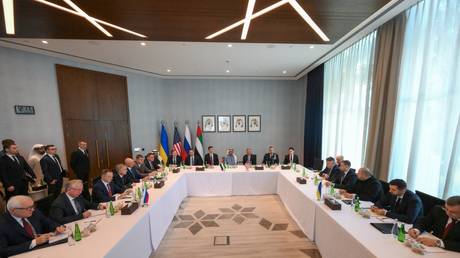
Cold coffee. That is what diplomacy actually smells like when the cameras leave the hallway and the heavy oak doors click shut.
Not ink. Not power. Just burnt Arabica sitting in paper cups beside three-ring binders filled with maps that nobody wants to sign.
When Kyiv’s lead negotiator confirmed that Ukrainian and Russian delegations had entered a second day of US-led talks, the world received the news in a sterile, twelve-word wire alert. Two sentences. A timestamp. A fleeting blip on a glowing phone screen before the thumb scrolls down to sports scores or weather forecasts. To an observer sitting three thousand miles away, "Day Two" sounds like bureaucratic routine. It sounds like scheduling.
It is not scheduling. It is endurance.
I remember sitting in a basement shelter in eastern Ukraine during the winter of 2022, listening to the radiator hiss while the power grid flickered two miles away. When you live inside a conflict that stretches across years rather than weeks, time stops moving forward in a straight line. It pools. Every diplomatic headline becomes a barometer for whether you will fix the roof before the next frost, whether your brother comes home for his daughter's birthday, or whether you pack the suitcase sitting by the front door one more time.
The Architecture of a Second Morning
Walking back into a negotiation room on the second day requires a specific kind of psychological armor.
On Day One, everyone brings their flags. Delegations arrive with prepared statements, rigid red lines, and the rehearsed posture of nations defending their survival or asserting their dominance. The first twenty-four hours of any high-stakes summit—especially one mediated by Washington—are spent performing strength for the audiences back home. Every syllable is weighed against domestic politics. Every glance across the mahogany table is analyzed by intelligence briefings before lunch.
Day Two is different.
By the second morning, the talking points have already been exhausted. The sharp suits are slightly wrinkled. The mediators from the United States—carrying the quiet, immense weight of American leverage, security guarantees, and geopolitical impatience—have spent the night shuttling between hotel suites, stripping away the theater to see what actually remains on the bone.
Consider a hypothetical scene inside that room, built from the documented mechanics of modern ceasefires from Dayton to Minsk.
Picture two men sitting twelve feet apart across polished wood. Neither man wants to be there. One represents a nation whose cities bear the craters of ballistic strikes, where every square kilometer on the map corresponds to the graveyard of a neighbor or a classmate. The other represents a state locked into a grinding war economy, defending territorial claims its leadership has staked its entire historical legacy upon. Between them sits an American envoy, armed with satellite reconnaissance, economic projections, and a ticking clock.
When Kyiv’s chief negotiator steps out to confirm that talks have resumed for a second day, that single fact tells us something vital. Nobody walked out. Nobody flipped the table. In the grammar of international conflict, staying in the room for forty-eight hours means the gap between total war and a fragile framework has narrowed just enough to keep talking.
Why Words Become Weapons
People often ask what negotiators actually argue about when the core positions seem irreconcilable. If one side demands full sovereignty and the other demands territorial concessions, what fills twelve hours of debate?
Syllables. Prepositions. Verification mechanisms.
Think of a truce not as a handshake, but as an engineering blueprint for a bridge built over a fault line. If a single bolt is miscalculated, the entire structure collapses the moment traffic begins to move.
In US-led talks between Russia and Ukraine, the invisible stakes live inside the technical annexes. What does a "demilitarized zone" actually mean when modern warfare is fought with fiber-optic drones that fly twenty kilometers and artillery shells that travel forty? Who monitors the line of contact when neither side trusts international observers, and satellites can be blinded by cloud cover? What happens at 3:14 AM when a nervous twenty-year-old soldier hears a branch snap in the dark and fires a burst across a frozen treeline?
Without an airtight protocol for that exact moment, a ceasefire is just a pause for reloading.
History offers brutal lessons here. Look back at the Minsk agreements of 2014 and 2015. On paper, they promised a halt to heavy weapons and a path toward political settlement. In reality, they left deliberate ambiguities—poison pills tucked inside diplomatic phrasing—that allowed both sides to interpret the sequence of events differently. Should elections happen before border control is restored, or border control before elections? That single question paralyzed Europe for seven years and paved the road to full-scale invasion.
Kyiv’s negotiators carry the scar tissue of those failed documents into every session. They know that signing a vague promise today simply guarantees a deadlier war three years from now.
The Invisible Weight on the American Chair
Washington’s presence at the head of that table changes the gravity in the room, though not always in the ways outsiders assume.
There is a common misconception that the United States can simply dictate terms to Kyiv or force Moscow into compliance with a single threat. Reality is far messier. American mediators walk a razor's edge between two competing pressures: the strategic necessity of preventing a wider European catastrophe and the political reality of a public back home growing weary of endless foreign entanglements.
To understand the American role, imagine a referee trying to stop a heavyweight fight while holding the water bottles for one corner and threatening to freeze the bank accounts of the other.
Washington brings tools nobody else possesses. Only the United States can offer credible intelligence-sharing architectures, advanced air defense replenishment, or the gradual lifting of biting financial sanctions. Yet every card Washington plays carries domestic consequences. Promise too much security support to Kyiv, and critics in Congress warn of permanent entanglement. Push Kyiv too hard toward territorial compromise, and allies from Warsaw to Tokyo begin questioning whether American security guarantees are worth the paper they are printed on.
That tension hangs over the second day of talks like static electricity. Every time the American envoy speaks, both Moscow and Kyiv are listening not just to what Washington wants today, but to what Washington will still be willing to enforce five years from now.
Life in the Waiting Room
While diplomats debate buffer zones and monitoring mandates, millions of ordinary lives remain suspended in mid-air.
Take Olena, a composite portrait drawn from dozens of teachers and nurses across central Ukraine. Her apartment in Dnipro still has windows, though they are taped in neat X-patterns to keep glass from shattering during air raid alerts. Her husband has been rotating near the eastern front for nineteen months. Her twelve-year-old son attends school in a converted subway station whenever the sirens wail.
When Olena sees the headline that Kyiv’s lead negotiator has entered a second day of US-led talks, she does not feel a surge of cinematic hope. Hope is expensive when you have spent years rationing it.
Instead, she feels a tight, watchful anxiety.
She knows that diplomacy is rarely a clean victory. In the real world, wars end through painful arithmetic. If the negotiators agree to freeze the front lines, what happens to her cousin’s home in the occupied south? Does freezing the conflict mean peace, or does it mean living forever beside an armed border where sirens could return at any hour? Yet if the talks collapse, she knows what winter will bring: more strikes on substations, more dark evenings boiling water over camp stoves, more names added to the memorial wall in the town square.
Across the border, in provincial Russian towns rarely visited by foreign correspondents, a quieter, muted version of that same exhaustion exists. Families watch state television with a mixture of fatalism and fatigue, quietly counting the cost of inflation, closed borders, and sons who haven't called home in weeks. Nobody outside the Kremlin's inner circle gets a vote on the negotiating mandate, yet their futures are being traded across that same conference table.
The Myth of the Breakthrough
Modern media trains us to expect diplomacy to look like a movie climax. We wait for the dramatic press conference, the historic pen stroke, the sudden release of doves into a clear sky.
Real peace processes almost never look like that. They are ugly, incremental, and deeply unsatisfying.
When talks stretch into a second day, the progress being made is usually measured in millimeters rather than miles. Perhaps the two delegations agreed on a prisoner exchange framework—a small, human lifeline that will bring a hundred gaunt men back to their mothers before the month ends. Perhaps they established a direct military-to-military hotline to prevent accidental clashes over the Black Sea. Perhaps they simply agreed on the agenda for a third day.
It is easy to feel cynical watching giants haggle over lines in the dirt while cities burn. Honestly, there are moments when the sheer gap between the sterile language of diplomatic communiqués and the visceral reality of a hospital ward feels obscene.
Yet the alternative to that sterile room is a wasteland without rules.
Every war in human history eventually ends at a table. The only question is how many graves get dug between the first attempt at talking and the final signature. Staying in the chair for Day Two—drinking the cold coffee, reading the same disputed paragraph for the fourteenth time, refusing to let pride dictate the fate of millions—is its own grueling form of courage.
Outside the building where the delegations meet, night falls early. Streetlights flicker on along wet pavement. Somewhere inside, behind heavy doors guarded by men with earpieces, a negotiator uncovers a fresh sheet of paper, picks up a pen, and starts reading the next clause aloud.