Cold.
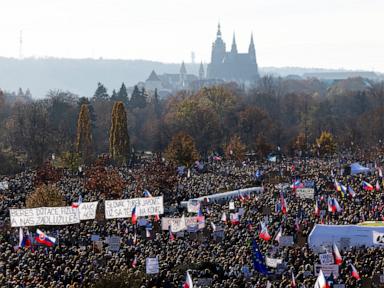
That is the first thing you notice when you stand on the cobblestones of Wenceslas Square in Prague after dark, watching tens of thousands of breath-plumes rise into the damp air like smoke from a muffled fire. The wind cuts down from the National Museum, rattling the plastic handles of hand-painted cardboard signs, numbing fingers wrapped around paper cups of mulled wine, and turning ears the color of raw steak. People do not come out into weather like this for a tax bracket. They do not stand shoulder to shoulder for three hours on freezing granite because they are passionate about accounting ledgers or broadcast licensing statutes.
Yet there they were. Tens of thousands of Czech citizens—teachers from Brno, retirees from Plzeň, university students who could barely afford their train tickets into the capital—gathered in massive, shivering numbers to fight a government plan that, on paper, sounded like a gift.
A tax cut. A household savings measure. An end to the monthly fee every Czech home pays to fund Czech Television and Czech Radio.
Who marches in the freezing cold to demand the right to keep paying a bill?
To understand why Prague’s most historic avenue filled to capacity, you have to stop looking at the invoice and start looking at the leash. Because when a government offers to pick up your tab for the news, it rarely leaves the menu untouched.
The Anatomy of a Trojan Horse
Let us look at the mechanics of the proposal that brought Prague to a standstill. For decades, public broadcasting in the Czech Republic has operated on a simple, stubbornly democratic financial model: the concessionary fee. Every household with a television or radio—and under modern revisions, every household with a smartphone or internet connection capable of receiving a stream—pays a small, fixed monthly sum directly into the coffers of Czech Television (ČT) and Czech Radio (ČRo).
It is a clunky system. Nobody loves paying a mandatory monthly charge of roughly 150 Czech koruna for television and 55 for radio, especially when inflation has spent the last few years chewing through grocery budgets and heating bills. When politicians stand at a podium and promise to abolish that fee, folding the funding of public media directly into the annual state budget instead, it sounds like common sense. Relief for the working family. Modernization. Efficiency.
Now consider a hypothetical scenario to see how that efficiency actually works in practice.
Meet Hana. She is sixty-four, lives in a two-room flat in Ostrava on a fixed pension, and starts every morning at 6:30 AM with the kettle boiling and Czech Radio’s morning broadcast murmuring from a battered plastic speaker on her windowsill. Under the current system, Hana pays her small monthly fee directly. That tiny trickle of money from millions of Hanas across the country pools into an independent reservoir. No minister signs off on it each autumn. No prime minister can threaten to turn off the tap if an investigative reporter asks an uncomfortable question about a state tender, a sudden land deal, or a conflict of interest in the cabinet.
Now flip the switch. Abolish Hana’s fee and fund the newsroom through the state budget.
Suddenly, every autumn, the survival of Czech Television and Czech Radio becomes a line item in the Ministry of Finance’s spreadsheet. Imagine you are the editor-in-chief of the evening news. In three weeks, parliament votes on next year's budget allocation for your network. Today, your best investigative journalist walks into your office with watertight documents showing that the Minister of Transport’s brother-in-law just won a questionable highway contract.
Do you run the story at 7:00 PM? Of course you want to. You tell yourself you will. Yet sitting in the back of your skull, cold and heavy as a lead weight, is the knowledge that running that segment might cost your newsroom four hundred million koruna in the next budget cycle—meaning regional bureaus closed, documentary units gutted, and forty colleagues laid off before Christmas. Nobody has to pick up a phone and issue an order. Nobody has to send a censor into the control room. Self-censorship does the dirty work quietly, politely, and entirely out of sight.
That is the difference between a public broadcaster and a state broadcaster. One answers to the citizens who pay its bills; the other answers to the politicians who sign its checks.
Ghosts on the Cobblestones
If that distinction feels overly dramatic to anyone living in a country where cable news is a shouting match and public television mostly means British period dramas, you have to remember where Prague sits on the map—and what its cobblestones remember.
I still remember the gray, metallic taste of the air in Central Europe before 1989, when the evening news was a choreographed lullaby of tractor production quotas and fraternal handshakes, and the real truth lived on crackly, forbidden shortwave frequencies hissed through bedroom walls after midnight. In the Czech Republic, media independence is not an abstract seminar topic debated by journalism professors. It is a scar tissue that is barely thirty-seven years old.
During the Velvet Revolution in November 1989, right here on Wenceslas Square, one of the most decisive turning points was not a battle in the streets, but the moment state television workers broke ranks and broadcast live footage of the student demonstrations and the brutal police crackdown on Národní třída. Until that broadcast went out, half the country did not know what was happening in their own capital. When the cameras finally pointed at the truth, the regime collapsed within weeks.
Czechs know, in their bones, what happens when the state holds the power cord to the transmitter.
They have also watched their neighbors. You do not need a crystal ball in Prague; you only need a train ticket south to Budapest or north to Warsaw. Over the past fifteen years, Central Europe has served as a live laboratory for how modern democracies are hollowed out without a single tank rolling down a boulevard. You do not arrest journalists anymore—that looks terrible on international television. Instead, you starve them, sue them, pack their oversight boards with loyalists, and route their funding through the state treasury until the public broadcaster becomes a megaphone for the ruling party. In Hungary, public television became so completely captured by the state that opposition politicians were famously granted five minutes of airtime once every four years during election campaigns, while state anchors read government talking points word for word. In Poland, it took a bruising political war and dramatic courtroom standoffs just to begin untangling the state apparatus from the newsroom after years of partisan control.
When Czechs looked at their government’s plan to scrap the concessionary fee and move public media under the state budget, they did not see a fiscal reform. They saw a familiar blueprint unfolding right on their own doorstep.
The Invisible Infrastructure of Trust
Even so, standing in that crowd in Prague, I had to admit something uncomfortable—and something that the protest organizers themselves rarely put on their banners.
Public media is deeply imperfect.
Ask a twenty-two-year-old software developer in Prague when he last watched Czech Television, and he will probably laugh, pull out his phone, and show you three YouTube channels, two podcasts, and a Telegram feed. Ask a struggling factory worker in northern Bohemia how she feels about paying a mandatory media fee while her electricity bill doubles, and she will tell you, quite reasonably, that she feels like she is subsidizing Prague elites who rarely tell stories about her town. Those frustrations are real. Ignoring them is how populist politicians win arguments before the opposition even laces up its boots.
But look closer at what happens when that local ecosystem disappears.
Think of a public broadcaster not as a television channel, but as the municipal water supply. You might prefer buying bottled sparkling water from a boutique brand, or squeezing your own juice at home. You might think the city tap water tastes slightly metallic and boring. Yet the very existence of clean, regulated, universally accessible tap water forces every private vendor in town to meet a basic standard of safety—and ensures that when a drought hits, nobody dies of thirst because they cannot afford a bottle.
In small and medium-sized language markets like the Czech Republic—a nation of roughly ten and a half million people—the economics of commercial journalism are brutal. Advertising revenue has been siphoned away for over a decade by global tech giants that do not employ a single local reporter in Olomouc or České Budějovice. Private oligarchs bought up major Czech newspapers years ago, turning once-fierce dailies into quiet shields for their own business empires and political ambitions.
Without an independently funded public broadcaster, who pays for a correspondent to sit in Brussels for three weeks tracking agricultural subsidies? Who funds a six-month investigation into toxic chemical dumping in a rural river? Who broadcasts a classical concert from the Rudolfinum, produces children’s programming without toy commercials, or keeps a regional radio desk open in a border town where commercial stations only play automated pop playlists?
Nobody. Because none of those things turn a quarterly profit.
What Happened When the Square Filled Up
The government architects behind the funding overhaul clearly underestimated that arithmetic—not the financial math, which they had calculated down to the last decimal, but the civic math.
They assumed voter fatigue would do their work for them. They assumed that framing the debate around household savings, bureaucratic waste, and modernizing an outdated fee structure would make the protesters look like out-of-touch defenders of an expensive status quo.
Instead, the rallies swelled. From Prague to regional squares across Moravia and Bohemia, ordinary citizens turned out with homemade signs reading Public, Not State and We Pay for the Truth Ourselves. Journalists, actors, historians, and union workers took the stage, not to defend every editorial decision Czech Television had ever made, but to defend the structural wall separating the newsroom from the treasury.
Listen closely to the people in that crowd, and you hear a remarkably sophisticated grasp of power. They are not naive. Nobody standing in the slush on Wenceslas Square believes that journalists are saints or that public television is infallible. What they understand—what lived history has burned into their collective memory—is that imperfect independence is infinitely better than polished obedience.
You can argue with an independent broadcaster. You can write angry letters to its ombudsman, complain about its bias, vote to reform its oversight council, or change the channel. You cannot argue with a state monopoly whose budget depends on flattering the person sitting in the prime minister's chair.
The Cost of Free
By 9:00 PM in Prague, the speeches end. The crowd begins to thin, spilling down toward the Mustek metro station, boots crunching on salted slush, red cheeks slowly thawing in the warm rush of underground air.
Somewhere in an apartment three tram stops away, a kettle clicks off. A radio hums quietly on a kitchen counter, delivering the late-night bulletin—unvarnished, occasionally irritating, stubbornly unbought by any ministry in town. Outside, the city settles back into the dark, knowing that for at least one more night, the signal belongs to the people paying the bill.