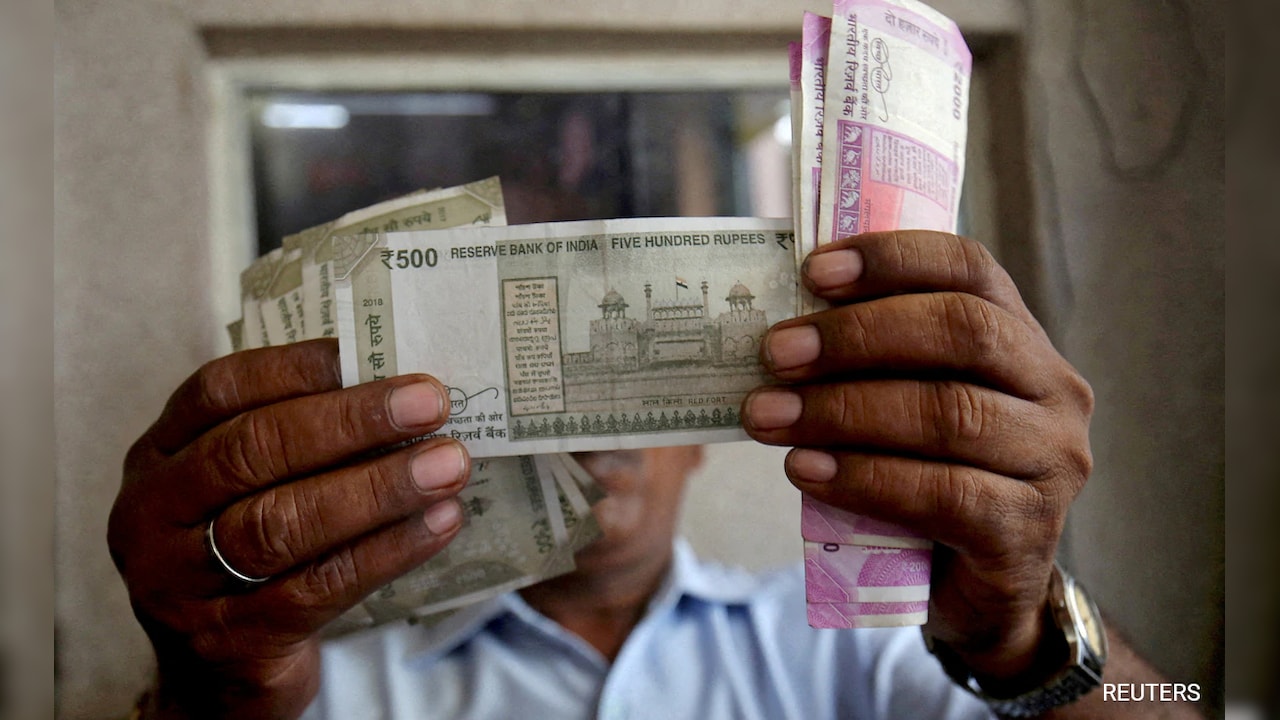
The ceiling fan in Rajeshwar’s living room in Pune makes a rhythmic, metallic click every third rotation. He has lived with that sound for eleven years. He has lived with the peeling paint near the balcony door, the aging scooter parked downstairs under a tarp, and the quiet, persistent ache in his lower back from three decades of standing behind a bank counter.
He did everything right.
Let us be clear about Rajeshwar: he is a hypothetical composite, a character drawn from the millions of Indian households that treat thrift not merely as a financial habit, but as a moral virtue. Yet his arithmetic is painfully real. Every month for thirty-two years, Rajeshwar resisted the siren song of speculative equity markets, crypto schemes, and flashy urban consumption. He trusted the institutions. He put his faith in fixed deposits, government securities, provident funds, and the debt mutual funds that financial planners once called the bedrock of a sensible portfolio. He believed in the social contract of the Indian saver: hand over your hard-earned rupees to fund the nation's infrastructure and sovereign borrowing, and in return, your capital will be safe, growing steadily enough to buy dignity in your old age.
Today, that contract is fraying in plain sight. While television anchors celebrate record highs on the Sensex and glistening new expressways slice through the countryside, a silent hemorrhage is underway in the Indian bond market. Yields are shifting, fiscal pressures are mounting, and inflation is chewing through fixed returns with the patience of termites in an old teak cupboard.
The savers are losing. And most of them do not even realize the game has changed.
The Illusion of the Safe Harbor
To understand why the ground beneath Rajeshwar’s feet is giving way, you have to strip away the jargon of Mumbai’s Dalal Street and look at what a bond actually is. Forget the spreadsheets for a moment. Think of a bond as a simple promise written on heavy paper. You lend the government or a corporation one hundred rupees today. They promise to pay you seven rupees every year for ten years, and at the end of that decade, they hand back your original hundred.
Simple. Predictable. Boring.
For generations, Indian families worshipped at the altar of that boredom. Volatility was viewed as a cousin to gambling. When the stock market crashed in 2008, or tumbled during the pandemic in 2020, the savers in fixed-income instruments smiled quietly over their morning filter coffee. Their numbers did not turn red. Their passbooks remained neat, orderly, and reassuring.
Here is the trap nobody warned them about: nominal safety is not the same thing as real wealth.
When the Indian bond market bleeds, it rarely looks like a dramatic stock market crash. There are no circuit breakers halting trading, no panicked brokers clutching their heads on evening news broadcasts. Instead, a bleeding bond market looks like a slow rise in yields coupled with stubborn inflation and aggressive government borrowing.
Consider the mechanics of what happens when bond yields climb. As a metaphor, imagine two buckets on a seesaw. On one side sits the interest rate—the yield—offered on newly issued government bonds. On the other side sits the market price of the older bonds already sitting in mutual funds and pension portfolios. When the government needs to borrow massive sums of money to bridge fiscal deficits or fund capital expenditure, it often has to offer higher interest rates to attract buyers, or the Reserve Bank of India keeps rates elevated to fight off rising food and fuel prices. As that yield bucket rises, the price bucket of existing bonds drops.
Suddenly, the "safe" debt funds that millions of middle-class Indians poured money into over the last few years begin showing stagnant, or even negative, mark-to-market returns. The very instruments designed to protect capital start eroding it.
Where the Money Goes When the State Borrows
Walk through any major Indian city right now and you can see where the capital is going. Flyovers rise on concrete pillars like giant gray centipedes. Metro rail tunnels bore beneath historic neighborhoods. Airports gleam with glass and steel. India is building at a furious, historic pace, and the ambition behind it is undeniable.
Somebody has to pay for the concrete.
That somebody is the domestic bond market. Over the past several years, the Indian government’s borrowing program has expanded to staggering proportions. When the central government and state governments step into the debt market week after week to auction hundreds of billions of rupees in securities, they absorb the lion's share of available liquidity. Economists call this "crowding out," though to a retiree in Chennai or a schoolteacher in Lucknow, it feels far more personal.
Think about what happens when a giant walks into a small room. Everyone else gets pressed against the walls.
Because the state is borrowing so heavily, bond supply floods the market. When supply outpaces organic demand, bond prices fall and yields stay stubbornly high. Meanwhile, the Reserve Bank of India finds itself walking a tightrope over a canyon. If the central bank cuts interest rates too soon to relieve pressure on bondholders and stimulate growth, the rupee weakens and inflation—driven by erratic monsoons and volatile global oil prices—threatens to roar back. If the RBI holds rates high to protect the currency and tame vegetable prices, bond prices languish and debt investors suffer.
I remember sitting in a cramped tax consultant’s office in Mumbai three winters ago, watching an elderly retired engineer stare at his annual statement. He had shifted his entire retirement corpus out of equities at age sixty, following textbook advice to "de-risk." He adjusted his thick spectacles twice, convinced the printer had smudged a decimal point. Between the newly introduced tax changes on debt mutual funds—which stripped away long-term indexation benefits and taxed gains at his peak income slab—and the sluggish performance of bond prices, his post-tax, inflation-adjusted return was below zero.
He had not lost a single rupee on paper. Yet he could afford less healthcare, less travel, and fewer groceries than he could twelve months earlier. He looked up at the consultant and asked a question that still echoes in my ears: "If I cannot trust government debt to keep up with the price of milk and medicine, where am I supposed to go?"
Nobody in that room had a clean answer.
The Silent Tax of Inflation and Policy
Why does this hurt so deeply right now? Because three separate currents have converged into a single riptide pulling against the Indian saver.
First, there is the quiet brutality of household inflation. Official consumer price index numbers might hover around five or six percent, a figure central bankers consider manageable for a fast-growing emerging economy. Anyone who actually buys cooking oil, pulses, school uniforms, or hospital insurance in urban India knows that personal inflation feels closer to eight or nine percent. When a bank fixed deposit offers seven percent interest, and you pay thirty percent of that interest in income tax, your net take-home yield shrinks to 4.9 percent. Subtract eight percent real-world inflation, and you are losing more than three percent of your purchasing power every single year.
You are paying for the privilege of lending your money.
Second, the tax architecture shifted beneath savers' feet. For years, debt mutual funds offered a clever escape hatch from the punitive taxation of traditional bank deposits. By holding a debt fund for more than three years, investors could use indexation—adjusting their purchase price for inflation—and pay a modest twenty percent tax only on the real gains. When policymakers abruptly removed that benefit, taxing debt fund gains at marginal income tax rates regardless of holding period, they effectively kneecapped one of the most efficient wealth-preservation tools available to the middle class. Billions of rupees were stranded in a suddenly less hospitable tax regime, forcing savers either to swallow higher tax bills or migrate toward riskier assets they barely understood.
Third, global capital is fickle. Even with India’s celebrated inclusion in major global bond indices—a milestone that brought billions of foreign dollars flowing into sovereign debt—international investors do not buy Indian bonds out of patriotism. They buy them for yield spreads and currency stability. The moment US Treasury yields spike or geopolitical tremors rattle emerging markets, foreign money heads for the exits, leaving domestic institutions and ordinary savers holding the bag.
The Dangerous Migration
When you lock the front door to safety, people climb out the windows.
That is precisely what is happening across Indian household balance sheets today. Look at the surge in retail participation in equities, mutual fund systematic investment plans, and—most alarmingly—hyper-speculative futures and options trading. Millions of first-time investors are pouring their savings into the stock market, not necessarily because they have developed a sophisticated appetite for corporate risk, but because fixed income has stopped paying a living wage.
History has seen this movie before, and the ending is rarely gentle.
In the late 1970s in the United States, and during multiple inflationary cycles across emerging economies, prolonged negative real yields on bonds forced conservative savers to chase returns in unfamiliar territory. When retirees and salaried workers abandon debt markets out of frustration, they tend to enter risk assets near the top of the cycle. They buy momentum without understanding valuation. They mistake a prolonged bull market for permanent immunity against loss.
Rajeshwar, our retired bank clerk in Pune, feels this pressure every time he visits his nephew. The younger man pulls out his smartphone, flashes a green portfolio screen full of mid-cap stocks, and laughs gently at his uncle’s fixed deposits. "Uncle," he says, "your money is sleeping while the world runs past you."
Rajeshwar smiles politely and says nothing. He remembers the market crashes of 1992, 2000, and 2008. He remembers colleagues who lost decades of savings in leveraged bets. He knows that a sixty-five-year-old man cannot rebuild a wiped-out corpus by working overtime. Yet late at night, lying awake listening to that rhythmic click of the ceiling fan, doubt creeps in. What if the nephew is right? What if caution has become the greatest risk of all?
That psychological toll is the invisible casualty of a bleeding bond market. Financial security is not merely a mathematical equation; it is emotional oxygen. When savers lose faith in fixed income, the entire financial ecosystem loses its anchor.
Navigating the Wreckage Without Panicking
If you are holding bonds, debt funds, or fixed deposits today, despair is useless, and reckless gambling is worse. The bond market is brutal right now, yes, but debt is cyclical. Yields do not rise forever, and sovereign paper remains the backbone of financial architecture. Surviving this squeeze requires abandoning old habits and reading the terrain as it actually exists, rather than how we wish it were.
Stop treating all debt as identical. Duration is the lever that determines whether a bond portfolio bends or breaks when interest rates move. Long-duration bonds—those maturing in ten, fifteen, or thirty years—are wildly sensitive to interest rate changes. When yields spike, long-duration funds bleed heavily. Conversely, short-duration instruments, money market funds, and treasury bills maturing within six to eighteen months absorb rate shocks far more gracefully, resetting quickly to capture higher prevailing yields. In uncertain rate environments, keeping your bond maturities short is like anchoring a boat in a shallow cove rather than out in the open swell.
Look closely at sovereign-backed alternatives that still carry structural protections. Public Provident Fund accounts, Senior Citizens’ Savings Schemes, and floating-rate savings bonds issued by the RBI exist precisely to shield small savers from market volatility. They will never make you rich, and their liquidity is constrained, but their sovereign guarantee and tax structures remain far sturdier than corporate debt papers offering an extra percentage point of yield in exchange for hidden credit risk.
And above all, beware the trap of reaching for yield. Whenever the bond market bleeds, shady issuers and over-leveraged corporations emerge from the shadows offering dazzling twelve or fourteen percent returns on non-convertible debentures and unlisted bonds. Remember the oldest rule in fixed income: nobody pays you extra interest out of generosity. They pay you extra because there is a very real chance they will never give your principal back. Losing ten percent of your purchasing power to inflation is painful; losing one hundred percent of your capital to a corporate default is fatal.
The Quiet Ledger
The tragedy of India’s bond market slump is not that the wealthy are getting poorer. The wealthy have family offices, private credit funds, real estate hedges, and global diversification to weather domestic rate cycles.
The tragedy belongs entirely to the quiet, disciplined majority who built the country’s savings pool brick by brick, rupee by rupee, trusting that moderation would be rewarded. An economy cannot sprint forward indefinitely on infrastructure concrete if the households funding that growth feel quietly betrayed at the kitchen table. Eventually, savers stop saving, or they channel their wealth into gold bars locked in steel almirahs, starving the formal financial system of the patient capital it desperately needs.
Back in Pune, morning light filters through the balcony grill, catching the dust motes dancing beneath Rajeshwar’s clicking ceiling fan. He sits at his small wooden desk with a freshly sharpened pencil and a ruled notebook, calculating the renewal rate on a matured certificate of deposit against the rising cost of his wife’s blood pressure medication. He crosses out one number, writes another beside it, and stares quietly at the gap between what the nation promises and what the grocer demands.