Rain is supposed to be a comfort.
It taps against the windowpane. It waters the sprawling cornfields of the Midwest. It washes the dust from the heavy summer air. We sleep better when it falls. We wrap ourselves in blankets and listen to the rhythmic drumming against the roof, secure in the knowledge that we are inside and warm.
Until.
Until the rhythm shifts from a lullaby to a threat.
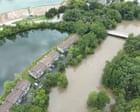
In Indiana, over a stretch of agonizing days, the sky simply broke open and forgot how to close. What began as a standard weather advisory mutated into a slow-moving, suffocating catastrophe. The rain buried highways. It swallowed neighborhoods. It overwhelmed the engineering of a century. And it claimed at least six human lives.
Six.
That is not just a statistic flashing across the bottom of a news broadcast. That is six empty chairs at dinner tables. Six cell phones ringing in the dark, unanswered. Six families thrust into a sudden, incomprehensible grief because the water did not stop.
To understand how a landlocked state built on managing its waterways falls victim to such devastation, we must look past the dry meteorological reports. We must look at the physics of saturation and the terrifying reality of human vulnerability.
Think of the Indiana soil as a dry kitchen sponge. When you first run a dry sponge under the faucet, it absorbs everything eagerly. But leave it beneath a heavy, running tap for ten minutes. The water has nowhere to go. The sponge is full. The water pools, spills over the edges, and violently seeks the lowest point of gravity.
This is a grounded metaphor for the earth beneath our feet. When successive storm systems align—meteorologists call this "training," where thunderstorms follow the exact same path like freight train cars on a track—the ground simply stops absorbing. Rivers break their leashes. Creeks that children skip stones across on Tuesday become roaring, lethal arteries of debris by Thursday.
We hear the phrase "record flooding" on the evening news, and it often glosses over the brain. The words have lost their edge through repetition. But what does a record actually mean?
It means the maps we drew to keep ourselves safe lied to us. It means the water surpassed the absolute worst-case scenario our grandparents planned for. It means the earthen levees, the carefully poured concrete culverts, the drainage basins—they all failed. The math of the sky beat the math of the ground.
To grasp the terror of these storms, we must step away from the colorful radar loops. We must scale the disaster down to the human level.
Consider a hypothetical commuter. We will call him David. David is not a specific person, but rather a composite built from the harrowing rescues and tragic realities that unfolded across the Hoosier state this week.
David leaves his office at 5:00 PM. The rain is blinding. The windshield wipers are losing the battle against the deluge. The local radio announcer advises staying off the roads, but David is already halfway home. He turns down a familiar county road, a route he has driven thousands of times without a second thought.
There is water flowing over the asphalt ahead. In the fading light, it looks like a shallow puddle.
It is not a puddle.
It takes only six inches of fast-moving water to knock a grown, athletic adult off their feet. Twelve inches will buoy and carry away a small sedan. Two feet of rushing water will lift a heavy-duty pickup truck and turn it into a steel coffin floating downstream.
David’s tires touch the water. Instantly, the steering wheel goes completely dead in his hands. The vehicle rotates, caught in an invisible, terrifying current. Panic spikes in his throat. He tries to open the door, but the sudden, immense water pressure against the outside metal makes it impossible to budge. The water begins seeping through the floorboards. Ice cold. Smelling of mud and gasoline.
This is how rapidly the mundane becomes lethal. For six people in Indiana, the margins between a routine evening and a fatal trap evaporated in seconds. They were neighbors, parents, and friends caught in the sudden, quiet violence of nature. They did not do anything wrong. They simply encountered a world that had temporarily lost its rules.
In the rural expanses of the state, flooding is often a slow, creeping horror. The fields turn to vast, muddy lakes. The rivers swell over days, giving farmers time to move livestock to higher ground, even as their crops are drowned and financially ruined. It is an agricultural tragedy that unfolds at the speed of a rising tide.
But in the towns and cities, the topography of concrete creates a different kind of monster entirely. Flash flooding.
Urban environments are heavily paved. Asphalt, concrete, sprawling warehouse rooftops. When rain falls at a rate of two or three inches per hour, it cannot soak into the ground. It immediately becomes runoff. The municipal storm drains, designed for ordinary spring showers, are instantly choked.
The water pools in highway underpasses, creating hidden, ten-foot-deep lakes on major thoroughfares. It rushes down sloped streets with the immense force of a whitewater rapid.
We build our cities to be efficient, channeling water away as fast as possible. But when the sheer volume of water exceeds the capacity of our pipes, the streets themselves become the new rivers. Water weighs roughly sixty-two pounds per cubic foot. A wave of it moving at just a few miles per hour packs the kinetic energy of a solid wall of moving earth. It crushes reinforced garage doors. It pushes brick walls entirely off their foundations.
We treat water as something soft. Something yielding. We forget its density. We forget its brutal, uncaring power.
When the emergency 911 calls began flooding dispatch centers across the state, the infrastructure of rescue was immediately pushed to the breaking point. First responders abandoned heavy fire engines for flat-bottomed aluminum boats. They navigated suburban streets where mailboxes barely breached the surface, trying to read submerged street signs in the dark.
Every rescue is a high-wire act of courage. Hidden beneath the opaque, churning brown surface of these temporary rivers are open manhole covers, downed power lines humming with lethal electricity, and jagged debris. A rescue boat engine snags on a submerged barbed wire fence. A firefighter leans dangerously over the bow to pull a shivering teenager from the roof of a sinking sedan.
The bravery of these crews is staggering. But so is the deep, bone-weary exhaustion.
And then the rain eventually stops. The water begins to recede. The news cameras pack up and move on to the next crisis. But for the survivors, the disaster is just beginning.
Floodwater is not the pristine blue of a swimming pool. It is toxic. It smells of ruptured sewage lines, diesel fuel, and rotting earth. When it breaches the threshold of a living room, it brings the outside world in, coating everything in a thick, noxious sludge that stains whatever it touches.
Drywall acts like a sponge, pulling the contaminated water upward into the walls. Hardwood floors buckle and heave into jagged, unnavigable peaks. Generations of irreplaceable family photos, stored safely in bottom-drawer cabinets, are dissolved into wet pulp. The damage is total and absolute.
And then comes the mold.
The stifling humidity of the American Midwest traps the moisture inside these ruined shells of homes. Residents return in rubber boots, carrying heavy-duty trash bags, and stand frozen in their doorways. Where do you even begin? You rip out the carpets, heavy and foul-smelling. You tear down the walls to the wooden studs. You pile your entire life—your couches, your children's toys, your mattresses—onto the curb, waiting for a garbage truck that might not come for weeks.
It breaks the spirit.
Then comes the invisible, suffocating weight of the aftermath: the financial ruin.
Most homeowners do not have flood insurance. Standard homeowners policies explicitly exclude rising groundwater. Unless a home sits in a federally designated high-risk flood zone, insurance agents rarely push the coverage. Even when they do, the premiums are staggeringly expensive.
So, a family wakes up to find three feet of water in their kitchen. They survive. The storm passes. They call their insurance company, desperate for a lifeline to rebuild.
The voice on the phone is polite but firm. Your policy covers wind-driven rain, but not water that enters from the ground up. Claim denied.
Devastating.
In a single afternoon, a family's primary source of wealth—their home equity—is washed away entirely. They are left holding a mortgage on a rotting, uninhabitable structure. The economic ripple effects will quietly choke these Indiana communities for a decade. Small businesses that flooded will simply never reopen their doors. Local property values will plummet. The municipal tax base will shrink, leading to underfunded schools and neglected infrastructure.
The water takes the lives first. Then it takes the futures.
People search for reasons in the wake of such loss. They want to know why this happened now. Why Indiana? Why these specific days of storms?
We are living in an era of a warmer atmosphere. Warm air fundamentally holds more moisture. It is a basic thermodynamic reality. For every one degree Celsius the atmosphere warms, it can hold roughly seven percent more water vapor. The storm systems of today are carrying heavier payloads than the storms of our childhoods. When they finally drop that payload, they drop it with unprecedented fury.
Our current infrastructure was built for the climate of the 1970s. We are facing 21st-century storms armed only with 20th-century drainage pipes. The record flooding in Indiana is a blaring alarm bell ringing in a room where too many people are still wearing earplugs.
What happens to the human mind after you survive a flood like this?
The sky itself becomes a trigger.
Months from now, a gentle spring shower will move across the Indiana plains. For most, it will be a mild inconvenience, an excuse to cancel a picnic or carry an umbrella to the car. But for the survivors of this week's terror, the sound of rain hitting the roof will cause the heart to race. They will walk to the window. They will watch the street gutters. They will wait, breath held, for the water to stop draining.
This is the hidden psychological toll of extreme weather. The loss of sanctuary. A home is supposed to be the one place on earth that keeps the danger out. When water breaches that sacred defense, the illusion of safety is broken forever. You never look at a river the same way again. You never trust a puddle on a dark road.
The radar maps have finally cleared over Indiana, replaced by high-pressure systems and blue skies.
But the sun does not fix what the water broke. It only illuminates it.
It shines fiercely on the mud caked halfway up the living room walls. It shines on the ruined, waterlogged cars abandoned on the shoulders of the interstate. It shines on the weary faces of the rescue crews packing away their flat-bottomed boats.
We will rebuild. We will pour new concrete, erect new drywall, and draw new flood plain maps. We will tell ourselves that this time, we are prepared for the worst. We will try desperately to forget the heavy, suffocating weight of the rivers that slipped their bounds.
But the water remembers.
And the water always waits.