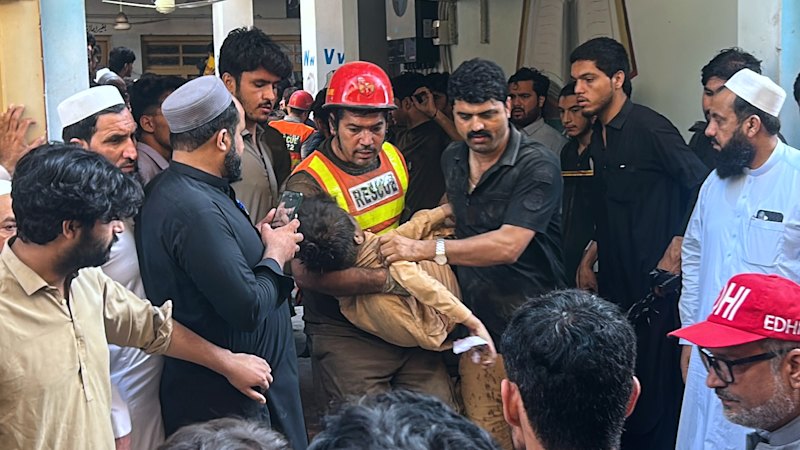
Silence.
That is the first sound anyone notices after a ceiling gives way over a crowded morning classroom in Peshawar, before the sirens reach the narrow street, before the dust settles into the folds of school uniforms, before neighbors drop shovels and begin digging with bare hands. One moment a teacher is holding chalk and a dozen or more children are leaning over notebooks, rehearsing multiplication or Urdu vowels. The next moment, what felt permanent becomes rubble. If you found value in this post, you should check out: this related article.
When a headline reduces that catastrophe to a single dry sentence about a roof collapse killing dozens of pupils and a teacher in Peshawar, it fulfills a basic news duty. It tells you where it happened and how high the toll climbed. Yet cold summaries rarely capture what happens inside the hours around a structural failure like that. They skip the small, ordinary details that make a room feel alive—the smell of damp plaster after a rainstorm, the scuff of wooden benches against brick floors, the quiet trust parents place in a neighborhood schoolhouse when they wave goodbye at eight in the morning.
I have stood inside buildings after heavy monsoon rains and earthquakes in South Asia, breathing in the sharp, mineral scent of wet mortar and crushed lime while rescue crews worked carefully so falling debris would not trap them too. You learn fast that buildings do not announce their breaking point with a polite warning bell. Most of the time, they whisper first. A hairline crack widens along a beam. A patch of ceiling darkens after water seeps through unsealed edges. A lintel sags a fraction of an inch over years of thermal expansion, monsoon moisture, and subtle ground movement. For another angle on this event, check out the recent update from TIME.
What Happens When Shelter Turns Heavy
To understand why a school roof collapse in Peshawar hurts so deeply—and why it is never just an isolated accident—we need to look past the tragedy itself and examine the invisible forces pressing down on everyday infrastructure. (Note: The following portrait of a family and school morning is a clearly labeled hypothetical scenario built to illustrate real-world conditions described in structural safety reporting and emergency response accounts.)
Picture a hypothetical morning in a crowded Peshawar neighborhood. Tariq walks his eight-year-old daughter, Nadia, to a modest school building tucked between older brick homes. Tariq works irregular hours and counts on this school not just for reading and arithmetic, but for a safe, structured place where Nadia can grow up with peers. Inside, her teacher, Salma, writes the day's lesson on a blackboard while twenty-five pupils sit shoulder to shoulder along long benches. Outside, clouds gather heavy and gray. For months, tiny flakes of whitewash have drifted onto the desks when doors slam hard, a nuisance everyone brushes off because replacing a roof or reinforcing masonry costs money a stretched school budget simply does not have.
When the slab or beam fails without warning, the physics is brutal. A heavy roof made of concrete, timber, and brick carries immense dead weight. When support walls lose strength—whether from water infiltration corroding steel reinforcement, poor mortar bonding, unreinforced masonry, or repeated stress from seismic tremors in a tectonically active region—gravity collects its debt all at once. Unlike a car crash, which lasts a split second and leaves a twisted frame on a road, a structural collapse buries people beneath the very shelter meant to protect them.
Rescue workers arriving at a collapsed school face a grim race against time and instability. Heavy concrete slabs require cutting gear, hydraulic jacks, and cranes that can struggle to maneuver down tight residential lanes. Every shifted block carries the risk of a secondary slide. Meanwhile, parents gather behind police tape, holding up photographs of their children on phones or faded ID cards, asking the same frantic question over and over: Which room was she in? Was she near the door?
Why do tragedies like this keep happening in vulnerable school buildings? Usually, no single villain is to blame. Instead, several pressures stack together like bricks without mortar. Rapid urban growth pushes schools into converted houses or aging structures that were never engineered for high occupancy or heavy upper loads. Maintenance gets postponed when operating funds barely cover salaries and utility bills. Oversight can be patchy across dense neighborhoods, especially where informal expansions or extra stories are added over time.
The Hidden Economics of Safe Walls
Let me be candid about something that often makes conversations around building safety uncomfortable: I do not have a neat, effortless fix for decades of underinvestment, and pretending otherwise would insult the families grieving a loss. Structural engineering is unforgiving. Reinforcing weak walls, testing materials, and upgrading older roofs require skilled labor, quality cement and steel, and real money—resources that are scarce in cities juggling competing crises.
Still, we can make the engineering logic intuitive. Think of a building's load-bearing frame like the human skeleton. If a spine develops a stress fracture and you keep lifting heavy weights without treating the injury, the bone eventually buckles. In construction, water is one of the quietest destroyers of that skeleton. Rainwater seeping into cracks weakens mud or low-grade mortar, swells timber, and rusts internal rebar from the inside out. Once steel corrodes, it expands and cracks the surrounding concrete, turning a solid beam into brittle stone.
Historically, major disasters across South Asia—from severe earthquakes to devastating floods—have repeatedly shown that vulnerability is concentrated where cheap materials, weak enforcement, and deferred repairs intersect. When tragedy strikes a school, the shockwave is magnified because children are concentrated in one place during daytime hours, and a teacher standing near the front or supervising the class often shares the same fatal space.
What do people usually ask after reading about a roof collapse in Peshawar? They want to know how survivors are pulled out, how authorities determine what caused the failure, and whether other schools nearby face the same danger.
Emergency teams focus first on live voids—small pockets of air left where beams angle against walls or heavy desks hold up falling debris—while medical responders triage crush injuries and shock. Afterward, engineers and local officials typically examine soil conditions, drainage, material quality, and whether structural alterations occurred before the collapse. Yet investigators rarely find just one flaw; they find a chain of small compromises that held until the day they didn't.
Why Everyday Vigilance Matters Before Disaster Strikes
Consider what happens next when a community tries to prevent the next collapse: inspections matter, of course, but inspections only change lives if they lead to action rather than sitting in a file cabinet. A building that looks intact from the street can hide severe deterioration overhead. Damp patches on a ceiling, diagonal cracks radiating from window corners, or doors that suddenly stick in their frames are early clues that deserve a qualified structural assessment, not another coat of paint.
Communities and local leaders can also treat school safety as a shared civic priority rather than an afterthought. Prioritizing vulnerable classrooms for structural retrofitting, enforcing clear occupancy and construction standards, keeping drainage channels clear so water does not pool against foundations, and establishing practical evacuation and emergency response drills can turn a fragile space into a safer one. None of these steps is glamorous. None of them trends for long. Every single one of them buys precious margin against catastrophe.
There is a temptation, once the news cycle moves on to another crisis, to treat a collapsed school roof as a distant story belonging only to one city on one tragic morning. Resist that urge. Safe classrooms are the quiet foundation of every child's future, built out of ordinary decisions made long before any emergency siren sounds.
A single chalk mark left halfway across a slate board, covered in fine gray dust, catching the pale light that finally breaks through broken plaster.